

In this 21st century, pleasing customers is essential for growth and survival. Each customer interaction and every detail is precious. But what if that information is scattered across various spreadsheets, inboxes, or lost sticky notes? You’ve got chaos, lost opportunities, and a struggling business.
Centralised contact management can help. It brings all that valuable data into one system where it’s easily accessible to everyone to use when they need it. At Wortal, we believe good customer relationships, effective operations, and sustainable growth rely on a good and structured manner of handling customer and sales contacts.
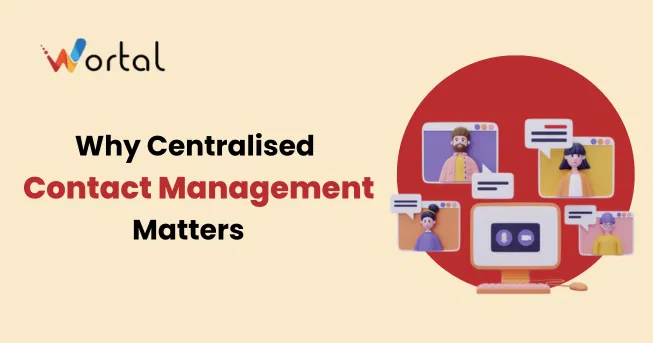
Let’s discover why “Centralised Contact Management Matters” and how it can change how you do business.
The Problem with Scattered Data
Think of trying to draw a beautiful picture with just a few colours or driving through a busy city without a map. That’s what it’s like when customer data is scattered. Different departments usually operate in isolation, which results in:
- Inconsistent Information: A customer may provide an updated email address to the sales staff but still have the outdated one stored in the marketing department. This can lead to inapplicable communications.
- Time and Effort Spent in Vain: Salespeople may spend hours trying to find a customer’s contact details or trying to gather a customer’s history from different sources.
- Duplicates and Errors: Having multiple customer records for the same customer causes confusion, wasted effort, and poor customer experience.
- Missed Opportunities: Without a comprehensive view, it’s simple to overlook key insights, like a customer’s lacking interest or an opportunity to sell the goods or services.
- Lack of Collaboration: Teams can’t succeed in solving customer problems if they don’t have the same current information.
These issues aren’t only frustrating; they can damage your bottom line by decreasing your customer satisfaction, diminishing sales efficiency, and reducing overall productivity.
The Benefits of a Centralised Contact Database
Your contact database is the foundation for successful contact management. It is not just a typical address book; it’s a listing of all interactions, preferences, and facts about your customers, leads, and partners. To have all your contact data in one place offers many benefits:
- Integrated Customer Data: A single contact database at the centre is a “single source of truth.” That is all the people in your organisation – sales, marketing, customer service – share the same most current information. No more duplicate files and stale data.
- Better Team Coordination: Since sales contacts are now associated with marketing campaign data and customer support interactions, the teams can coordinate better. The salespeople know what has been communicated by marketing, and the support can see a customer’s entire history of purchases and previous queries. This two-way awareness streamlines the customer experience.
- Improved Data Quality: Centralisation promotes standard data entry processes, and you can quickly spot mistakes or repeated entries. Most modern systems incorporate automated cleaning and scrubbing utilities in their systems so that your customer information is correct.
- Increased Efficiency: Try to envision the amount of time your team will save when they do not have to search for information! Quick access to a complete customer profile leads to faster response times and streamlined workflows.
- Enhanced Customer Relationships: With their likes, purchase history, and past interactions, you could tailor your messages and offers, making them special. This allows higher customer satisfaction and loyalty.
The Rise of the Integrated CRM: It’s Not Just Contacts
One contact database is essential, but now the trend is to have integrated CRM systems. An integrated CRM does more than hold contact information; it brings together sales, marketing, customer service, and, in some cases, operations and analytics into one platform.
CRM has come as “all-in-one customer relationship software” that has replaced spreadsheets and outdated means of storing customer data. This integrated strategy has significant benefits:
- 360-Degree Customer Perspective: One CRM delivers a 360-degree view of all customer interactions, from the first point of contact with a marketing campaign to their latest support request. It is this complete view that is used as the foundation upon which to understand customer behaviour, predict needs, and solve problems in advance.
- Seamless Customer Experience: With the same integrated CRM across all departments, customers get to experience seamless interaction. Customers do not need to repeat their story to different teams, which makes each interaction easier and more enjoyable.
- Better Sales Performance: It enables better contact management for salespeople, having one CRM under one umbrella does wonders. It enables:
- Better lead management: Following leads from first contact to conversion so nothing falls through the cracks.
- Streamlined selling processes: Automate leads scoring, follow-up reminders, and reporting to allow sales reps to focus on selling.
- Deeper insight into opportunities: A prospect’s entire interaction history provides visibility to sales reps, enabling them to personalise pitches and form more relevant relationships.
- Better pipeline visibility: Explicit pipeline visibility allows managers to identify bottlenecks and schedule resource allocation.
Best Practices for Implementing Unified CRM
In order to properly implement the integrated Customer Relationship Management (CRM) system, you must follow a well-defined plan. Below are some fundamental best practices:
1. Set Clear Goals:
Know what you want from your CRM. Do you want to retain customers for longer, sell more effectively, or enhance marketing? Clarifying your goals will enable you to select and install the appropriate system.
2. Select the Appropriate CRM:
Not all CRMs are created equally. Research and compare them. Find systems that will scale with you, are intuitive, and play nicely with other apps you’re using.
3. Cleanse Your Data:
Check for errors, duplicates, and gaps. Cleanse your data to avoid the hassle of moving and correcting records from the beginning.
4. Establish Data Entry Guidelines:
In order to guarantee data accuracy, define explicit guidelines on how users must enter and update information. Consistency is the name of the game.
5. Train Employees:
Make sure everyone who uses the CRM is trained in that manner. Provide hands-on training, simple-to-follow guides, and ongoing support. Make them feel why CRM will make their work easier.
6. Promote Team Working:
Promote team working by showing them how cooperating departments can benefit from shared customer data in the CRM.
7. Keep Your Data Current:
Your customer information needs to be refreshed periodically. Schedule time to sanitise the data, authenticate facts, and remove outdated information to keep your records current.
8. Interoperate with Other Systems:
Your CRM needs to easily integrate with your other main tools, like email applications, marketing systems, and accounting programs. This provides you with a complete picture of your data.
9. Monitor and Enhance:
Track key metrics and compare your CRM’s performance. Use the information you gather to refine your processes, enhance customer contact, and hone your strategies.
How This Impacts Customer Relationships
In the end, the fact that you have one CRM is what makes the customer relationships stronger. With coherent information for each of your customers, you are able to:
- Offer Better Customer Service: You can anticipate needs and problems before they happen, and so customers are more satisfied.
- Personalize Experiences: You can personalise your communications, promotions, and service to each customer so they feel valued.
- Create Customer Loyalty: Positive, repeated interactions based on good info build trust, leading to repeat business and referrals.
- Manage Communication Preferences: An integrated system monitors communication preferences, eliminating mistakes and maintaining regulation compliance.
Customers expect streamlined and personalised interactions. Through a single CRM platform, you are able to guarantee all contacts are informed and aligned, building long-term relationships.
Future-Proofing: AI and Centralised Contact Management Ahead
The destiny of contact management centralised to a significant degree rests on developments in AI. Looking at the year 2025 and beyond, we can expect enhanced AI capabilities in CRM software:
- Intelligent automation: AI will perform increasingly complex tasks autonomously, responding to needs and taking action independently.
- Hyper-personalisation: AI will allow businesses to better understand and respond to individual customers’ special preferences.
- Predictive customer insights: AI will get better at forecasting customer behaviour, keeping businesses one step ahead.
- Improved security: With greater volumes of data, strong AI-driven security measures will be critical to protecting sensitive customer information.
These improvements will increase the stakes on centralised contact management, and it will become essential for business success.
Conclusion
In an age of customer relationships, fragmented information will leave you behind. Single, centralised contact management with a robust contact database and integrated CRM is required nowadays. It gives your people proper records of customers and instant access to sales contacts, thereby maximising collaboration, optimising productivity, and allowing you to build stronger, more profitable relationships with your customers.
We at Wortal CRM know that your customers are your most valuable asset. Investing in centralised contact management is not just generating information; it’s an investment in your firm’s future. It’s time to consolidate your insights, combine your efforts, and release the full potential of your customer relationships. The hour of centralisation has arrived.