
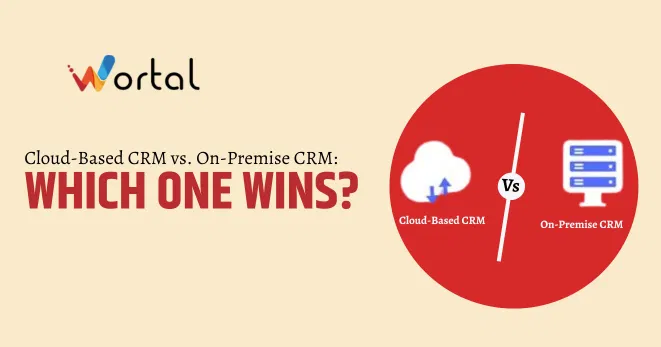

Managing customer relationships is important for success in today’s changing business world. Customer Relationship Management (CRM) systems help a business improve processes, enhance customer interactions, and build loyalty and growth. One key decision you’ll face is choosing a “cloud CRM” or an “on-premise CRM.”
This is similar to whether to rent or purchase a home. Both come with advantages and disadvantages, and the appropriate option is based on your individual requirements.
What can we consider for a Cloud CRM?
Cloud CRM applications are hosted on the vendor’s servers, and you can access them over the Internet. This arrangement provides flexibility and convenient access from anywhere with an internet connection. It’s useful for businesses with remote workers or those requiring mobile access. Cloud CRMs typically have lower initial costs and less IT effort because the vendor maintains and updates them.
Conversely, on-premise CRM programs are hosted on your firm’s servers. You have greater control over the program, data protection, and personalisation. When your company requires stringent data safeguards or unique compliance requirements, an on-premise option may be preferable. Though it often means a higher initial cost and exclusive IT support to maintain and upgrade, some businesses prefer this alternative for custom solutions and enhanced security features.
Ultimately, it’s up to you whether you go for cloud or on-premise CRM based on your business size, budget, and operational requirements. By assessing the pros and cons of each option would enable you to choose the best solution for your long-term vision and customer relationship strategies. In the modern dynamic business environment, customer relationship management is the key to success. Customer Relationship Management (CRM) systems help a business to improve its processes, enhance customer interactions, and build loyalty and growth. One key decision you’ll face is whether to choose a “cloud CRM” or an “on-premise CRM.”
You can think of this choice like deciding between renting a house and buying one. Both options have their pros and cons, and the right choice depends on your specific needs.
What’s the hype about about a CRM?
First, let’s be on the same page. CRM software assists companies in tracking customer interactions, sales, and information. They are digital Rolodexes on steroids that assist you in forming better relationships with your customers.
The Two Contenders: Cloud vs. OnPremise
Let’s introduce our contestants:
Cloud CRM (or SaaS CRM):
Consider this renting software. You use it over the Internet, and the company takes care of all the technicalities. “SaaS CRM” is another name for cloud-based CRM and refers to “Software as a Service.”
On-Premise CRM:
It is similar to purchasing the software outright. You install it on your company’s own servers and do all the maintenance.
The following are the key rounds of differences between Cloud CRM and OnPremise CRM.
Round 1: Costs and Setup
Cloud CRM:
Less initial cost. You pay a subscription fee, such as a monthly rental.
Easy and fast installation. You can begin to use it right away.
On-Premise CRM:
More expensive initially. You pay to purchase the software and hardware.
Takes more time to set up. You’ll require IT professionals to install and integrate it.
Round 2: Flexibility and Accessibility
Cloud CRM:
Access from anywhere in the world with internet connectivity. Ideal for remote teams.
Simple to scale up or down. Want more users? Simply change your subscription. This is critical for “business scalability”.
OnPremise CRM:
Only access it through your company network.
Scaling can be difficult and costly. You’ll have to purchase additional hardware and software.
Round 3: Maintenance and Updates
Cloud CRM:
The provider does all the updates and maintenance. Always get the latest version.
This allows your IT personnel to focus on other projects.
On-Premise CRM:
Your IT department handles all maintenance and updates. This takes time.
Round 4: Security and Control
Cloud CRM:
Security is the provider’s concern. They tend to have very good security controls.
Certain companies are concerned about storing information on another company’s servers.
On-Premise CRM:
You get to have full control over your data and security.
This, however, also implies that you’re on your own for any security issues.
When to Opt for Cloud CRM?
The following are the situations and points when a Cloud-based CRM could be your best buddy for your business use.
- Economical and Versatile: If you own a small or mediumsized enterprise, cloud CRM systems can prove economical. They usually follow a subscription price model, which keeps you in control of your expenses without requiring you to spend much on hardware and software initially.
- Remote Teams Support: Cloud CRM is ideal for companies that have remote teams. It permits access to customer data anywhere, and with this, remote teams can cooperate and remain engaged more easily.
- Concentrate on Business: To enhance your core business operations without thinking about IT responsibilities, cloud CRM allows you to leave IT control to the provider. Therefore, you are able to concentrate on strategy work and interacting with clients.
- Scalability: Cloud-based CRM provides scalability to scale your usage and features easily as your requirements shift, without any substantial cost or interruptions. With your growing business, you can adapt the CRM to accommodate new demands.
When to Opt for On-Premise CRM?
The following are the situations where you should go for an On-Premise CRM.
- Complex Requirements of Big Businesses: If your company is big with intricate needs—such as advanced workflows—a(n) onpremise CRM would work better. You can configure and integrate according to your requirements.
- Robust Data Security: If your company deals with sensitive data or let’s say is subject to strict regulations, you may like onpremise CRM systems. This allows you to have complete control over your data and security controls, staying compliant without relying on third parties.
- IT Resources Available: If you have an inhouse IT team to take care of software installations and support, onpremise solutions can effectively utilise those resources. Your team can address issues, updates, and customisations directly.
- Requirement for Customisation: If your company requires deep customisation,on-premise CRM provides support for adjustments to suit your distinct processes. You can design workflows and interfaces according to your business model for a more personalised experience.
The Future: A Simple Hybrid Approach
Increasingly, companies are adopting a hybrid customer relationship management (CRM) approach. This approach brings together cloud and on-premise solutions. It allows organisations to benefit from cloud CRM for sales and marketing while safeguarding sensitive customer information with on-premise systems.
Key Points:
- Advantages of Cloud CRM: Cloud CRM solutions are economical, particularly for small and medium enterprises. They are flexible and scalable, enabling businesses to develop and transform according to requirements. The intuitive interfaces enable groups to start promptly and utilise the tool efficiently. What is SaaS CRM? Cloud CRM is sometimes called “Software as a Service” (SaaS) CRM since it operates on a subscription basis. This enables companies to receive ongoing updates without having to make a large initial investment.
- Benefits of On-Premise CRM: On-premise CRM solutions are more suitable for companies that require more control and customisation. Storing data within the company ensures that companies can meet stringent data protection regulations and maintain complete control over customer data. This is particularly significant in sectors where data security is vital.
- Business Factors: While deciding between onpremise and cloud CRM, businesses should think about their size, requirements, and cost. A small startup may gain more from a cloud-based solution, whereas a bigger organisation with specific customisation requirements may want an on-premise solution.
- Scalability with Cloud Systems: One of the most important aspects of cloud CRM is its scalability. It can expand as your business grows. As your business grows, your CRM can also scale easily without having to undergo extensive system upgrades that can interfere with your operations.
Conclusion
At Wortal CRM, we recognise that choosing the correct CRM is a significant business decision. We hope this summary gives you an idea of the advantages and considerations of both cloud-based and on-premise CRM solutions. Take time to consider your business goals and needs in order to determine the CRM best suited for you. The correct tool can assist in creating stronger relationships with your customers and enable growth.
Wortal CRM is a cloud-based CRM which dives into various benefits, as discussed in the above blog. Learn more about Wortal CRM, sign up today or book a free demo.