

Running a business in India without a proper inventory management system is a bit like cooking without knowing what’s in your kitchen. You manage, somehow but there’s always something missing exactly when you need it most.
Most small and mid-sized businesses here still track stock in Excel sheets or, worse, physical registers. That works fine until orders pick up, the team grows, or you start selling across multiple channels. Then it falls apart fast.
The real issue is that inventory problems rarely show up alone. They’re almost always tangled with customer problems, wrong deliveries, delayed orders, promises made without checking stock first. That’s exactly why inventory management software in India paired with CRM integration has started making a lot of sense for businesses, especially in manufacturing, trading, and distribution.
Why Standalone Inventory Tools Often Fall Short
A basic inventory tracking software will tell you what’s in stock. That’s useful, but it’s only half the picture.
What it won’t tell you is that a customer who ordered last week is waiting, that your salesperson just promised the same stock to three different clients, or that the batch sitting in your warehouse has been there for 90 days and is quietly eating into your margins.
That’s where things usually go wrong not in the warehouse, but in the gap between your stock data and your sales team.
An inventory management system that talks to your CRM closes that gap. Your sales team knows what’s available before they quote. Your operations team knows who’s waiting when stock arrives. And your finance team isn’t chasing people down to figure out what got dispatched.
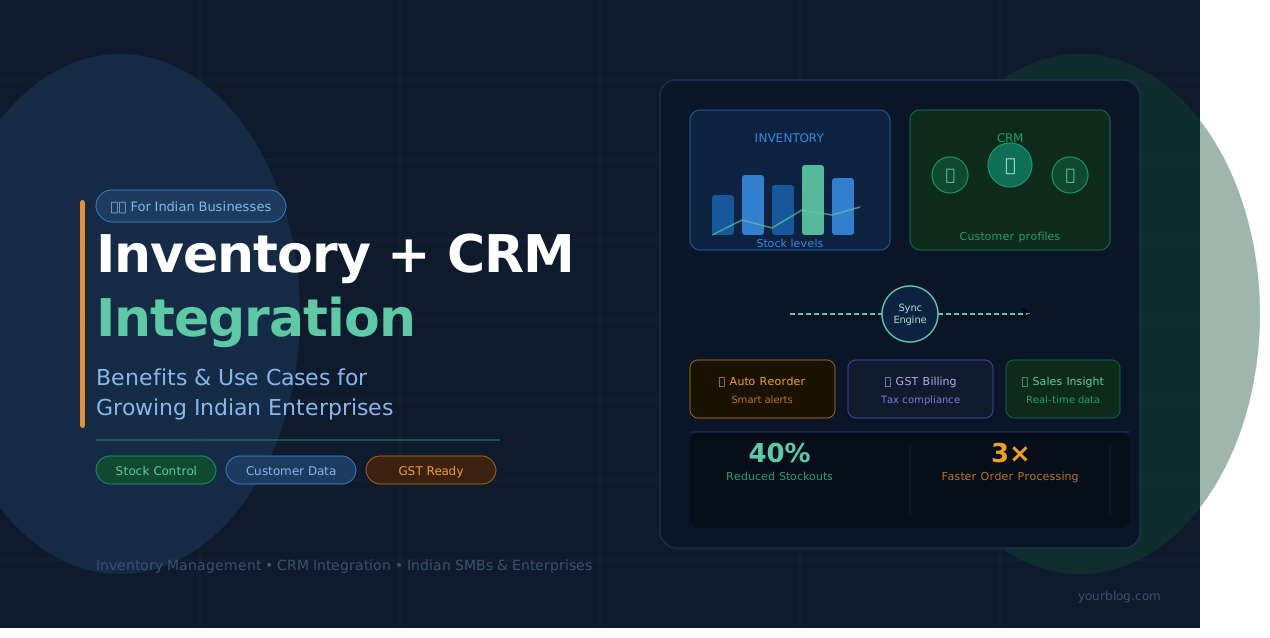
What CRM + Inventory Integration Actually Looks Like
This isn’t complicated in practice. Think of it as two systems sharing one brain.
When a lead converts into a customer and places an order, the inventory control software updates automatically. No one needs to call the warehouse and then update a spreadsheet. The stock reflects the committed quantity in real time.
Here’s a scenario that plays out constantly in Indian trading companies:
A salesperson in Mumbai confirms a bulk order over WhatsApp. Meanwhile, another rep in Pune quotes the same products to a different client. Without connected inventory tracking software, both transactions look fine until dispatch day, when the stock physically doesn’t exist for both.
With CRM integration, the moment an order is committed through the CRM, the inventory management software marks it as reserved. The second salesperson sees updated availability before quoting. No surprises at the warehouse.
This kind of real-time visibility is also at the heart of what Wortal’s sales management tools are built around giving your field team and your operations team the same picture at the same time.
Book a Free Demo
See how Wortal can simplify your business and help you close more deals.


Key Benefits for Indian SMBs
Real-Time Stock Visibility Across Teams
Good inventory control software shows you stock levels across locations whether it’s one warehouse or three branches and makes that data available to your sales team, not just your store manager.
Wortal’s real-time inventory insights feature is specifically built for this: your reps can see live stock data without calling the godown manager first.
This matters especially for businesses with field sales teams who are constantly making promises without visibility into actual availability.
Fewer Stockouts, Less Overstocking
An inventory management system that tracks movement trends helps you see what’s moving fast and what’s sitting idle. Over time, you stop over-ordering items that don’t sell and stop running short on the ones that do.
Most people ignore this part: the cost of overstocking is just as real as the cost of a stockout. Blocked capital, storage costs, expiry risks they add up. If that’s something you’re currently dealing with, these inventory management tips for maximum efficiency are worth a read.
Better Customer Communication
When your inventory tracking software is connected to your CRM, customer-facing teams always have accurate delivery timelines. No more “let me check and call you back” they can see availability in real time, give committed dates, and actually meet them.
That kind of reliability builds the sort of trust that repeat business runs on. It also connects directly to centralized contact management when every customer interaction and every order history is in one place, your team stops losing context between conversations.
Streamlined Order-to-Dispatch Process
The handoff from sales to operations is where orders get lost, delayed, or confused. Connected inventory management software and CRM removes a lot of that friction – orders flow automatically from confirmed sale to dispatch queue without manual entries in between.
Stock transfers between branches and warehouses becomes significantly simpler when both sides of the transaction are recorded in the same system.
Use Cases That Make Sense for Indian Businesses
Manufacturing units use inventory control software to track raw materials against production orders, ensuring procurement happens at the right time and nothing sits idle waiting for parts.
Distributors and traders rely on inventory tracking software to manage stock across locations, coordinate with sales reps, and ensure committed stock doesn’t get double-allocated. The role of inventory management in growing your business covers this segment in more detail.
Retail businesses with B2B clients use an inventory management system alongside CRM to manage reorder cycles, send low-stock alerts, and automate replenishment follow-ups. Pair this with quotation automation and your sales cycle becomes significantly faster.
A Real Example: How One Surat Trading Firm Stopped Losing Orders

Last year I sat down with the owner of a yarn trading business in Surat’s Ring Road area – a setup with around 18 people, two godowns, and four field sales reps covering different parts of Gujarat and Maharashtra.
His problem wasn’t unfamiliar. Every Monday, his team would spend almost two hours just “reconciling” – figuring out what got sold over the weekend, what was promised, and what was actually sitting in the godown. He told me, half-joking, “Mera Excel sheet Sunday raat ko sach bolta hai, Monday subah jhooth bolne lagta hai” (My Excel sheet tells the truth Sunday night, but starts lying by Monday morning).
The actual breaking point came during Diwali season. One of his reps confirmed a 200-bale order to a buyer in Bhiwandi. Around the same time, another rep – unaware of this – quoted the same lot to a regular client in Surat itself. Both buyers showed up expecting dispatch. There was enough stock for one order, not both. The owner ended up splitting the lot, upsetting both clients, and one of them switched to a competitor for the next two seasons.
When he finally moved to a CRM with inventory tracking built in, the change wasn’t dramatic on day one – it rarely is. But within about three weeks, his reps stopped calling the godown manager before quoting. The system showed them what was actually free to sell, including stock that was already reserved against other orders. His Monday reconciliation dropped from two hours to maybe fifteen minutes, mostly just checking dispatch confirmations.
What stuck with me from that conversation was something he said almost in passing: “Maal toh tha hi, bas pata nahi tha kis ko bech chuke hain” (The stock was there all along – we just didn’t know who we’d already sold it to). That’s really the core of the problem this kind of integration solves. It’s rarely about not having enough stock. It’s about not knowing what you’ve already committed.
For businesses running multiple sales reps across cities – which is extremely common in Surat’s textile trade – this single change (reps seeing reserved vs. available stock in real time) tends to prevent the exact kind of double-booking that quietly costs repeat customers.
Key Takeaways
- Standalone inventory management software solves a warehouse problem. CRM integration solves a business problem.
- Real-time stock visibility across sales and operations prevents the most common dispatch errors.
- An inventory management system connected to your CRM gives every customer-facing team member accurate information before they make commitments.
- The goal isn’t just tracking it’s making sure the right information reaches the right person at the right time.
- For Indian SMBs scaling beyond 10-15 people, this integration stops being a nice-to-have and starts becoming a basic operational requirement.
If your sales team is still calling your store manager to check stock before quoting a customer, that’s the clearest sign it’s time to look at better inventory control software one that works with your sales process, not separately from it.
Wortal’s inventory management and sales management modules are built to work together for exactly this reason. If you want to see how it works for a business your size, book a free demo or start a free trial.
Frequently Asked Questions (FAQs)
Inventory Management Software with CRM Integration combines stock tracking, warehouse management, sales operations, and customer relationship management into a single platform. This enables businesses to manage inventory levels, customer interactions, orders, and sales data from one centralized system.
CRM integration provides real-time visibility into customer orders, sales pipelines, and inventory availability. This helps businesses prevent stockouts, reduce order delays, improve demand forecasting, and deliver a better customer experience.
Retailers, wholesalers, distributors, manufacturers, eCommerce companies, and trading businesses can benefit significantly. The integration streamlines operations, improves order fulfillment, and enhances customer relationship management across multiple sales channels.
Yes. By automating inventory updates, reducing manual data entry, minimizing stock discrepancies, and improving order accuracy, businesses can lower operational costs and increase overall efficiency.
Indian businesses often manage high-volume transactions, multiple sales channels, and growing customer bases. An integrated solution provides centralized data, faster decision-making, improved customer service, and scalable operations to support business growth.