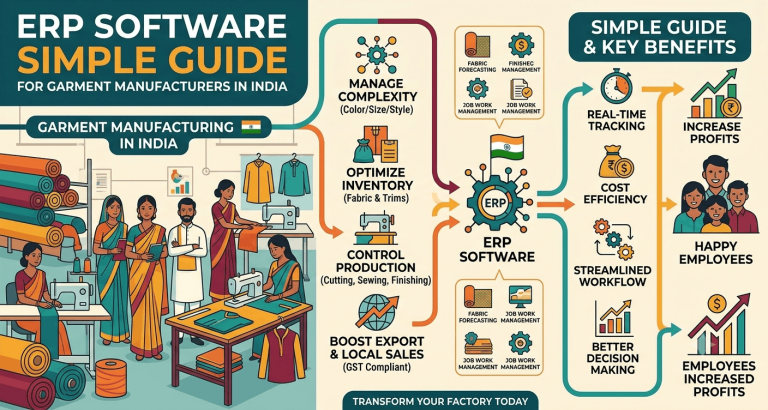



If you run a textile business in Surat, Bhiwandi, Ichalkaranji or anywhere in India’s fabric belt, you already know the real headache isn’t manufacturing or sales. It’s knowing what’s sitting in your godown right now, this minute, without walking down three floors to check.
I’ve spent years talking to textile traders, and the story repeats itself. The owner checks the stock register. The register says 400 meters of a fabric roll. Godown boy says 250. Somewhere between the last sale and today, 150 meters just… vanished into paperwork confusion. Nobody stole it. Nobody lied. The system just broke.
This is exactly why an inventory management system for textile industry operations isn’t a luxury anymore. It’s the difference between knowing your business and guessing at it.
Why Textile Inventory Is Genuinely Harder Than Other Industries
Most inventory software gets built for retail shops selling countable units – one phone, one shirt, one chair. Textile doesn’t work like that.
You’re tracking:
- Meters and yards, not pieces
- Multiple units for the same fabric (thaan, roll, bale)
- Colour and design variations under one SKU
- Job work sent out to weavers or dyers that isn’t “in stock” but isn’t “sold” either
- Returns from wholesalers that come back partially used
A generic stock management software for textile business built for a grocery store or electronics dealer simply won’t understand a “cut piece” or a “short length” sitting in your rack. This is the part most software vendors skip when they pitch you. They show a nice dashboard, but the moment you ask “can it handle meter-based partial billing with GST rounding,” things get quiet.
Here’s what actually matters: does the software speak the language of your godown, or does it force your godown to speak the language of the software?
What Happens Without Proper Fabric Inventory Software
Let me give you a real scenario. A trader in Surat’s Ring Road market – dealing in polyester fabric, roughly 40 lakh turnover a month – was running everything on Excel and a manual bahi khata for backup.
Every Diwali season, the same thing happened. Orders would spike. His two staff members would take stock counts manually, on paper, twice a day. By the time the count reached the owner, it was already three hours old. He’d quote a client 500 meters of a design, only to find out later that 300 meters had already been committed to another buyer that morning.
He lost that client. Not because his fabric was bad. Because his numbers were wrong.
This is where fabric inventory software India businesses actually need comes in – real-time visibility, not end-of-day reconciliation. The moment stock moves, the number updates. No lag, no guessing, no double-committing the same roll to two buyers.
Book a Free Demo
See how Wortal can simplify your business and help you close more deals.


Key Features To Actually Look For
Skip the sales brochure language for a second. Here’s what genuinely separates a working system from a shiny one:
1. Meter and unit-based tracking – Not everything sells in pieces. Your software needs to handle mixed units – meters, kg, pieces – without you doing manual conversion math every single time.
2. Batch and lot tracking – Different dye lots of the “same” fabric often have slight colour variation. A serious inventory management system for textile industry setup lets you track which batch came from where, so you’re not mixing lot numbers on a single bulk order and upsetting a buyer who notices shade difference.
3. WhatsApp-based stock alerts – Your godown manager probably isn’t sitting at a computer all day. If stock updates and low-stock alerts come straight to WhatsApp, adoption actually happens. Software that needs a laptop login every time gets abandoned within a month – I’ve seen this pattern too many times.
4. Job work and outward tracking – Fabric sent for dyeing, printing, or embroidery needs its own tracking category. It’s not sold, it’s not fully in-stock either. Good stock management software for textile business operations treats this as a separate, trackable state.
5. Integration with billing and CRM- Stock and sales can’t live in separate silos. When an order is booked, inventory should reduce automatically. Manual double-entry is where errors creep in.
Here’s a quick look at how manual tracking stacks up against a proper system, based on patterns we’ve seen across dozens of textile businesses:
Manual Register vs Software Tracked
Where the numbers actually move once stock tracking is automated.
The gap isn’t small. It’s the difference between running a business and firefighting one.
How Wortal Fits Into This Picture
This is where I’ll be direct instead of vague. Wortal is a CRM and stock tracking platform built specifically with Indian SMB sectors in mind, and textile is one of its core focus areas – not an afterthought bolted on later.
What makes it relevant here:
- Inventory management built around how Indian textile traders actually operate, with stock updates tied directly to sales and lead activity
- WhatsApp and email automation, so godown staff and sales teams stay in sync without needing to be glued to a dashboard all day
- A visual deal pipeline that shows exactly where an order stands, so fabric doesn’t get promised twice
- WCaller, which tracks calls with buyers and suppliers, useful when half your negotiations still happen over phone, not email
- Pricing that starts free to trial, with Standard at Rs.200/user/month and Premium at Rs.350/user/month – accessible for a mid-sized trading firm, not just large exporters
A textile-specific card scanning feature for exhibitions is also part of the setup – scan a visiting card at a trade fair, and the contact flows straight into your CRM instead of sitting in a drawer until someone eventually types it in three weeks later, if at all.
Practical Tips Before You Buy Any Software
Don’t buy on demo alone. Ask the vendor to show you meter-based stock deduction on a real, messy example – a partial roll sale with a return. If they fumble, that’s your answer.
Check WhatsApp dependency of your team. If your godown staff barely uses computers, prioritise mobile-first, WhatsApp-integrated systems over desktop-heavy ones.
Migrate old data properly. Most failures happen not because the software is bad, but because old stock data gets dumped in half-correctly, and the first month shows wrong numbers, killing trust in the system.
Start with one product line. Don’t switch your entire inventory overnight. Run the new system parallel with your old register for two to three weeks on one fabric category before going all-in.
A Real Case: Ichalkaranji Powerloom Cluster

A small but instructive example. A powerloom unit dealing in grey fabric, supplying to processing houses, was managing roughly 15 fabric varieties with three staff members handling stock manually.
Their biggest issue wasn’t theft or damage – it was double allocation. The same lot would get quoted to two buyers because the register update lagged behind actual sales by half a day.
After moving to a proper inventory management system for textile industry setup with real-time updates, their double-booking complaints dropped from roughly 6-7 a month to near zero within the second month. Not because the fabric changed. Because the number on the screen finally matched the number in the godown.
That’s really the whole point. Software doesn’t make more fabric. It makes the truth visible faster.
Key Takeaways
- Generic software rarely handles meter-based, batch-tracked textile stock well
- Real-time updates matter more than fancy dashboards
- WhatsApp integration drives actual staff adoption
- Job work and outward fabric need separate tracking states
- Migrate old data carefully, and test on one category first before full rollout
Frequently Asked Questions
Straight, honest answers to the questions traders ask most before switching to stock management software.
For very small operations, it can work for a while. But once you cross a certain order volume, someone always forgets to update a cell, and that’s when mismatches start piling up quietly.
Yes, if it’s built with flexible unit tracking. Wholesale usually needs bulk lot handling while retail needs cut-piece tracking – a good system supports both without extra workarounds.
In most cases I’ve seen, about two to three weeks if there’s WhatsApp-based training and someone walks the godown staff through it hands-on, rather than just handing over a login and a manual.
Most decent platforms link stock movement directly to invoicing, which reduces manual GST calculation errors, especially with meter-to-rate conversions.