

Every business owner tracking stock in Excel says the same thing at some point: “It’s working fine for now.” Then a shipment goes missing, or two staff members update different versions of the same file, and suddenly a Rs.40,000 stock discrepancy shows up during the audit. That’s usually when the search for inventory software begins.
I’ve watched this pattern play out with dozens of small businesses over the years – a wholesaler, a spare parts dealer, a packaging unit. The story is almost always identical. Spreadsheets feel free. They’re not. The real issue is that spreadsheets hide their cost instead of removing it.
This post breaks down the actual, rupee-by-rupee comparison between spreadsheets and dedicated inventory management software in India, based on what businesses genuinely experience, not the sanitized version you read in most software blogs.
Why Spreadsheets Feel Cheap But Aren’t
Excel or Google Sheets costs nothing upfront. That’s the entire appeal. No subscription, no onboarding, no learning curve because everyone already knows how to type numbers in a cell.
But here’s what actually matters: the cost isn’t in the tool. It’s in the hours someone spends fixing what the tool can’t do on its own.
A spreadsheet doesn’t warn you when stock runs low. It doesn’t stop two people from editing the same file at the same time. It doesn’t automatically deduct quantities when an order goes out. Every one of those gaps gets filled by a human, manually, every single day.
Most people ignore this part until they sit down and actually calculate the hours lost. A store manager checking, correcting, and re-checking stock sheets for even 45 minutes a day adds up to roughly 19 hours a month. At a modest salary, that’s real money spent maintaining a “free” tool.
Book a Free Demo
See how Wortal can simplify your business and help you close more deals.


The Hidden Costs Nobody Adds Up
Let’s get specific, because vague statements like “spreadsheets are inefficient” don’t help anyone make a decision.
1. Human error compounds silently
A single wrong entry in a spreadsheet doesn’t just sit there. It gets copied into the next month’s file, referenced in a reorder decision, and eventually shows up as a stock mismatch nobody can trace back. I’ve seen a Rajkot-based auto parts distributor lose track of nearly 200 SKUs simply because three different staff members maintained three different versions of “the master sheet.”
2. No real-time visibility
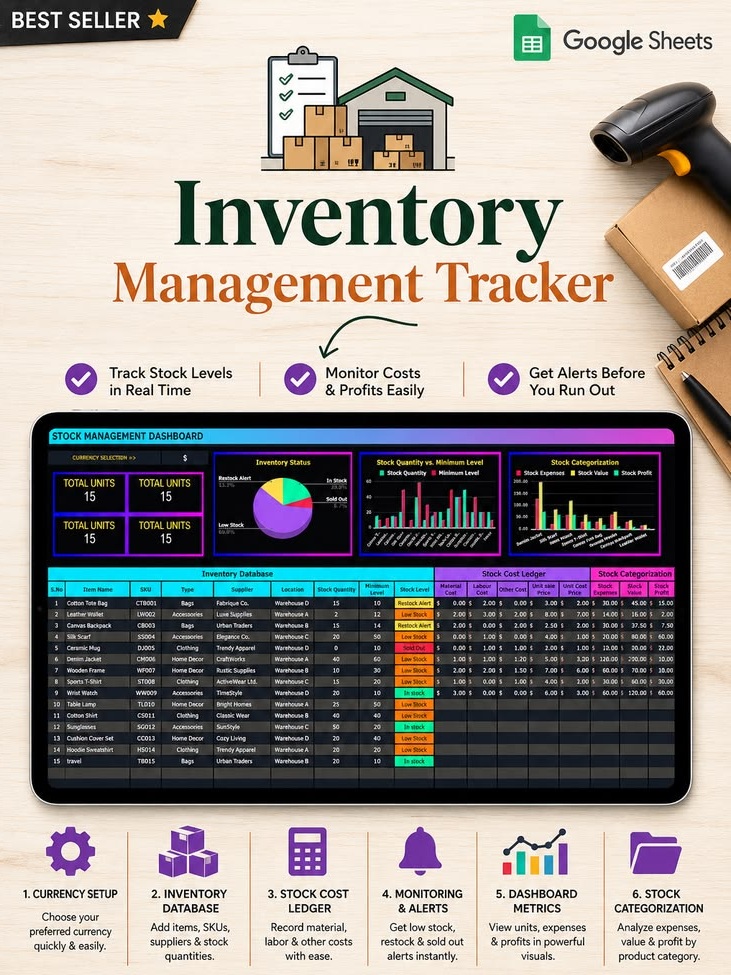
Spreadsheets show what someone typed, not what’s actually happening in the godown right now. By the time an update is manually entered, the numbers are already outdated. This is exactly the gap inventory software India solutions are built to close, real-time sync means the moment stock moves, the record moves with it.
3. Reordering becomes guesswork
Without automated low-stock alerts, reordering depends on someone remembering to check. That either leads to overstocking (cash stuck in unsold inventory) or understocking (lost sales because the item wasn’t available). Both are expensive, just in different ways.
4. Scaling breaks the system
A spreadsheet that works for 50 products becomes unmanageable at 500. Formulas break, files get too heavy, and multiple branches create version chaos. This is where businesses usually realize spreadsheets were never built for scale, they were built for lists.
5. No audit trail
If a stock number looks wrong, spreadsheets don’t tell you who changed it, when, or why. Good inventory management software in India logs every change automatically, which matters more than people expect when accounts don’t match during a GST filing or a client dispute.
What Inventory Software Actually Changes
Here’s what actually matters when you switch: it’s not about features looking impressive on a sales page. It’s about the daily friction disappearing.
- Stock updates automatically when a sale or purchase is recorded
- Low-stock alerts remove the need for manual checking
- Multiple users can access the same live data without version conflicts
- Reports generate in seconds instead of hours of manual compilation
- Barcode or catalog-based tracking reduces manual entry errors significantly
Good inventory software doesn’t just replace a spreadsheet, it removes the daily babysitting that spreadsheets demand.
| Cost Factor | Spreadsheets | Inventory Software |
|---|---|---|
| Software cost/month | Rs. 0 | Rs. 200–Rs. 350 per user |
| Staff hours spent on manual updates | 15–20 hrs/month | 2–3 hrs/month |
| Estimated cost of staff hours (at Rs. 150/hr) | Rs. 2,250–Rs. 3,000 | Rs. 300–Rs. 450 |
| Stock discrepancy losses (avg. estimate) | Rs. 3,000–Rs. 8,000/month | Near negligible |
| Reorder inefficiency (overstock/stockouts) | Rs. 2,000–Rs. 5,000/month | Minimal, alert-based |
| Approximate total monthly cost | Rs. 7,000–Rs. 16,000 | Rs. 500–Rs. 800 |
The gap isn’t small. It’s not a “nice to have” difference, it’s the difference between a business quietly bleeding money every month and one that isn’t.
Spreadsheet costs climb as your product range and order volume grow. Inventory software India costs stay flat and predictable, you know exactly what you’re paying, month after month.
The Packaging Business That Switched Mid-Year
A packaging materials supplier in Surat ran their stock entirely on Excel for four years. Two staff handled orders, one handled purchases, and everyone updated the “master sheet” independently. It worked — until it didn’t.
During a busy festive season, an order for 5,000 units of a specific box size got confirmed to a client — but the spreadsheet hadn’t been updated after the previous day’s dispatch.
The actual stock was 1,200 units short. The client had already promised delivery dates to their own customers — leaving no room to recover quietly.
That single mismatch cost the business a client relationship worth roughly Rs. 6 lakh annually. Not because the team was careless — because the system they relied on had no way to prevent it.
After switching to dedicated inventory software, the business set up automatic stock deduction on order confirmation and low-stock alerts at a 15% threshold.
Key Takeaways
- Spreadsheets have no subscription cost, but they carry hidden labor and error costs that grow every month
- Inventory management software in India typically costs less overall once you factor in time saved and errors avoided
- Real-time stock tracking prevents the kind of mismatch that costs actual client relationships
- Reordering becomes predictable instead of reactive
- The switch pays for itself faster than most business owners expect often within 2-3 months
In practical terms, spreadsheets aren’t wrong for every business. A very small operation with under 50 products might genuinely be fine with Excel for another year or two. But the moment stock volume, staff count, or order frequency starts climbing, the manual system becomes the most expensive part of running the business even though it never shows up as a line item anywhere.
Platforms like Wortal are built specifically for Indian SMBs dealing with this exact transition combining inventory tracking with CRM and order management so stock data connects directly to sales and customer records, instead of living in a separate, disconnected file.
Inventory Software for Small Businesses
Straight answers on cost, setup time, and migration – for teams deciding between spreadsheets and dedicated inventory software in India.
Yes – if you’re managing more than 50–100 SKUs or have multiple staff updating stock. Below that, spreadsheets might still work. See question 10 for more on business size.
Most solutions range from ₹200 to ₹500 per user per month, depending on features. Worth weighing against the SKU threshold in question 1.
Yes — most modern tools also let you export reports to Excel format if needed, so you’re never locked out of a spreadsheet view. Migration details are in question 9.
Most cloud-based tools do, though some offer offline modes with later sync — useful if you’re also tracking multiple warehouses.
Usually 1–2 weeks for setup and staff training, depending on stock complexity. Training itself is lighter than most expect — see question 6.
Basic training is enough — most tools are designed to be simpler than Excel formulas, which keeps the switch time in question 5 short.
Yes — accurate stock records make GST reconciliation much easier and faster, and pair naturally with the pricing in question 2.
Yes — most inventory software supports multi-location tracking in real time, even alongside the offline scenarios in question 4.
It can usually be imported directly, so you don’t lose historical records — part of the same setup window covered in question 5.
No — it’s actually more valuable for small and mid-sized businesses trying to avoid costly manual errors, echoing the guidance in question 1.