

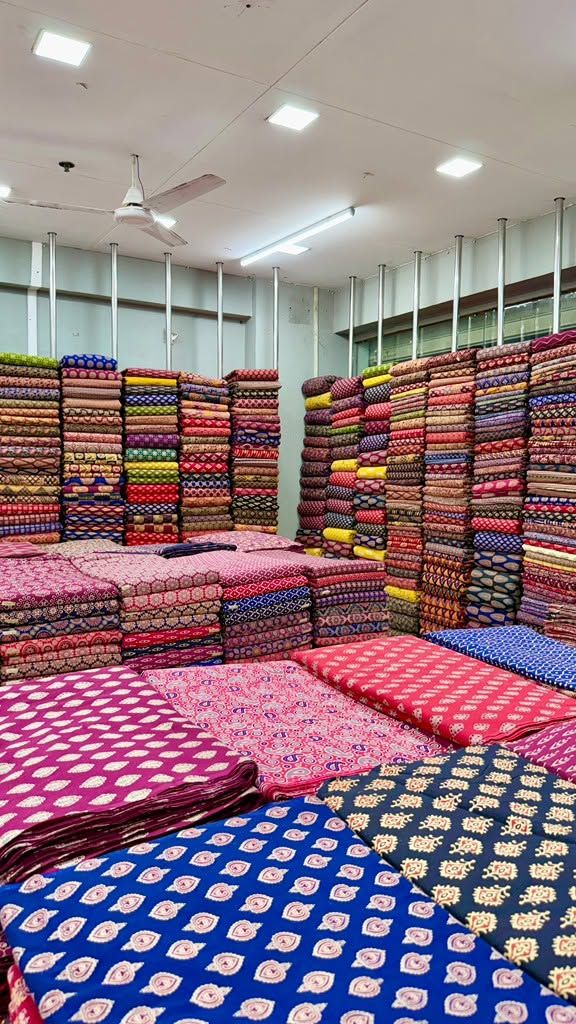

Introduction: What Are the Main Textile Markets in Surat?
Textile markets in Surat are large trading hubs where wholesalers, retailers, resellers, boutique owners, exporters and textile businesses source sarees, dress materials, fabrics, kurtis, lehengas, suit materials and other textile products in bulk.
Surat is one of India’s most important textile trading centres, with major market clusters around Ring Road, Sahara Darwaja, Umarwada and nearby areas. The key point for a wholesaler or manufacturer is that a “market” does not always mean a manufacturing unit. Many shops are traders, distributors or catalog sellers, while manufacturing may happen elsewhere in Surat’s wider textile ecosystem.
That distinction matters. If you are buying 500 sarees, sourcing fabric rolls, looking for a new supplier or comparing manufacturers, simply visiting the biggest building is not enough. You need to know which textile market in Surat fits your product, buying quantity, price segment and business model.
Quick Summary
This guide covers 10 major textile markets in Surat that are useful for wholesalers, manufacturers, retailers and bulk buyers.
You will learn:
- Which markets are best for sarees and dress materials
- Where to look for designer and premium collections
- Which areas are useful for bulk fabric sourcing
- The difference between a market trader and a manufacturer
- How to compare suppliers before placing a large order
- How to organise enquiries, quotations, inventory and follow ups after your Surat sourcing trip
Important: Market specialisations overlap heavily in Surat. Product availability changes with season, supplier and new collections. Treat the list below as a practical sourcing guide, not as a fixed ranking.
10 Best Textile Markets in Surat for Bulk Buyers
1. New Textile Market – Best for Broad Product Sourcing
New Textile Market is one of the oldest and biggest wholesale complexes in Surat’s main textile belt. It is located in the Moti Begumwadi/New Textile Market area and attracts retailers, resellers, boutique owners and buyers from different parts of India.
You can find:
- Sarees
- Dress materials
- Kurti fabrics
- Dupattas
- Blouse materials
- Laces
- Embroidered fabrics
- Catalog collections
Who should visit?
New buyers who want to compare many categories in one trip will find this market useful.
For a wholesaler, the biggest advantage is variety. You can compare several suppliers before committing to a large order.
Business Tip: Don’t ask only, “What is your lowest rate?” Ask for the fabric composition, available quantity, repeat stock possibility, MOQ, dispatch time and defect replacement policy.
2. Surat Textile Market – Best for Established Wholesale Trading
Surat Textile Market sits on Ring Road in the New Textile Market area and is one of the city’s established wholesale textile hubs. The market deals in sarees, fabrics, dress materials, lehengas, suits and kurtis.
It is particularly useful if you want to meet established textile traders and compare multiple collections.
For manufacturers and distributors, the location is also convenient because several other textile markets in Surat are concentrated nearby.
Best suited for
- Saree wholesalers
- Fabric buyers
- Retail chains
- Boutique suppliers
- Resellers
- Regional distributors
Expert Insight: When visiting a large market, shortlist suppliers instead of trying to buy from the first shop that shows you an attractive design.
3. Millennium Textile Market – Best for Designer and Premium Collections
Millennium Textile Market is a prominent Ring Road wholesale market known for contemporary textile collections and finished ethnic wear. Available categories include designer sarees, kurtis, salwar suits and party wear.
This is worth considering when your customers are looking for fashion led products rather than only basic fabrics.
Good fit for
- Boutique owners
- Premium retailers
- Designer wear wholesalers
- Wedding and occasion wear sellers
- Online fashion businesses
The trade off is straightforward: premium looking collections can carry higher prices. Don’t compare a heavily worked saree with a basic saree only by piece price. Compare fabric, embroidery, finishing, accessories and packaging too.
4. Raghukul Textile Market – Strong Option for Sarees and Fashion Fabrics
Raghukul Textile Market is another established wholesale destination on Ring Road. Sources covering the market list sarees, dress materials, kurtis, dupattas and designer fabrics among its key categories.
It attracts retailers, resellers, boutique owners and exporters.
Why wholesalers consider it
The market gives buyers access to multiple textile traders and collections in one location. This makes it useful for price and design comparison.
Pro Tip: If you are sourcing for a repeat business model, don’t judge a supplier by one good collection. Ask to see their regular stock range and previous season repeatability.
5. Avadh Textile Market – Useful for Sarees, Dress Materials and Cut Pieces
Avadh Textile Market is located opposite New Bombay Market near Sahara Darwaja. It is known for wholesale sarees, kurtis, dress materials, lehenga materials and cut-piece products.
This makes it useful for buyers who don’t want to restrict themselves to one product category.
Best for
- Small and medium wholesalers
- Boutique owners
- Online sellers
- Retailers
- Buyers looking for mixed product ranges
One practical advantage is its location. You can combine a visit here with nearby markets rather than spending an entire day travelling between distant textile zones.
6. New Bombay Market – Good for Women’s Ethnic Wear
New Bombay Market is in the Umarwada textile zone. It serves both retail and wholesale buyers and is particularly associated with women’s fashion products such as sarees, lehengas, kurtis, gowns and designer dress materials.
For retailers, this can be useful when the objective is not just fabric procurement but building a ready to sell women’s ethnic wear assortment.
Before placing a bulk order
Check:
- Size and design availability
- Fabric details
- Colour/shade consistency
- Quantity available
- Packaging
- Dispatch commitment
- Replacement terms
This becomes especially important when you are buying catalog based products.
7. Old Bombay Market – A Traditional Textile Trading Hub
Old Bombay Market is a historic wholesale textile area near Sahara Darwaja and is associated with sarees, dress materials, embroidered fabrics and traditional textiles.
It can be useful for businesses selling traditional and occasion oriented products.
Suitable buyers
- Saree wholesalers
- Traditional wear retailers
- Boutique businesses
- Wedding wear sellers
- Resellers
Common Mistake: Buyers sometimes assume that a famous market automatically means factory-direct pricing. It doesn’t. A shop inside a textile market may be a trader buying from another supplier.
Always ask:
“Are you manufacturing this product, or are you trading it?”
That single question can change your price comparison completely.
8. Sahara Darwaja Textile Market – Best Viewed as a Whole Trading Cluster
Sahara Darwaja is not simply one shop or one building. It is one of the important textile trading areas in Surat, with multiple market complexes and nearby textile businesses. Products commonly found in the cluster include sarees, dress materials, embroidered fabrics, bridal textiles, lehengas and suit materials.
For a wholesaler, the benefit is supplier density.
You can move from one market to another and compare:
Product → Quality → Supplier → MOQ → Rate → Credit Terms → Dispatch
That is often more valuable than finding one supposedly “cheapest” shop.
9. Globale Textile Market – Modern Option for Premium and Trend-led Sourcing
Globale Textile Market is located in the Bombay Market/Umarwada zone and is positioned as a wholesale and semi-wholesale textile destination. Its listed categories include designer fabrics, sarees, kurti fabrics, blouse materials, dupattas, embroidered fabrics and ready-stock catalogues.
It can suit businesses that want a more contemporary product mix.
Good for
- Fashion retailers
- Online sellers
- Boutiques
- Premium resellers
- Businesses looking for newer designs
For manufacturers, the important question is whether you are sourcing finished goods or raw/semi-finished material. Don’t mix the two while calculating your purchase cost.
10. Kohinoor Textile Market – Useful for Sarees and Dress Materials
Kohinoor Textile Market is located within the New Textile Market region and caters to buyers looking for sarees, fabrics and dress materials, including embroidered and designer options.
It can be considered when you are already visiting the New Textile Market cluster.
Best approach
Don’t make Kohinoor a separate full day destination unless you have a specific supplier or category in mind. Combine it with nearby markets and compare the same product across several sellers.
Textile Market Comparison for Wholesalers
🧵 Ahmedabad Textile Markets Guide
Market • Specialty • Buyer Type
| Market | Best Suited For | Buyer Type |
|---|---|---|
| New Textile Market | Wide textile range | Wholesalers, retailers, resellers |
| Surat Textile Market | Sarees, fabrics, dress materials | Bulk buyers |
| Millennium Textile Market | Designer and premium ethnic wear | Boutiques, premium retailers |
| Raghukul Textile Market | Sarees, kurtis, designer fabrics | Wholesalers, retailers |
| Avadh Textile Market | Sarees, kurtis, dress materials, cut pieces | Small/mid-size buyers |
| New Bombay Market | Women’s ethnic wear | Retailers, boutiques |
| Old Bombay Market | Traditional and embroidered textiles | Saree and wedding-wear sellers |
| Sahara Darwaja Cluster | Broad textile sourcing | Wholesalers and distributors |
| Globale Textile Market | Trend-led and premium ranges | Fashion retailers, online sellers |
| Kohinoor Textile Market | Sarees and dress materials | Retailers, resellers |
The list is not a strict “best to worst” ranking. The right market depends on what you are buying.
How Manufacturers and Wholesalers Should Source in Surat
Visiting textile markets in Surat is only half the job. The real work starts when you begin comparing suppliers.
Use this simple process:
📦 Supplier Sourcing Process
Step-by-step workflow
For manufacturers
Focus more on:
- Fabric specifications
- Yarn/fabric quality
- GSM and width where applicable
- Shade consistency
- Lot information
- Production capacity
- Processing requirements
- Delivery commitments
For wholesalers
Focus more on:
- Selling price
- Product movement
- MOQ
- Margin
- Repeat demand
- Stock availability
- Supplier reliability
- Dispatch speed
The Biggest Mistake: Confusing Market Shops With Manufacturers
This deserves special attention.
Many buyers search for “manufacturer” when what they actually find is a wholesaler or trader.
That is not necessarily bad. A good trader may offer variety, small MOQs and quick dispatch. A manufacturer may offer better control over production but may require higher quantities or longer lead times.
So decide based on your requirement.
⚖️ Trader/Wholesaler vs Manufacturer
Comparison by requirement
| Requirement | Trader / Wholesaler | Manufacturer |
|---|---|---|
| Small Quantity | Usually easier | May not be ideal |
| Large Repeat Order | Depends on supplier | Often better suited |
| Product Variety | Usually high | Often narrower |
| Customisation | Limited to available range | More possible |
| Ready Stock | Often strong | Depends on production |
| Direct Production Visibility | Low | Higher |
Business Tip: Never choose a supplier only because they say “factory rate.” Verify what they actually manufacture.
Practical Buying Checklist
Before confirming a bulk order, check:
- Product specification is written clearly
- Shade/colour is confirmed
- Quantity is confirmed
- MOQ is understood
- Rate includes/excludes GST as applicable
- Packing charges are clear
- Transport/dispatch responsibility is clear
- Delivery date is confirmed
- Defect/replacement terms are discussed
- Supplier contact details are saved
- Product photos/catalogue are stored
- Payment details are verified
This sounds basic. In actual textile trading, these small details prevent many avoidable disputes.
Illustrative Case Study: A Wholesaler Buying From Surat
Consider a fictional but realistic example.
Problem
A women’s wear wholesaler from Rajasthan visited Surat twice a month. Her team bought sarees and dress materials from different markets.
The problem wasn’t finding products.
The problem was control.
Orders were recorded partly in WhatsApp chats, partly in notebooks and partly in Excel. After returning from Surat, the owner couldn’t quickly answer:
- Which supplier supplied which design?
- Which orders were dispatched?
- How much stock was still available?
- Which buyer had asked for a repeat?
- Which salesperson had promised a price?
Solution
The business created a simple supplier and order recording process.
Every supplier was given a record containing:
Supplier → Product → Rate → MOQ → Market → Contact → Last Purchase → Payment Terms
Every buyer order was then connected to the relevant product and stock information.
Result
The owner could compare suppliers without depending on memory. Sales staff could see previous buyer conversations, while the warehouse team had a clearer picture of what was committed versus available.
Lesson
The biggest gain did not come from finding a “cheaper” market.
It came from keeping the information generated during sourcing organised.
That is where many growing textile businesses eventually need better systems.
How Wortal Fits Into the Textile Sourcing Process
Wortal is built for textile businesses that need to manage the work after enquiries start coming in.
For a wholesaler or manufacturer, the useful part is not simply having another software dashboard. The value is keeping buyer enquiries, follow ups, orders, inventory and team work connected.
Wortal’s textile platform supports buyer inquiry management, quotations, order tracking, inventory across godowns, stock tracking by attributes such as shade and lot, GST billing and dispatch workflows.
For example, imagine a salesperson meets 20 potential buyers during a sourcing trip.
Instead of keeping everything in personal WhatsApp chats:
Buyer enquiry → Follow-up → Quotation → Order → Stock → Dispatch
can be tracked in one workflow.
Wortal also supports multi-godown inventory, order management and stock movement tracking, which becomes useful once a textile business is handling several locations or large volumes.
For businesses where sales staff spend significant time visiting retailers, field-sales tracking can also help owners understand visits and follow-ups instead of relying entirely on verbal updates.
The point is simple: Surat can give you access to thousands of products and suppliers. A proper system helps you manage what happens after those supplier and buyer conversations begin.
Key Takeaways
- Textile markets in Surat are concentrated mainly around Ring Road, Sahara Darwaja and Umarwada.
- The New Textile Market is a strong starting point when you need broad product variety.
- Millennium Textile Market is more relevant for designer and premium collections.
- Raghukul is useful for sarees, dress materials, kurtis and designer fabrics.
- Avadh is useful for mixed wholesale sourcing and cut piece requirements.
- New Bombay and Old Bombay markets are relevant for women’s ethnic and traditional products.
- Sahara Darwaja should be treated as a wider textile trading cluster.
- Globale is worth considering for trend led and premium ranges.
- Not every shop inside a textile market is a manufacturer.
- Always compare MOQ, quality, repeat availability, payment terms and dispatch time-not just price.
- Keep supplier records after your Surat visit; otherwise much of the value of the sourcing trip is lost.
- Wortal can help textile businesses connect enquiries, follow ups, orders and inventory after sourcing begins.
Conclusion
Finding the right textile market in Surat is not about visiting the market with the biggest name.
It is about matching the market to your product and buying requirements.
A saree wholesaler, a`fabric manufacturer, a boutique owner and a pan-India distributor may all visit Surat on the same day but need completely different suppliers.
Start with the right market cluster. Compare several sellers. Verify whether you are dealing with a manufacturer or trader. Test quality before committing to a large order. And, once your supplier and buyer network starts growing, keep the information organised.
The businesses that manage textile sourcing well usually aren’t the ones that simply find the lowest price. They are the ones that know exactly what they bought, from whom, at what rate, for which customer, and what needs to happen next.
❓ Frequently Asked Questions
Surat textile markets — buyer guide
New Textile Market is a practical starting point for wholesalers because of its broad product range and concentration of textile businesses. However, the “best” market depends on the product. Premium ethnic wear buyers may prefer Millennium, while other buyers may find better supplier matches in the Sahara Darwaja or Umarwada clusters.
Wholesale sarees are available across several major markets, including New Textile Market, Surat Textile Market, Raghukul, Millennium, New Bombay and other Ring Road and Sahara Darwaja markets. Compare fabric, work, finishing, MOQ and repeat availability before choosing a supplier.
Some market shops may be manufacturers, but many are traders, wholesalers or distributors. Do not assume that every “factory rate” claim means direct manufacturing. Ask the seller about their production facility, product ownership and supply chain before placing a large order.
Millennium Textile Market, Raghukul and several markets around Ring Road and Sahara Darwaja can be useful for designer sarees. Availability changes by collection and season, so it is better to compare several suppliers rather than depend on one market.
Yes. Many markets serve retailers and resellers, although individual shops can have different MOQs. Ask about minimum quantity before spending time comparing a collection. Markets such as Avadh and New Bombay can be useful for smaller and mixed-category buyers.
Check fabric composition, width, GSM where relevant, shade consistency, lot details, available quantity, MOQ, defect policy, packing, GST treatment and dispatch terms. If the order is large, test a sample or small lot first.
Many major wholesale markets generally operate Monday through Saturday, with Sunday closures commonly reported. Exact timings vary by market and shop, so confirm before travelling, especially during holidays and festivals.
Start with the Ring Road/New Textile Market and Sahara Darwaja clusters because several major markets are concentrated there. This lets you compare suppliers without spending excessive time travelling between separate parts of the city.
Compare the same product specification, quantity, fabric quality, MOQ, GST treatment, packing, transport, delivery time and replacement terms. A supplier quoting Rs.10 less per piece may not actually be cheaper if the fabric or finishing is different.
Yes. Wortal is designed for textile businesses to manage buyer enquiries, follow-ups, orders, inventory, billing and team activities. Its textile inventory tools can track stock across godowns and by attributes such as shade, lot and quality, while order workflows help connect sales with fulfillment.