

Picture this – a broker in Ahmedabad gets 60 leads on a Monday from three different sources. By Wednesday, his team has called maybe 20 of them. The rest? Sitting in a WhatsApp group, waiting for “someone” to follow up.
That someone never comes.
I’ve spoken to enough sales managers in real estate to know this isn’t a rare situation. It’s basically the default. And the frustrating part is, the leads weren’t bad. The project wasn’t bad. The team just didn’t have a system.
That’s the actual problem a Real Estate CRM Software solves. Not just organizing contacts – but making sure nothing slips through while your team is busy handling yesterday’s chaos.
Finding the right one, though? That takes some thinking. Especially in India, where your leads arrive through 99acres, Housing.com, Facebook ads, walk-ins, and broker referrals – all at the same time, all needing a response within minutes.
Here’s what’s actually worth your attention in 2026.
Why Generic CRMs Don’t Cut It for Real Estate
Most CRM tools were designed for SaaS teams or retail businesses. Clean pipelines, email sequences, subscription-based sales cycles. Real estate works completely differently.
Your sales cycle might be eight months. A lead goes cold, then comes back six weeks later after a site visit. Someone inquires for a 2BHK but ends up buying a 3BHK. A channel partner sends you five referrals in one day and you don’t know which one is serious.
A Best Real Estate Lead Management System built for this environment handles multi-source lead capture, long nurturing cycles, inventory mapping, site visit tracking, and team accountability – all at once. Most generic tools handle two of those, maybe three.
That gap matters.
The 10 Best Options Right Now
1. Wortal CRM
Wortal is the one I’d point most Indian brokers toward first – not because it’s the flashiest, but because it actually fits how Indian sales teams function.
WhatsApp is the primary sales channel in India. Not email. Not phone calls – well, phone calls yes, but WhatsApp before and after. Wortal understands this. The automation workflows are built around it. New lead comes in at 11 PM from a Facebook ad? An automated WhatsApp message goes out within minutes. By the time your sales rep starts work the next morning, the lead has already heard from you.
The visual pipeline is genuinely useful – not just a nice-looking board that nobody uses. Each deal moves through stages that your team actually defines. And the WCaller app tracks real call activity, so managers aren’t guessing whether follow-ups are happening.
Features worth knowing:
- Lead Management with automatic assignment rules
- Sales pipeline with visual deal tracking
- WhatsApp and email automation in the same workflow
- Inventory and employee management modules
- WCaller app for outbound call tracking and logging
- Task dashboard with daily activity visibility
What works well:
- Built specifically for Indian SMB sales teams – the workflows reflect local habits
- Pricing is honest. Standard at 200/user/month, Premium at Rs.350/user/month. No surprise charges
- Free trial available – you can run it alongside your current process before switching
- Setup doesn’t require a technical team; most teams are live within two to three days
- Inventory management built in – particularly useful during project launches when unit availability changes daily
Where it has room to grow:
- The analytics dashboard is functional but not as deep as enterprise tools
- Large operations with 100-plus sales staff may want more advanced role hierarchies
As a CRM for real estate brokers and developers handling 100 to 800 leads a month, Wortal hits the right balance. It’s not trying to be Salesforce. It’s trying to make sure your team follows up – and it does that well.
2. Salesforce Real Estate Cloud
Salesforce is the tool everyone knows and most people can’t fully use.
The platform is genuinely powerful. Custom objects, Einstein AI forecasting, territory hierarchies, multi-step automation that rivals any enterprise software – it’s all there. Developers with offices in five cities and 80-person sales teams use it because nothing else scales the same way.
Features worth knowing:
- Einstein AI for lead scoring, opportunity forecasting, and activity suggestions
- Fully customizable – every field, workflow, and dashboard can be built from scratch
- Deep integration with marketing automation, ERP systems, and financial tools
- Advanced role-based access and territory management
What works well:
- Scales to any size operation without performance issues
- Third-party app marketplace is enormous – almost any integration exists
- Reporting depth is unmatched; custom dashboards can show literally anything
- Strong compliance and data security features for large organizations
Where it falls short:
- Licensing alone often crosses Rs.5,000 per user monthly – before implementation costs
- Getting it configured properly takes months and usually requires a dedicated Salesforce admin
- For most broker teams, 70% of the features will never get touched
- Support is documentation-heavy; getting actual human help takes time
Most people who buy Salesforce for a 15-person broker team regret it within six months. Not because the tool is bad – because it was built for a different problem at a different scale.
3. Zoho CRM
Zoho is probably the most commonly used Real Estate CRM Software among mid-sized Indian businesses right now. It’s deeply customizable, reasonably priced, and the broader Zoho ecosystem means it connects with accounting, HR, and marketing tools without much friction.
Features worth knowing:
- Blueprint feature that enforces your defined sales process step by step
- Lead scoring with custom scoring rules based on behavior and demographics
- SalesIQ for tracking website visitors and initiating conversations
- Email, SMS, phone, and social media communication from one interface
- Custom modules to build real estate-specific data structures
What works well:
- Pricing starts around Rs.800/user/month – accessible for growing teams
- Extremely flexible; you can model almost any real estate workflow
- Large user community means solutions to most problems exist online already
- Zoho One bundle gives access to 45+ apps including Books, Campaigns, and Desk
Where it falls short:
- Not built for real estate specifically – portal integrations with 99acres or MagicBricks need third-party connectors
- Can get cluttered quickly as you add more modules and custom fields
- The interface feels dated in places compared to newer tools
- Support quality is inconsistent depending on your plan tier
Zoho works best when someone on your team is willing to invest time configuring it properly. Out of the box, it’s average. Properly set up, it’s genuinely good.
Book a Free Demo
See how Wortal can simplify your business and help you close more deals.


4. HubSpot CRM
HubSpot built its reputation on inbound marketing, and that DNA shows up in the CRM too. The contact management, email sequences, and meeting scheduling are polished in a way most tools aren’t.
Features worth knowing:
- Free tier includes pipeline management, contact tracking, and email integration
- Sequences for automated follow-up over days or weeks
- Meeting scheduling links that sync with Google or Outlook calendar
- Marketing Hub integration for running campaigns and tracking attribution
- Clean interface that most users can figure out without training
What works well:
- Free plan is genuinely functional – not just a stripped-down demo
- Setup is fast; a new team can be operational in hours
- Email marketing tools are among the best available
- Strong reporting at the Sales Hub Professional and Enterprise tiers
Where it falls short:
- Pricing jumps sharply. From free to the first paid tier is a significant jump, and professional plans can cross Rs.4,000/user/month
- WhatsApp integration requires a third-party connector – not native
- Real estate-specific features are essentially absent
- Better suited for marketing-led organizations than high-volume inquiry management
For a real estate team managing 500 inbound inquiries a month across portals, HubSpot isn’t the right fit. For a boutique brokerage focused on content-driven lead generation and email nurturing, it works well.
5. Freshsales
Freshsales doesn’t get talked about as much as Zoho or HubSpot, but for digitally-driven sales teams it punches above its price point. The Freddy AI assistant surfaces which leads are most likely to convert based on actual behavior – emails opened, pages visited, responses to sequences.
Features worth knowing:
- Freddy AI for predictive lead scoring and deal insights
- Built-in calling with call recording and voicemail drop
- Auto-enrichment pulls public data to fill contact profiles
- Sales sequences with conditional branching based on prospect behavior
- Territory management with round-robin lead assignment
What works well:
- AI lead scoring is practical, not just a marketing claim – it genuinely helps large teams prioritize
- Built-in calling means one less integration to manage
- Clean interface with low friction onboarding
- Competitive pricing relative to feature set
Where it falls short:
- Offline leads – walk-ins, phone calls from hoardings – don’t integrate naturally
- WhatsApp needs a separate integration
- Real estate-specific workflows need custom configuration
- Analytics at lower price tiers are limited
Works best when the majority of your leads come through digital channels and you need help deciding who to call first.
6. LeadSquared
LeadSquared is the Best Real Estate Lead Management System for developers running large launches with high inquiry volumes. It was built with Indian B2C sales in mind, which means the portal integrations, SMS workflows, and field sales app all reflect local requirements.
Features worth knowing:
- Native integrations with 99acres, MagicBricks, and Housing.com
- Multi-step drip campaigns across email, SMS, and WhatsApp
- Field sales app with GPS check-in for site visits
- Lead quality scoring with customizable rule sets
- Detailed source-level reporting showing which campaigns and portals convert
What works well:
- Portal integrations actually work reliably – leads flow in automatically without manual entry
- Marketing automation depth is impressive for a mid-market tool
- Field sales tracking is useful for developers with multiple site offices
- Scales well for launch-phase volumes of 1,000-plus inquiries per month
Where it falls short:
- UI has a genuine learning curve – expect two to three weeks before the team is comfortable
- Pricing is higher than most tools on this list; not suited for small broker teams
- Support response times have been a consistent complaint in user reviews
- Some advanced features are locked behind enterprise pricing
If you’re a developer managing 800-plus inquiries a month across five portals, LeadSquared is worth the investment. Below that volume, probably not.
7. Propacity
Propacity is relatively new but built exclusively for Indian real estate – which means the feature decisions reflect actual developer workflows rather than generic sales processes.
Features worth knowing:
- Unit-level inventory management with real-time availability tracking
- Booking and payment plan tracking integrated with lead management
- Channel partner portal for managing broker networks
- WhatsApp-based lead communication
- Site visit scheduling with automated reminders
What works well:
- Inventory management is genuinely strong – developers launching projects find this valuable
- Channel partner management is a standout feature; most CRMs ignore this workflow entirely
- Faster implementation than enterprise tools – teams go live within a week typically
- Purpose-built for real estate so fewer workarounds needed
Where it falls short:
- Smaller feature set overall – if you need advanced marketing automation, it’s not there yet
- Reporting and analytics are basic compared to mature platforms
- Limited integration options with external tools
- Smaller support team means slower issue resolution
Promising tool for developers specifically. Worth evaluating if your primary need is inventory and channel partner management alongside basic lead tracking.
8. REsimpli
Including this one because some India-based NRI investment brokers use it. To be straightforward – it’s built for American real estate wholesalers. Skip tracing, direct mail, driving for dollars. None of that translates to Indian residential real estate.
What works well:
- Very good for US investment deal sourcing workflows
- All-in-one for the specific use case it was designed for
Where it falls short:
- No Indian portal integrations
- Currency, compliance, and market assumptions are all US-specific
- Not relevant for domestic Indian broker operations
Only worth looking at if you’re managing US-based real estate investment from India.
9. Pipedrive
Pipedrive does pipeline management better than almost anyone. The drag-and-drop deal view is clean, intuitive, and actually gets used – which isn’t something you can say about every CRM interface.
Features worth knowing:
- Visual pipeline with customizable stages and deal cards
- Email sync with automatic activity logging via Smart BCC
- Activity reminders and daily focus list
- 400-plus marketplace integrations
- Good mobile app for field sales reps
What works well:
- Teams go live in a day or two – minimal setup overhead
- High adoption rates because the interface doesn’t frustrate people
- Transparent pricing with no hidden feature gates at base tiers
- Good for tracking deal progress on smaller portfolios
Where it falls short:
- No real estate-specific features – everything needs custom setup
- WhatsApp automation requires third-party tools
- Not suited for high-volume lead management without significant customization
- Automation at base tiers is limited
Best fit for a broker team of 5 to 12 people who want a clean, functional pipeline without spending three months on configuration.
10. Realvolve
Realvolve takes a different approach entirely. Rather than focusing on new lead generation, it’s built around the idea that past clients are your most valuable asset – and that most brokers are terrible at staying in touch with them.
Features worth knowing:
- Relationship timeline showing full interaction history per contact
- Automated workflows triggered by dates – anniversaries, birthdays, transaction milestones
- Referral source tracking to understand where your business actually comes from
- Transaction management for post-sale follow-through
- Long-term nurturing sequences designed for 12-to-24-month cycles
What works well:
- Relationship nurturing is genuinely thoughtful – better than most tools in this regard
- Referral tracking helps identify which past clients generate the most business
- Good for brokers who’ve been in the industry long enough to have a meaningful database
- Helps maintain post-sale relationships that turn into referrals two years later
Where it falls short:
- Not designed for high-volume new lead generation at all
- US market focus – Indian market nuances aren’t reflected
- Pricing doesn’t scale well for larger teams
- Very limited reporting for team-level sales management
Realvolve makes sense for a boutique broker doing 20 to 30 transactions a year almost entirely through referrals. For anyone running volume-based lead generation, it’s the wrong tool.
Real-Life Case: A Surat Developer’s Follow-Up Problem – and What Fixed It
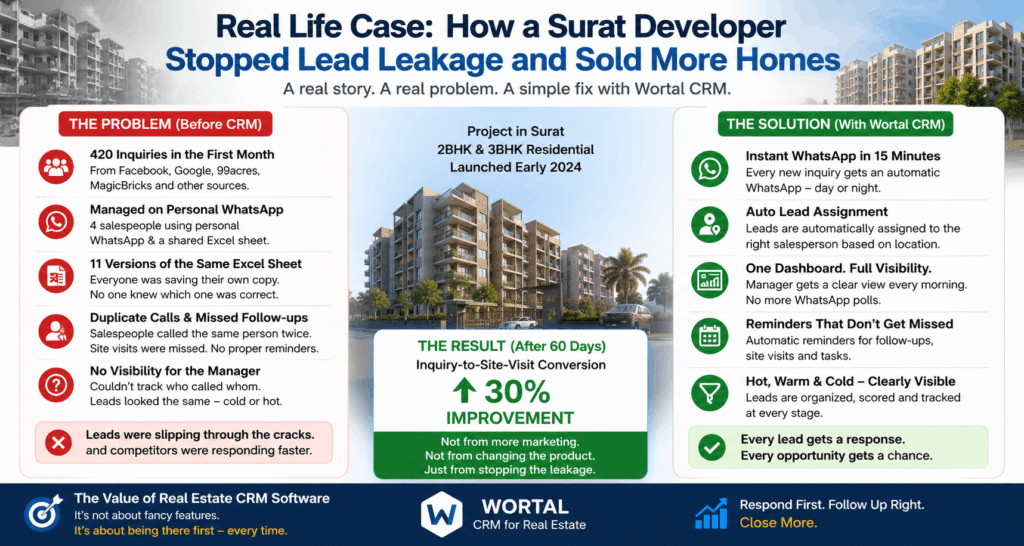
A developer in Surat launched a residential project with 2BHK and 3BHK units in early 2024. Marketing was running on Facebook and Google, plus listings on 99acres and MagicBricks. The first month brought in roughly 420 inquiries.
Four salespeople were managing everything through personal WhatsApp, with a shared Excel sheet that was supposed to track who called whom. Within three weeks, the sheet had 11 different versions because everyone was saving their own copy.
The manager couldn’t tell which leads had been contacted. Salespeople were occasionally calling the same person twice. Cold leads and hot leads looked identical in the spreadsheet. Site visits were being missed because the reminder was a WhatsApp message someone forgot to send.
After switching to Wortal CRM, a few things changed immediately. Every new inquiry triggered an automatic WhatsApp within 15 minutes – day or night. Lead assignment happened automatically based on location. The manager opened one dashboard each morning instead of running a WhatsApp poll asking “who called who yesterday.”
Over the next 60 days, inquiry-to-site-visit conversion improved by roughly 30%. Not from spending more on marketing. Not from changing the product. Just from stopping the leakage that was already happening.
That’s the actual value of a proper Real Estate CRM Software – not the fancy features, but the basic guarantee that a lead gets a response before your competitor does.
What Actually Matters When Choosing
Here’s what most people get wrong – they evaluate CRMs on feature lists. More features feels like more value. It usually isn’t.
The CRM for real estate brokers and developers that works is the one your sales team opens every day without being asked to. The one where data gets entered because it’s easier than not entering it. The one that reduces the manager’s anxiety about what’s happening in the pipeline.
A few things that matter more than the feature count:
- Response automation – if the system can’t trigger a WhatsApp within minutes of a new inquiry, you’re leaving conversions on the table
- Source tracking – knowing that MagicBricks gives you volume but 99acres gives you buyers is the kind of insight that changes your budget decisions
- Team adoption – a complex tool that nobody uses is worse than a simple tool everyone uses consistently
- Realistic pricing – the Best Real Estate Lead Management System for a 10-person team isn’t the one built for 200-person enterprises
Start with your actual problem. If your problem is follow-up speed, solve that first. If it’s pipeline visibility, solve that. Don’t buy a tool for problems you don’t have yet.
Frequently Asked Questions
Everything you need to know about Real Estate Lead Management Software in India.