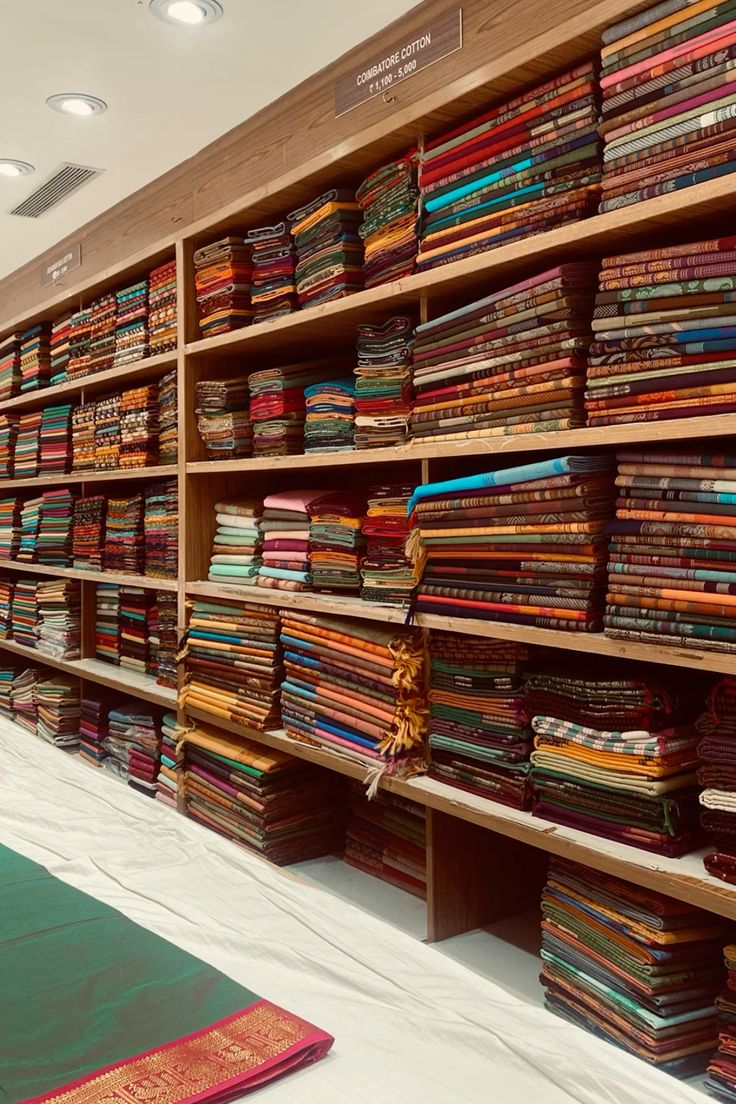

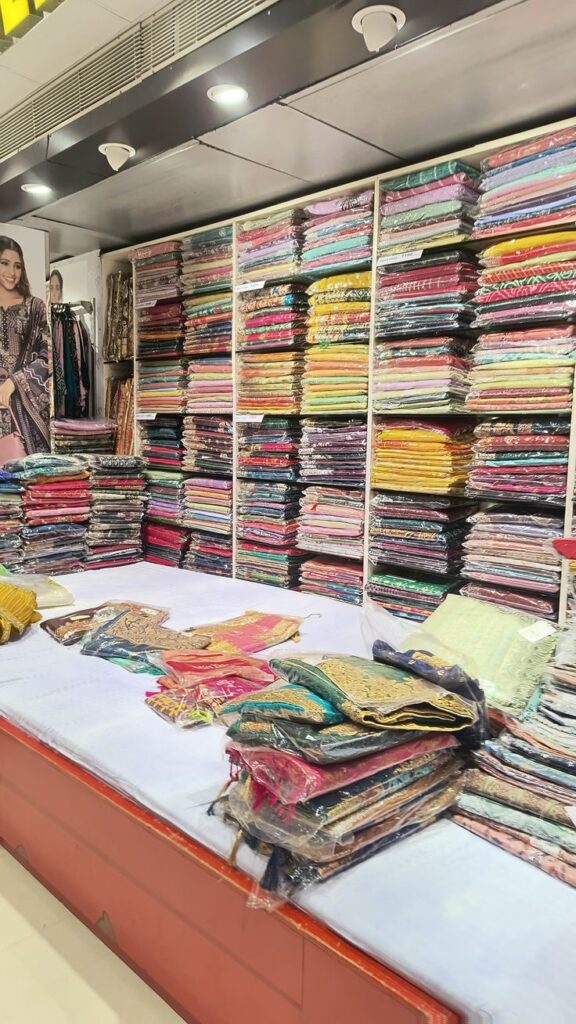

Dress material & suit piece wholesale means buying unstitched fabric sets or suit components in bulk from manufacturers, textile traders, distributors, or wholesale markets and then selling them through retail stores, boutiques, resellers, or other business channels.
In simple terms, a wholesale buyer may purchase cotton suit pieces, printed dress materials, rayon sets, georgette materials, embroidered fabrics, dupattas, or coordinated fabric sets at a business price and sell them individually at a retail margin.
Surat is one of India’s most important textile trading and manufacturing centres, with major wholesale activity concentrated around areas such as Ring Road and Sahara Darwaja. The city’s textile ecosystem includes manufacturers, processors, embroidery units, traders, wholesalers and distributors, which is one reason buyers can compare a very wide range of products in a relatively concentrated area.
But buying from Surat is not simply about finding the lowest rate.
The better question is: Can you buy the right designs, quality and quantity at a price that still leaves you a healthy margin after transport, wastage, discounts and slow moving stock?
That is where experienced wholesale buyers usually think differently.
Quick Summary
This guide is useful for:
- Dress material retailers
- Suit piece wholesalers
- Boutique owners
- Textile distributors
- Online resellers
- Small clothing businesses
- Regional dealers
- Businesses planning to source from Surat
You will learn how the Surat wholesale market works, what to check before buying, how to compare suppliers, how much stock to purchase, common mistakes, and how inventory software such as Wortal can help once your product range starts growing.
Book a Free Demo
See how Wortal can simplify your business and help you close more deals.


Why Surat Is a Major Sourcing Centre for Dress Materials
Surat’s textile trade is much larger than a single market building.
The Ring Road and Sahara Darwaja areas form important commercial clusters, while manufacturing and processing activity extends into other parts of the city. Current market sources describe Ring Road as a major sourcing belt for synthetic fabrics, georgette, chiffon, polyester fabrics and dress materials, while Sahara Darwaja serves a broad wholesale trade covering fabrics, dress materials and ethnic products.
This creates an advantage for buyers.
You can compare:
- Fabric quality
- Printing
- Embroidery
- Colour combinations
- Design freshness
- Packing
- Minimum order quantity
- Supplier reliability
- Price
- Replacement terms
The last two are often overlooked.
A supplier offering a Rs.20 lower price is not necessarily cheaper if five pieces arrive with shade variation, missing components or quality issues.
The Surat advantage for small buyers
A small retailer does not always want 1,000 pieces of one design.
They may want 10 pieces of one catalogue, 20 pieces of another, and a few premium designs for testing.
That makes wholesale markets particularly useful for businesses that want variety without committing their entire working capital to one product.
Dress Material vs Suit Piece: Know What You Are Buying
The terms are often used interchangeably, but buyers should still understand what is included in a particular product.
Product Types, Sale Format & Buyer Concerns
| Product | Usually Sold As | Typical Buyer Concern |
|---|---|---|
| Dress Material | Coordinated unstitched fabric set | Fabric, print, dupatta and overall look |
| Suit Piece | Fabric / components intended for a suit | Length, fabric quality and included pieces |
| Semi-Stitched Suit | Partially prepared garment | Size flexibility and stitching quality |
| Printed Material | Printed fabric set or fabric | Print durability and colour fastness |
| Embroidered Material | Fabric with embroidery / work | Work quality, finishing and defects |
| Cotton Suit Material | Cotton-based fabric set | Shrinkage, colour bleeding and fabric feel |
| Synthetic / Blended Material | Polyester, rayon, blends etc. | Fabric hand-feel, finish and price positioning |
Always ask the supplier exactly what the set contains.
Do not assume that a product shown in a catalogue includes the same components as the physical sample.
That small misunderstanding can create a surprisingly large pricing problem.
What Should You Check Before Buying Wholesale?
The biggest mistake in dress material & suit piece wholesale is judging a product only from its appearance.
A beautiful catalogue photograph can hide problems that become obvious only after the material reaches your shop.
1. Check the actual fabric
Touch the fabric.
Check its weight, fall, softness, thickness and surface finish.
For cotton and cotton blend materials, ask whether shrinkage is expected. For synthetic fabrics, check whether the finish feels suitable for your target customer.
2. Check colour consistency
If you are buying multiple lots of the same design, compare them side by side.
A small shade difference may be acceptable in some markets but can become a problem when a customer wants matching pieces.
3. Inspect the print
Look closely at:
- Print alignment
- Colour spread
- Uneven printing
- Small blank areas
- Repeated design errors
- Smudging
For digital or screen printed products, ask whether the same design will be available again.
4. Check every component
If a set includes:
- Top fabric
- Bottom fabric
- Dupatta
- Lace
- Embroidery
- Other accessories
confirm each component before placing the order.
5. Ask about defects and replacement
Do not wait until a problem occurs.
Ask before payment:
“If I receive defective pieces, what is your replacement process?”
The answer tells you a lot about the supplier.
How to Choose the Right Wholesale Supplier in Surat
There is no single “best supplier” for every business.
A boutique selling premium festive suits needs a different supplier from a retailer selling Rs.499 everyday sets.
Use this simple decision matrix:
Match Your Priority to the Right Supplier
| Your Priority | Look For |
|---|---|
| Lowest Possible Price | High-volume trader / manufacturer |
| Premium Designs | Designer-focused supplier |
| Small Quantities | Flexible MOQ |
| Fast Repeat Orders | Supplier with dependable stock |
| Regional Distribution | Consistent quality and packing |
| Boutique Business | Better fabric and finishing |
| Online Resale | Strong product photographs and repeat availability |
| Large Wholesale Operation | Capacity, dispatch reliability and documentation |
Expert Insight
Do not judge a supplier after one successful order.
A supplier becomes valuable when they can give you consistent quality across multiple orders.
For a growing retailer, repeatability is often worth more than getting the cheapest first invoice.
How Much Stock Should a New Buyer Purchase?
There is no universal quantity.
Your first order should be treated as a market test.
Suppose a retailer has Rs.2 lakh available for a new dress material category.
Putting the entire amount into one supplier is risky.
A safer approach could be:
- 50% on proven everyday designs
- 25% on mid range fashion products
- 15% on festive/premium products
- 10% kept aside for quick replenishment
The exact split should change according to your customers.
A shop near a college area may sell differently from a store serving wedding shoppers in a smaller city.
Business Tip
Track sales by design, not just by category.
“Suit material sales = Rs.1.8 lakh” is useful.
But “Design A sold 42 pieces, Design B sold 7, Design C sold 31” is much more useful when deciding what to reorder.
Understanding Wholesale Price Properly
A low purchase price does not automatically mean high profit.
Your real cost is closer to:
Purchase Cost + Transport + Loading/Handling + Packaging + Taxes/Other Applicable Costs + Defect/Wastage Cost = Effective Cost
Then compare that effective cost with your realistic selling price.
For example:
A suit piece costs Rs.300.
If transport and other direct costs add Rs.20 per piece, your effective acquisition cost is already around Rs.320.
If you sell it for Rs.399 but routinely give Rs.30 discounts, your realised selling price becomes Rs.369.
Your gross difference is then roughly Rs.49 before other operating expenses.
That is why experienced buyers calculate the complete landed cost rather than looking only at the supplier’s quoted price.
A Practical Surat Sourcing Process
Use this process when visiting Surat or dealing with suppliers remotely.
From First Decision to Repeat Order
This approach is much safer than buying a large quantity simply because a design looks attractive.
Common Mistakes in Dress Material Wholesale
Mistake 1: Buying too much variety
Variety attracts customers, but excessive variety can lock money into slow moving stock.
A store with 500 designs but poor stock rotation can struggle more than a store with 150 well selected designs.
Mistake 2: Buying only on price
The cheapest fabric may not be the easiest fabric to sell.
Customers notice colour, feel, fall, embroidery and finishing.
Mistake 3: Ignoring repeat availability
A design that sells 30 pieces in a week creates a new problem if the supplier cannot provide another 30.
Ask:
“If this sells well, can you supply it again?”
Mistake 4: Not recording supplier details
Many businesses still save supplier information in WhatsApp chats.
Six months later, nobody remembers which trader supplied which quality.
Keep supplier, design, rate, purchase date and product details together.
Mistake 5: Mixing different qualities under one product name
“Rayon Suit” is often not enough information for proper stock control.
Different qualities, prints, lots and suppliers can have different costs.
Your inventory records should reflect that difference.
How Inventory Management Changes the Business
Once a retailer has 50-100 products, manual stock tracking becomes uncomfortable.
At several hundred designs, it can become a serious operational problem.
The owner may know that “some pink suit material” is available but not know:
- Which design?
- Which supplier?
- How many pieces?
- At what purchase price?
- In which godown?
- Which lot?
- How fast is it selling?
This is where a system such as Wortal can fit into the workflow.
Wortal’s textile focused inventory tools support tracking stock using attributes such as shade, lot, quality, size and other custom fields, along with stock movement and multi location visibility.
For a textile wholesaler, that matters because inventory is rarely just “50 pieces.”
It may actually be:
50 pieces → 4 designs → 3 shades → 2 lots → 2 godowns.
That distinction becomes important when a buyer places a repeat order.
Case Study: A Growing Surat Suit Piece Wholesaler
A Growing Surat Suit Piece Wholesaler
Consider a realistic example based on common wholesale operating problems.
A Surat wholesaler sells dress materials and suit pieces to retailers across Gujarat, Rajasthan and Madhya Pradesh.
The business has:
“Is this design actually available?”
— A question the owner faced repeatedlyThe sales team sometimes confirmed stock based on yesterday’s figures. By the time the order reached the godown, the quantity had changed.
The real issue wasn’t the sales team’s effort. It was the lack of a single, real-time source of stock truth across godowns.
The Solution
The business moved toward a connected process:
- Buyer inquiry was recorded.
- Product and quantity were added to the order.
- Available stock was checked.
- The order moved through its fulfillment stages.
- Dispatch information was recorded.
- Stock movement was updated.
- Buyer history remained available for future orders.
Wortal’s order management workflow is designed around stages from order creation through production/processing, dispatch and delivery, while its textile solution connects sales, orders and inventory.
The Result
The biggest improvement was not simply “better software.”
It was better visibility.
The owner no longer had to depend on three people giving three different stock numbers.
The sales team could also see previous buyer activity before suggesting products.
Lesson
Software does not fix a poorly defined process.
First decide how products, designs, lots, buyers and orders should be recorded.
Then automate that process.
When Should You Start Using Inventory Software?
You do not need sophisticated software on day one.
A small retailer with 30 products and 20 orders a month may be perfectly comfortable with a basic system.
But consider moving to dedicated inventory/order software when:
- You have multiple godowns.
- Salespeople book orders independently.
- Stock mismatches happen regularly.
- Buyers repeatedly ask for order status.
- You cannot quickly find purchase history.
- You sell hundreds of designs.
- You are losing track of slow-moving stock.
- Orders arrive through several channels.
- You are expanding to multiple cities.
Wortal combines textile CRM, inventory, order management and related business workflows, including buyer enquiries, quotations, orders, stock and dispatch tracking.
Online vs Physical Sourcing from Surat
| Factor | Physical Market Visit | Remote / Online Sourcing |
|---|---|---|
| Fabric Inspection | Excellent | Depends on samples |
| Design Comparison | Very Good | Easy if catalogue is organised |
| Travel Cost | High | Low |
| Supplier Relationship | Easier initially | Takes time to build |
| Small Test Orders | Often possible | Depends on supplier |
| Repeat Ordering | Easy after relationship | Very Convenient |
| Market Coverage | Limited by time | Potentially wider |
| Risk | Quality can still vary | Product may look different from photos |
Neither method is automatically better.
A good approach is often to establish reliable suppliers physically and then move repeat ordering to a faster remote process once trust is established.
A Simple Buying Checklist
Before confirming a wholesale order, check:
- Fabric type confirmed
- Set components confirmed
- Actual sample inspected
- Shade/colour checked
- Print or embroidery checked
- Quantity confirmed
- Price confirmed
- GST invoice/documentation requirements confirmed
- Transport cost discussed
- Defect/replacement policy understood
- Expected dispatch date confirmed
- Repeat availability discussed
- Supplier contact and product details recorded
This takes a few minutes.
Fixing a bad bulk purchase can take weeks.
Key Takeaways
- Dress material & suit piece wholesale is about buying unstitched textile products in business quantities for resale.
- Surat offers a large ecosystem of textile manufacturers, processors, traders and wholesalers.
- Ring Road and Sahara Darwaja are important wholesale sourcing clusters.
- Do not select a supplier only because the quoted rate is low.
- Always inspect fabric, colour, printing, embroidery and included components.
- Start with a test order when dealing with a new supplier.
- Track sales at design level, not only category level.
- Calculate landed cost before deciding your selling price.
- Repeat availability matters as much as the first order price.
- Multiple godowns make manual inventory tracking increasingly difficult.
- Dress material & suit piece wholesale businesses benefit from recording supplier, design, lot, shade, quantity and order information together.
- Wortal can help connect buyer enquiries, orders, inventory and dispatch workflows as a textile business grows.
Conclusion
Successful dress material & suit piece wholesale is not about buying the largest quantity or finding the lowest price in Surat.
It is about buying the right product for the right customer at the right quantity, then knowing exactly what happened to that stock after it entered your business.
That means checking suppliers carefully, testing new designs, watching stock movement, measuring design wise sales and reordering based on evidence rather than guesswork.
For a small retailer, this can start with a simple spreadsheet and disciplined records. For a growing wholesaler with multiple salespeople, godowns and hundreds of designs, a connected system such as Wortal can make the same process much easier to control.
The businesses that manage dress material & suit piece wholesale well are rarely the ones with the most stock.
They are usually the ones that know what is selling, what is stuck, what is available, what is ordered and what needs attention next.
Dress Material Wholesale
Common questions, answered clearly