
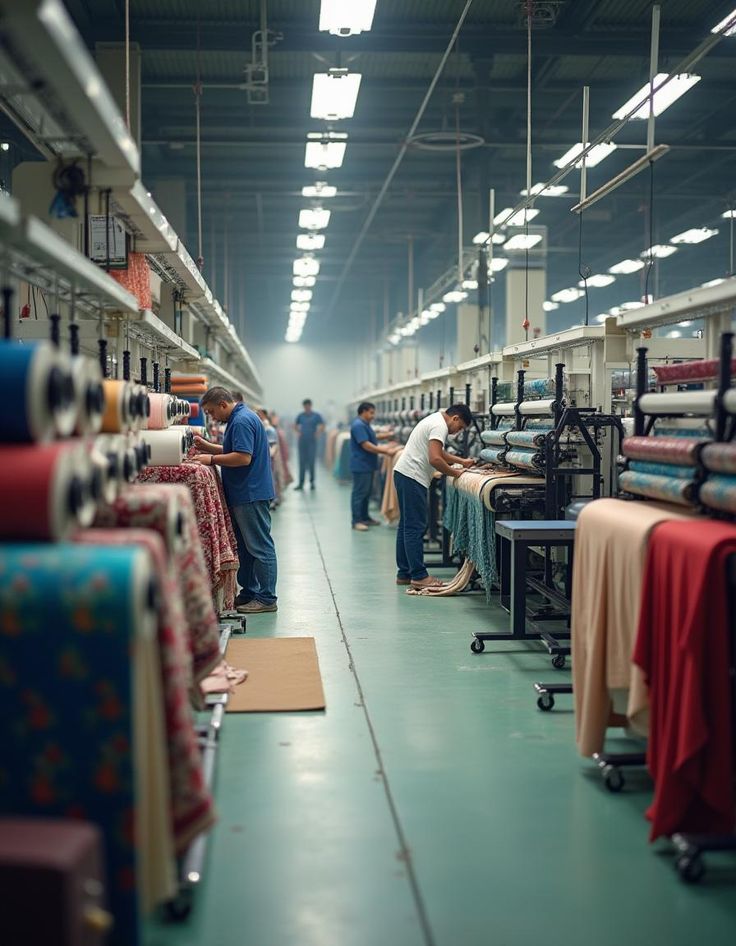

I spent three days last month sitting in a saree wholesaler’s office in Varanasi, watching his accountant flip through a register the size of a phone book. Every order was handwritten. Every stock count was a guess until someone physically walked to the godown and counted bundles.
That’s when it hit me – most saree and fabric traders aren’t losing money because business is slow. They’re losing it because nobody can find anything fast enough.
This is exactly the gap that ERP software for saree wholesalers is built to close. Not fancy dashboards for the sake of looking modern. Just a system that knows what you have, what you sold, and what you owe – the second you need to know it.
Why Sarees Are Different From Every Other Textile Category
Anyone who’s traded in sarees knows this business breaks every rule that works for plain fabric.
A single saree can have five variants stacked on top of each other – design, border type, blouse piece, zari content, and length. A Kanjeevaram silk and a Banarasi georgette aren’t the same SKU even if they’re priced identically. Try managing that on Excel and you’ll spend more time fixing formula errors than actually selling.
Generic accounting tools weren’t designed for this kind of layered inventory. That’s precisely why textile ERP software for saree & fabric wholesalers exists as its own category, separate from standard retail or manufacturing ERPs.
The Real Cost of Manual Tracking
Here’s a number that surprised even me. A mid-sized saree wholesaler in Surat we spoke with was doing roughly Rs.40 lakh in monthly sales, but couldn’t tell us – without a physical count – how many pieces of a specific Paithani design were sitting unsold.
His stock reconciliation took two full days, every single month. Two working days, every month, spent counting instead of selling. That’s 24 working days a year lost to a problem software solves in under a minute.
What Actually Matters in a Saree-Specific ERP
Not every ERP claiming to serve textile traders actually understands sarees. Here’s what separates the ones that do from the ones that don’t.
1. Design and lot-wise tracking – You need to search stock by design code, lot number, shade, and fabric type – together, not one at a time.
2. WhatsApp-first order booking – Most saree orders in India still come through WhatsApp voice notes and photos. A system that can’t convert that into a proper order entry is just extra software you’ll abandon in three weeks.
3. Multi-branch and godown sync – Traders with a shop in Surat and a godown in Bhiwandi need real-time stock visibility across both, not end-of-day syncing.
4. GST-ready billing – E-invoicing and GST returns shouldn’t be a separate headache bolted onto your billing.
5. Credit and payment tracking – Saree wholesale runs heavily on credit cycles. Knowing who owes what, and for how long, prevents the slow bleed of unpaid dues.
This is the checklist we used when building out Wortal’s textile-specific modules, because a wholesale textile ERP software that ignores even one of these ends up half-used within a quarter.
Book a Free Demo
See how Wortal can simplify your business and help you close more deals.


A Real Example: How One Trader Cut Order Errors by Half
Let me walk through the Surat trader’s actual numbers, because vague success stories help nobody.
Before switching systems, his team was logging around 18-20 wrong dispatches a month – wrong design, wrong quantity, wrong buyer. Each mistake meant a return shipment, a frustrated retailer, and roughly Rs.800-1200 in reverse logistics cost per incident.
After moving his order booking onto a structured system with design-wise stock visibility, that number dropped to 8-9 errors a month within the first 60 days. Not zero – nothing’s perfect – but close to a 50% cut.
Multiply that across a year and you’re looking at savings north of Rs.1 lakh, just from fewer wrong dispatches. That’s before you even count the time his staff got back.
Comparing Your Options: What Actually Fits a Saree Business
Numbers here reflect typical small business software pricing in India as of 2026; always confirm current rates directly.
The middle two columns aren’t bad tools. They’re just not built for the specific mess that saree inventory creates. That gap is why so many traders quietly go back to registers after a failed generic ERP rollout.
Choosing the Best ERP for Saree Traders: A Practical Filter
Skip the sales pitch and ask these questions instead when you’re evaluating any system:
- Can it search stock by design code within 3 seconds?
- Does it work on a basic Android phone, or does it need a desktop every time?
- Can your staff learn it in a day without a training manual?
- Does it handle partial payments and credit notes the way saree trade actually works?
- Is customer support available in Hindi or Gujarati, not just English?
If a vendor can’t answer these clearly, you’ve found the best ERP for saree traders by process of elimination – it’s whichever one actually answers yes to all five.
Why Smaller Traders Hesitate – And Why That’s a Mistake
I get pushback often from traders doing Rs.10-15 lakh a month who think ERP software for saree wholesalers is only for the big players.
That thinking cost one Bhiwandi-based trader nearly Rs.3 lakh in a single festive season. He oversold a design that was actually out of stock in two different branches, because his teams weren’t syncing manually maintained sheets fast enough.
Scale doesn’t determine whether you need this. Complexity does. And saree inventory is complex at any size.
Where Wortal Fits Into This Picture
We built Wortal’s textile modules after sitting through exactly these conversations, in exactly these godowns, with traders who’d tried and abandoned three other systems before us.
It’s not the only textile ERP software for saree & fabric wholesalers out there. But it was built specifically around Indian trading patterns – WhatsApp-first communication, credit-heavy sales cycles, and design-level SKU chaos – rather than adapted from a generic global template.
Pricing sits at Rs.200-350 per user monthly, with a free trial period to test it against your actual stock, not a demo dataset. For a trader spending two days a month on manual reconciliation, that cost pays for itself before the first invoice cycle ends.