

Walk into any textile unit in Surat, Bhiwandi, or Ludhiana and ask the owner how they track inventory. Nine times out of ten, you’ll hear “Excel” or “bahi khata, but digital now.” That’s the honest state of textile manufacturing in India right now. Everyone knows they need software. Almost nobody knows which one.
I’ve spent enough time around textile trade offices to know the real problem isn’t a lack of options. It’s that most textile erp software gets built for generic manufacturing and then gets a textile label slapped on it. The result? Fields that don’t match how a saree unit actually counts stock, or how a job-work order flows between three different karigars before it comes back finished.
This comparison isn’t going to give you a generic “top 10” list copied from a G2 page. It’s built around what actually matters when you’re running a dyeing unit, a powerloom shed, or a trading firm juggling grey fabric and finished goods at the same time.
Why textile businesses need something different from regular ERP
Here’s what actually matters: textile manufacturing doesn’t move in straight lines like most factories do.
A roll of fabric might leave your warehouse as grey cloth, come back as dyed cloth, leave again for printing, and return for finishing – all before it’s technically “your” finished product ready to sell. A regular ERP built for, say, an auto parts company has no idea what to do with that. It wants one product, one BOM, one clean production run.
Most people ignore this part until they’re three months into implementation and stuck. Textile production involves:
- Job work tracking – fabric that leaves your premises and comes back transformed
- Lot and batch-wise costing – because dye lots and yarn counts vary batch to batch
- Multiple units of measurement – meters, kilograms, pieces, sometimes all for the same product at different stages
- Wastage and shrinkage calculation – grey fabric shrinks after processing, and if your system doesn’t account for it, your costing is wrong from day one
If the ERP you’re evaluating doesn’t handle these natively, you’ll end up building workarounds in Excel anyway – which defeats the point of buying software.
Book a Free Demo
See how Wortal can simplify your business and help you close more deals.


What to actually look for in the best textile ERP software
Before comparing specific tools, here’s the checklist I’d use if I were sitting across the table from a vendor.
1. Job work and outsourcing management
If any part of your production – dyeing, printing, embroidery – happens outside your factory, your ERP needs a proper job work module. Not a hacked-together “purchase order” that pretends outsourced work is a regular vendor transaction.
2. Inventory that understands textile units
Look for support for meters, kgs, pieces, and conversion between them at different production stages. A good system should let you buy yarn in kg and sell fabric in meters without you doing manual math in a notebook on the side.
3. Costing that includes process losses
The best textile erp software options build wastage percentages directly into their costing engine. If a system just multiplies raw material cost by quantity without factoring in shrinkage, your margins on paper will look better than your actual margins.
4. GST and compliance built for Indian trade
E-way bills, HSN codes specific to textile categories, and GST returns that actually match how textile traders invoice – this isn’t optional in India. It’s table stakes.
5. Simple enough that your floor staff will use it
This one gets ignored constantly. I’ve seen units spend lakhs on ERP implementation only to have the actual weavers and supervisors keep maintaining a parallel paper register because the software felt like too much friction. Adoption matters more than feature count.
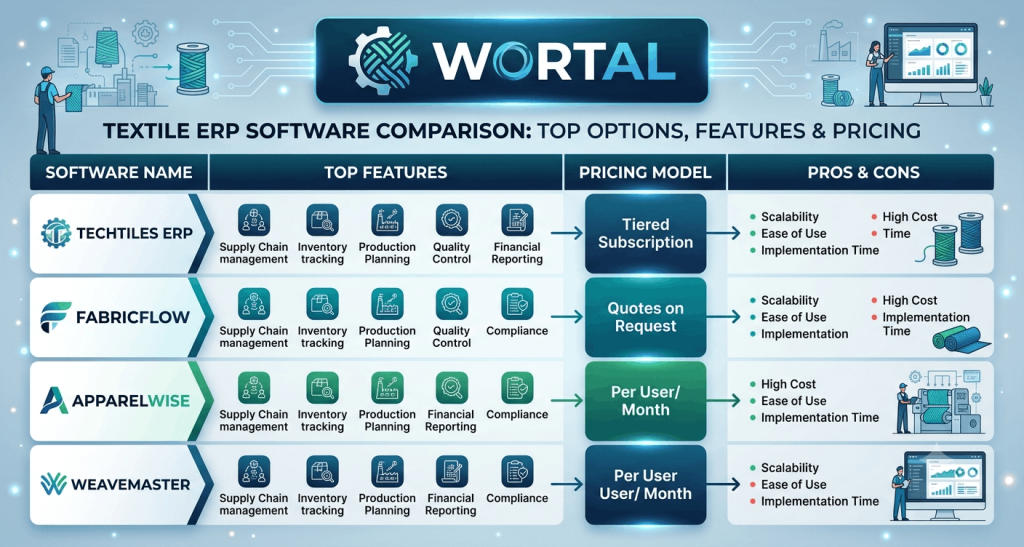
Comparing the top textile ERP software options
Here’s how the major players stack up on the things that matter for a textile business specifically.
| ERP | Best suited for | Job work module | Learning curve | Approx. starting price (Rs./user/month) |
|---|---|---|---|---|
| Wortal | SMB textile traders and small manufacturers | Yes, built for outsourced dyeing/printing | Low | Rs.200 (Standard) |
| TYASuite | Mid-size manufacturers wanting full ERP suite | Yes | Medium-high | Custom quote |
| Marg ERP | Textile traders needing billing + inventory | Limited | Low | Rs.150-300 range |
| SAP Business One (textile add-ons) | Large exporters, integrated units | Yes, via customization | High | Enterprise pricing, often 5-6 figures annually |
| BUSY Textile | Small traders wanting accounting-first ERP | Basic | Low | Rs.200-400 range |
A quick note on that last column – textile erp software pricing varies wildly depending on how many users you have, whether you need on-premise or cloud, and how much customization your process demands. A five-person unit doing job work for three vendors has a completely different pricing conversation than a fifty-machine powerloom operation exporting to Bangladesh.
Here’s a visual breakdown of where these options land on price versus how deep their job work handling actually goes:
Textile ERP — Approx. Starting Price
Rs. per user / month (log scale)
TYASuite is quote-based, so no bar is shown. SAP figure is an approximate entry point for textile-customized Business One deployments.
The log scale makes the gap obvious. SAP-level ERPs sit in a different universe entirely from SMB-focused textile erp software – which is exactly why so many small and mid-size textile units end up over-buying and under-using enterprise systems.
Deep dive: how the leading options actually perform
Let’s go one level deeper than the table, because pricing alone doesn’t tell you if a tool fits your workflow.
Wortal
Built specifically with Indian SMB manufacturing and trading in mind, including textile. What stands out is the CRM-plus-inventory combination – lead tracking, order management, and stock control sitting in one place instead of stitched together from three tools. For a Surat-based fabric trader juggling WhatsApp orders, IndiaMART leads, and godown stock simultaneously, that combination removes a genuine daily headache. Standard plan starts around Rs.200 per user per month, Premium around Rs.350 – which keeps textile erp software pricing predictable for a small team instead of ballooning with “implementation fees” that enterprise vendors love to add later.
TYASuite
A broader ERP play with genuine manufacturing depth, including procurement and job work modules. Good fit if you’re scaling past 50 employees and need finance integration alongside production. The learning curve is real, though – expect a proper onboarding phase, not a plug-and-play setup.
Marg ERP
Strong on billing and GST compliance, weaker on deep job work tracking. Works well for traders who mostly need invoicing, inventory, and tax filing sorted, without heavy production-side complexity.
SAP Business One
The real issue here isn’t capability – SAP can do almost anything with the right customization. The issue is cost and time. Implementation often takes months, and you’ll likely need a consultant on retainer. Makes sense for large exporters with dedicated IT staff. Doesn’t make sense for a 15-machine unit trying to digitize this quarter.
BUSY Textile
Accounting-first, with textile-specific inventory added on. If your core need is GST-compliant billing with basic stock tracking, this does the job without overwhelming a small team.
Practical scenario: choosing between two systems
Say you run a mid-size dyeing and processing unit – 30 workers, three job-work partners, and a warehouse that handles both grey and finished fabric. You’re stuck between a job-work-focused textile erp software and a general accounting-plus-inventory tool.
Here’s the test I’d apply: open the job work module of each and ask it to track a fabric roll that leaves for dyeing today and returns in eight days. If the system makes you create three separate manual entries and reconcile them yourself, that’s a system built for retail, not production. If it tracks the roll as one continuous record with automatic status updates, that’s built for what you actually do.
This single test eliminates half the shortlist immediately.
Key takeaways before you sign anything
- Don’t buy on feature count. Buy on whether job work and lot-wise costing are handled natively, not bolted on.
- Get a real demo with your own data, not the vendor’s sample dataset. Sample data always looks clean.
- Check GST and e-way bill compliance specifically for textile HSN codes before assuming it’s covered.
- Talk to floor staff before finalizing. If they find it harder than their current paper process, adoption will quietly fail.
- Compare textile erp software pricing on a per-user, per-month basis over 12 months, not just the headline monthly figure – some vendors add setup and training costs that double year-one spend.
A real case: what happened when a Surat unit switched systems

A small saree processing unit in Surat – around 25 workers, two outsourced dyeing partners – was running everything through separate Excel sheets and a WhatsApp group for order updates. Their biggest pain wasn’t stock counting. It was knowing which lot was with which job-work partner on any given day, and whether that lot was even profitable once dyeing costs and wastage got factored in.
They moved to a system with a proper job-work and lead tracking module. The change wasn’t dramatic on day one – nobody’s factory transforms overnight. But within two months, the owner could see, for the first time, which of his job-work partners consistently returned fabric late and which lots were quietly losing margin due to shrinkage he’d never actually calculated before.
That’s not a flashy outcome. It’s the kind of visibility that changes how you negotiate rates and choose partners going forward – and it only came from software that understood textile production instead of treating fabric like any other SKU.
Frequently Asked Questions
Straight answers, no sales pitch.