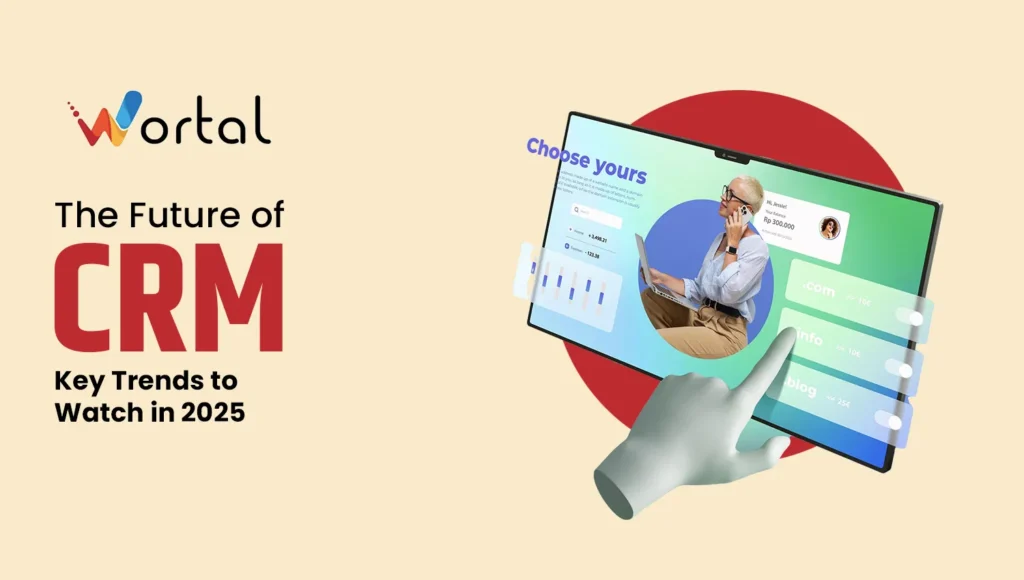

Customer relationship management is now a staple for any kind of business. This helps businesses track interactions, manage pipelines, and enhance customer service. In short, it has become the backbone of the success of a modern business. CRM streamlines interactions, manages pipelines, and creates a stronger relationship.
It enables businesses to succeed in the highly competitive world of today, but its future is not fixed. Instead, it keeps changing because it adapts to the changing technological trends.
However, with the changing trend of technology, CRM also will change. In this blog post, some trends will be discussed that will influence the future of CRM in 2025.
Key Trends to be seen in 2025 and beyond:
1. AI-Powered CRM
The application of artificial intelligence in CRM systems is already in progress, and this will be enhanced in coming years. AI can automatically do lead scoring, data entry, and customer service. CRM innovations can also be used to provide real-time insights into customer behavior for sales reps, which helps them close deals effectively.
For instance, AI-powered CRMs can use NLP to analyze customer interactions and determine the possible issues that might arise. Through machine learning, AI-powered CRMs can predict when customers will churn and make recommendations on what action to take.
Artificial intelligence is no longer just an imagination, but an ever-changing entity transforming the face of CRM. Future CRMs realise that AI holds massive power in automating mundane work and delivering profound insights about the customers.
In the future, we envision a CRM system in the following manner with respect to AI integration.
Key features:
- Smart Lead Scoring: AI will scan multiple data points to give a lead score, which may be considered the likelihood of buying. Thus, sales reps can focus more on high-scoring leads and improve outreach efficiency.
- Predictive Analytics: Using machine learning algorithms, the CRM will predict customers’ behavior about purchases and potential churn. That means the organization can fine-tune marketing efforts, personalize their interactions, and proactively fix issues before they happen.
- Intelligent Chatbots: AI-powered chatbots will seamlessly integrate within the CRM, providing 24/7 customer support and deflecting simple inquiries, freeing up human agents for more complex interactions.
2. The Rise of Social CRM
Social media is turning into a good source for connecting businesses with the customers. Through social media, it tracks customer conversations. It begins by responding to questions in the mood by the customer concerning the brand and creating leads.
For the future Scope of Social CRM, Social CRM will continue to become highly integrated with the traditional CRM system. Thus, businesses can achieve a comprehensive view of customers by interacting in various ways.
Customer communication is the undeniable power of social media. Social CRM helps businesses monitor and manage all their customer interactions from different media outlets.
Social Media Listening:
Social listening, or social media listening, means looking at online conversations about your brand and industry to understand your audience better. This involves monitoring your social media platforms to catch when people talk about your brand or give feedback.
There is an enormous scope for social listening through the CRM. It will bridge the gap between social media and traditional CRM functionality. The areas include –
i) Unified Social Inbox: All interactions on social media will be put together in a central hub in the CRM. Discussions can be dealt with smoothly across platforms for businesses.
ii) Advanced Sentiment Analysis: CRM will use artificial intelligence to analyze conversations on social media and focus on the sentiments related to messaging. Clients can spot trends and understand market expectations for their brands.
The CRM will collect leads from social media and automatically enter them into the system, which will save time in selling to prospects.
3. Customer Experience Focus End
Customer experience is now the talk of the day in this competitive business world of today. Indeed, good customer experience offers a route by which businesses can track their customers’ touch points as an avenue for improvement in certain aspects.
Expectations on CRM systems in the future, customer experience will have more emphasis than before, through features such as customer journey mapping, sentiment analysis, and customer feedback management.
Delivers the best possible customer experience in today’s extremely competitive environment. CRM believes that personalisation is the most powerful force in the marketplace and will arm the business with the tools to create a customer journey that is truly unique and individualized to the customer.
AI-powered Recommendation Engines: The CRM will use AI to suggest products, services, and content to individual customers, taking into account past behavior and preferences.
Connecting with CDPs: It will connect the CRM with new CDPs (Customer data platforms) so that it enables an integrated view of customer involvement across all channels. Such a comprehensive dataset will power very highly personalised marketing campaigns and customer experiences.
Customer Journey Mapping Tools: It will provide visual customer journey maps so that businesses can view potential pain points and tailor experiences across all touchpoints.
4. Internet of Things (IoT) Data Integration
The term IoT stands for networked devices that have some physical components surrounded with sensors and software that allow these devices to collect and exchange data. An IoT can, therefore, form an excellent data source for organizations. The future CRM technology 2025, can further aid in following customer behavior to spot trends and make prognoses of needs in consumers regarding product usage.
In the future, CRM systems will be integrated with IoT data. It will give businesses a comprehensive view of their customers and interaction with the business.
5. Cloud-Based CRM Growth
Cloud-based CRM systems are becoming popular due to user-friendliness and scalability. Cloud-based access to CRM data also allows businesses to access their data from anywhere, at any time.
In the near future, cloud-based CRM is most likely to prevail as the widely used deployment model. Cloud-based CRM systems compared to traditional CRM systems deployed onsite have various merits, and it includes lower values of costs, fully scalable, and easy integration with other business applications used by a business.
Here are some of the other CRM 2025 trends:
- Use of blockchain technology in CRM:
Blockchain is a distributed ledger technology which allows secure storage and tracking of data. In the future, blockchain can be used to improve security and transparency about CRM data.
- Making Powerful Technology Accessible
Specific CRM solutions have been developed with attention to specific industries. Solutions are designed for a particular industry with the needs.
Not only for big firms, CRM solutions are in vogue. The use of CRM is increasingly amongst the small and medium-sized businesses (SMBs) as more organizations score competitive advantage through the same. This is how the CRM technology is accessible to all.
i) Intuitive User Interface : The CRM will be oriented to an interface that is user-friendly and simple to navigate for any user regardless of his technical acumen.
ii) Flexible Pricing Plan: We believe that business houses need different pricing as their requirements vary and budget. The CRM shall offer multiple types of pricing options to fit in all.
iii) Comprehensive Training and Support: The CRM would provide complete training and continuous support to ensure businesses can unlock the potential of the entire CRM system.
- Data Privacy:
As data privacy laws are getting stringent, the requirement for CRM systems to be in line with such needs will rise. As data privacy regulations are becoming more rigid and strict, CRM vendors need to be focused on data security and compliance. It takes data privacy very seriously and is planning to implement the following measures:
i) Robust Data Security: High-end security protocols to safeguard customers’ data against unauthorized access or cyber-attacks shall be adopted.
ii) Compliance to Regulations: All relevant data protection regulations, for example, General Data Protection Regulation, shall be complied with in the CRM.
iii) Customer Data Control: The business shall have control over its data and what is being utilised in the CRM system.
Conclusion:
The future of CRM is very bright. CRM systems and Customer management are becoming stronger and more technologically advanced and will continue to be incorporated with more types of technologies. This will let businesses understand customers better and their relationships.
Further, one cannot underrate the importance of CRM in organisations at all levels. It remains one of the best ways in which businesses and companies can improve their relationship-building with customers when updated on the latest CRM trends.