

Last month, a textile trader from Surat’s Ring Road market called me in a mild panic. A vendor had quoted him Rs.4 lakh a year for ERP software. His neighbour, running a similar-sized unit, was paying Rs.18,000 a year for what looked like the exact same thing on the sales pitch. Same promises. Same buzzwords. Ten times the price difference.
That gap is not a mistake. It’s the textile ERP market in India right now, and almost nobody explains why it exists.
If you’re a mill owner, a fabric trader, or someone running a garment export unit and you’ve been quoted three wildly different numbers for textile ERP software, this is for you. I’m going to break down what actually drives ERP software pricing India wide, and what number you should be comfortable signing off on.
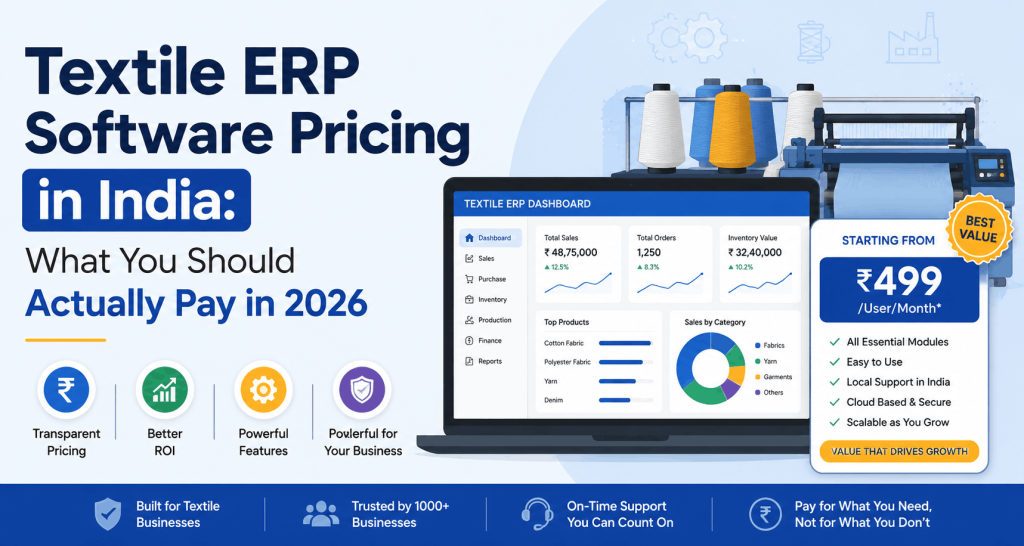
Here’s a chart showing how textile ERP pricing actually breaks down across categories in India right now:

Prices are typical per-user, per-month rates seen across Indian textile ERP vendors in 2026, GST not included
Why textile ERP pricing swings so wildly
Most buyers assume ERP pricing works like a SaaS subscription – flat, predictable, comparable across vendors. It doesn’t, not in this industry.
Textile ERP software in India gets priced on four things that have nothing to do with the software itself:
- How many modules you actually turn on (inventory alone vs inventory + payroll + job work tracking)
- Whether the vendor is quoting per-user or per-company
- If there’s custom development involved (most textile units need at least some)
- Whether support is bundled or billed separately
Here’s what actually matters: two vendors can sell you “the same” ERP, and one includes GST reconciliation and job-work costing baked in, while the other charges those as add-ons later. The base quote looked identical. The real bill wasn’t.
What you should actually be paying, tier by tier
I’ve worked with enough textile units – powerloom owners in Bhiwandi, saree wholesalers in Surat, garment exporters in Tirupur – to have a rough, honest sense of fair pricing. Not vendor-fed numbers. Actual market rates.
Small units (under 20 employees)
If you’re a single-location trader or a small manufacturing unit, you don’t need enterprise machinery. You need billing, basic inventory, and maybe WhatsApp-based order tracking.
Fair range: Rs.150-Rs.350 per user, per month.
Anything above Rs.500 per user at this scale usually means you’re paying for features you’ll never touch – multi-branch accounting, advanced BI dashboards, API access you have no developer to use.
Mid-sized units (20-100 employees, multiple godowns or branches)
This is where most Surat and Bhiwandi textile businesses actually sit. You need proper inventory across godowns, lead and order management, employee tracking, and some form of CRM because your sales team is juggling fifty WhatsApp threads a day.
Fair range: Rs.300-Rs.600 per user, per month.
This is also where textile ERP software earns its cost. A godown tracking module that catches stock discrepancies before your Diwali stock-count nightmare pays for itself in one season.
Book a Free Demo
See how Wortal can simplify your business and help you close more deals.


Large manufacturing or export units
Multiple production lines, compliance-heavy exports, job-work tracking across dozens of vendors, integration with accounting software – this tier genuinely needs custom configuration.
Fair range: Rs.800-Rs.2,500 per user, per month, sometimes with a separate implementation fee.
Most people ignore this part: implementation and onboarding cost should be quoted separately from monthly licensing. If a vendor bundles both into one number with no breakdown, ask them to split it. You need to know what you’re paying to switch on the software versus what you’re paying to keep using it.
The three pricing traps nobody warns you about
1. The “per module” drip
A vendor quotes Rs.250/user/month. Sounds great. Six months in, you realise inventory management, WhatsApp automation, and reporting are all separate add-ons at Rs.100 each. Your real bill is now Rs.450, not Rs.250.
Ask for the full module list and full pricing on day one, in writing.
2. The annual lock-in discount
Vendors love pushing annual contracts with a “20% off” sticker. That’s fine if you’ve actually used the software for a month first. I’ve seen textile units lock into a year, discover the CRM doesn’t sync with their existing WhatsApp workflow, and be stuck.
In practical terms – always negotiate a one-month trial before committing to annual ERP software pricing India vendors quote you.
3. Hidden data migration cost
Moving your existing customer data, stock records, and past invoices into a new system isn’t free labour on the vendor’s side, even when the sales rep implies it is. Ask directly: “What does migrating my current Excel/Tally data cost?” Get it in writing before signing.
A real example: what changed for a Surat textile trader

Rahul runs a sari wholesaling operation out of Surat, dealing with roughly 40 retail buyers across Gujarat and Rajasthan. Before switching software, his team tracked leads on WhatsApp and Excel – no visibility into who followed up on what, orders slipping through cracks during peak wedding season.
He moved to a CRM-based system with lead management, inventory tracking by godown, and WhatsApp automation built in – landing in that Rs.300-Rs.400 per user range I mentioned above for mid-sized units. Within two months, his team stopped losing track of pending orders during the festive rush, and he could finally see which retailer hadn’t reordered in 60 days without manually scrolling chat history.
The cost wasn’t the differentiator. The fit was. He’d have paid the same or more for an enterprise system with modules he’d never open.
This is where Wortal fits into that mid-tier bracket well – it’s built specifically around Indian SMB workflows like this, with lead management, godown-level inventory, and WhatsApp automation as core features rather than paid add-ons, priced at Rs.200-Rs.350 per user per month depending on the plan.
Key takeaways before you sign anything
- Don’t compare quotes on the headline number alone – compare on modules included per rupee
- Per-user pricing beats flat pricing once your team crosses 15-20 people
- Implementation and migration costs should always be itemised separately
- A one-month trial is non-negotiable, no matter how good the annual discount sounds
- The right textile ERP software for a 15-person unit and a 150-person export house are never the same product at different price points – they’re different products entirely
That’s where things usually go wrong: businesses buy the ERP their competitor uses, at whatever price their competitor pays, without checking if their operation actually needs the same modules.
Is GST included in ERP software pricing quotes in India?
Almost never. Most vendors quote base pricing and add 18% GST separately. Always ask for the final, GST-inclusive number before comparing across vendors.
Can I negotiate ERP pricing, or is it fixed?
You can, especially for annual contracts or teams above 20 users. Vendors have more room to move than they initially show – ask for a demo period and use it as leverage.
Do I need a custom-built ERP, or is off-the-shelf enough?
For most small and mid-sized textile businesses, off-the-shelf CRM-and-inventory software covers 90% of daily needs. Custom builds only make sense once you’re running complex multi-unit manufacturing with unique compliance needs.
How long does it take to actually see returns on ERP software cost?
Based on what I’ve seen with textile clients, most units notice reduced order-tracking chaos and fewer stock mismatches within the first 60-90 days, assuming the team actually adopts it instead of running parallel Excel sheets.