

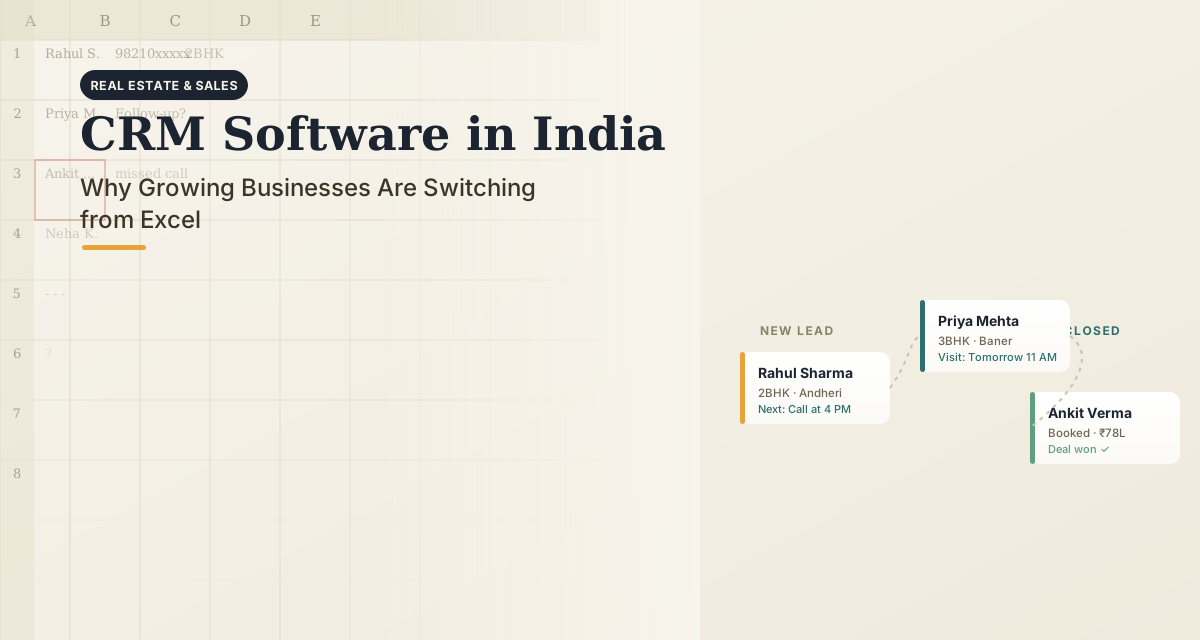

Think about your sales team’s daily routine. If they are like most growing Indian businesses, the morning starts with opening a massive spreadsheet.
There are rows for leads from the latest IndiaMART export, columns for follow-up dates, and color-coded cells meant to show who is “hot” or “cold.” It feels organized until an executive accidentally overwrites a formula, or two sales reps call the same client in Mumbai because both pasted the same lead into different tabs.
Excel is the undisputed default operating system for early-stage companies. It is free, completely customizable, and requires zero training. But as your team expands beyond three people and your lead volume crosses a few hundred a month, that trusted spreadsheet transforms into a silent growth killer.
The real issue is that spreadsheets were built to analyze static numerical data, not to manage dynamic, moving human relationships.
Across Delhi, Bangalore, Mumbai, and beyond, mid-market enterprises are hitting a wall where chaotic manual tracking stalls revenue. This reality explains why founders are actively moving away from sheets and searching for the best CRM software in India to restore sanity to their operations.
The True Cost of Managing Sales on Spreadsheets
Most people ignore this part: the cost of sticking with Excel isn’t calculated in subscription fees, but in leaked revenue and dropped balls.
When a company relies on manual entry, three fundamental breakdowns occur regularly.
1. The Invisible Lead Leakage
In a manual setup, a lead lands via a Meta ad or a website contact form. Someone has to copy that data and paste it into a row.
If your sales head is traveling or tied up in a long client meeting, that lead sits in limbo for six hours. In modern sales, a six-hour delay means the prospect has already moved on to three competitors.
A dedicated sales CRM software in India solves this by instantly pulling leads from your website, WhatsApp Business API, and listing portals into a centralized workspace without a single manual click.
2. Zero Accountability for Remote Teams
If your sales field executives are spread across regions like Gujarat, Maharashtra, or Karnataka, tracking their actual activity via shared sheets is nearly impossible.
You are left guessing. Did they actually pitch to that distributor, or did they just update the status to “Follow-up next week”?
Without structured activity logs, call recording integrations, and clear task assignments, your sales pipeline is essentially a black box.
3. The Nightmare of Data Ownership
What happens when a senior sales representative decides to leave your company to join a direct competitor?
If your data lives in local files or open Google Sheets, they can download your entire historical customer database with two clicks.
Transitioning to structured database applications keeps your intellectual property secure. You control access permissions, meaning employees only see the data required for their specific roles, preventing mass data extraction.
Book a Free Demo
See how Wortal can simplify your business and help you close more deals.


Why Growing Indian SMEs Face Unique Sales Challenges
The Indian business landscape functions differently than Western markets. The B2B sales cycle here relies heavily on deep personal relationships, continuous follow-ups, multi-channel communication, and fast turnarounds.
[Customer Inquiry]
├─► WhatsApp (Preferred for quick quotes & trust building)
├─► Phone Calls (Crucial for negotiation)
└─► Email (Used formally for POs and invoices)
Managing this multi-channel reality inside a flat spreadsheet is incredibly messy.
In practical terms, an Indian business development executive spends half their day toggling between WhatsApp Web, their phone logs, their personal email account, and a master tracking spreadsheet.
Important context gets lost in translation. A prospect might request a price revision on WhatsApp, but because that conversation happened on an employee’s personal phone, the management team has no visibility into the deal’s actual status.
Furthermore, the domestic market is highly price-conscious and competitive. If your team takes two days to generate a formal quotation because they have to manually calculate margins on an old Excel sheet, a more agile competitor utilizing local CRM software in India will send a professional digital quote within twenty minutes and secure the purchase order.
Key Differences: Excel vs. Professional Sales Workflows
| Operational Capability | Excel / Shared Spreadsheets | Professional Sales CRM |
|---|---|---|
| Lead Capture | Manual copying, typing, and pasting | Automatic integration via APIs and webhooks |
| Communication History | Scattered across personal phones and email inboxes | Unified chronological timeline of every customer interaction |
| Follow-up Reminders | Manual calendars or color-coded spreadsheet cells | Automated reminders, alerts, and push notifications |
| Data Security | Easy to copy, download, modify, or accidentally delete data | Role-based permissions with audit trails and secure access control |
| Analytics & Forecasting | Complex formulas that frequently break and require manual updates | Real-time dashboards and instant sales forecasting with live reports |
Real-Life Case Study: From Spreadsheet Chaos to Organized Scale

Let’s look at a concrete example from a manufacturing hub in Pune. A company specializing in custom industrial packaging components grew its sales team from two representatives to nine over an eighteen-month period.
That’s where things usually go wrong.
The founders used a master Google Sheet to manage their entire sales pipeline. Each representative had an individual tab, and the managing director spent every Saturday evening manually copying rows to build a consolidated pipeline view for the upcoming Monday review meeting.
The operational cracks showed up quickly:
- Duplicate Effort: Two reps accidentally pitched to different divisions of the same corporate client in Chennai, causing internal confusion and project delays.
- Lost Documentation: Technical drawings and custom quotation files were saved across random Google Drive links, often attached to the wrong rows.
- Delayed Follow-ups: Hot inquiries received at trade exhibitions sat unaddressed for days because the physical papers hadn’t been typed into the system yet.
The turning point came when they missed a major renewal contract simply because the row containing the client’s expiry date was accidentally filtered out during an internal audit.
The company transitioned its entire workflow to a specialized sales CRM software in India designed to handle complex business pipelines.
They integrated their team’s email interactions, set up automatic reminders for contract renewals, and moved their custom quotation generation inside the system.
The Quantifiable Business Impact
Within four months of dropping manual sheets, the company’s operational visibility transformed completely:
- Pune Manufacturing Firm – Business Metrics Over 4 Months:
- Response Time to Inquiries – Decreased from 14 hours to 22 minutes
- Missed Follow-ups – Dropped to near zero
- Overall Sales Conversion Rate – Increased by 26%
- Executive Pipeline Reviews – Cut from 4 hours to a 15-minute sync
The leadership team no longer had to spend weekends cleaning up data. Instead, they opened a live dashboard on their phones to check accurate monthly revenue forecasts based on concrete deal stages.
How to Choose the Right Platform for Your Team
When you begin searching for the best CRM software in India, it is easy to get overwhelmed by complex, expensive enterprise platforms built for multi-national corporations.
These massive software packages often fail for mid-market businesses because they are too complicated for average users, requiring months of custom engineering and extensive staff training.
Here’s what actually matters when evaluating a tool for your business:
- An Intuitive User Interface: If the software requires a 100-page manual to understand, your sales team will quietly abandon it and slip back to using personal notes and local sheets. Choose a platform where a new user can log a lead and schedule a follow-up task on day one without technical assistance.
- Deep Mobile Functionality: Indian sales professionals are frequently on the move, meeting distributors, visiting factory sites, or traveling for client pitches. The tool you select must have a reliable mobile application that lets field agents log call notes, update deal stages, and view client history while on the road.
- Localized Integration Capabilities: Ensure the system connects with the business communication tools you use daily, such as official WhatsApp accounts, local SMS gateways, and popular Indian lead generation portals like IndiaMART and TradeIndia.
- Scalable, transparent pricing: Avoid complex vendor contracts with hidden customization fees. Look for platforms like our product, Wortal, which offers clear feature sets and straightforward implementation costs designed to scale alongside your business growth.
Key Takeaways for a Smooth Transition
Moving away from spreadsheets doesn’t have to be an all-or-nothing operational headache. You can manage the shift systematically to ensure your team adopts the new system without disrupting daily operations.
- Audit and Clean Your Existing Data: Do not import years of messy, unverified rows into your clean new system. Use the transition as an opportunity to archive dead leads, correct formatting errors, and verify active contact numbers.
- Run a Focused Pilot Group: Instead of moving your entire workforce over on a single morning, introduce the tool to two of your most digitally active sales representatives first. Let them run their daily processes inside the system for two weeks, work out any workflow kinks, and share their practical successes with the wider team.
- Make the System Your Single Source of Truth: Once the transition phase is complete, enforce a strict operational rule: if an interaction, follow-up, or deal closed isn’t logged inside the platform, it officially does not exist. Tie your weekly sales performance metrics and incentive calculations directly to the reports generated by your system.
Sticking with spreadsheets might feel safe because it is familiar, but it ultimately caps your company’s growth potential.
Investing in a robust, localized CRM software in India provides your organization with the structured foundation needed to scale your operations, build institutional memory, and close deals efficiently.
Frequently Asked Questions
Common questions from teams evaluating a move from spreadsheets to a dedicated CRM platform.
Is it difficult to migrate our old data from Excel into a professional system?
How long does it typically take for a sales team to adapt to a new platform?
Can a dedicated system help us manage field agents across different cities?
Wortal CRM Bot
⚡ Powered by Meta APIStart your business automation journey with Wortal CRM
Book a free demo and discover how Wortal CRM simplifies your business