

Here’s a number that should worry every business owner buying leads on IndiaMART: nearly 35-40% of buyer inquiries go cold within the first hour. Not because the product was wrong. Not because the price was too high. Just because nobody called back in time.
I’ve watched this happen to a hosiery exporter in Tiruppur who was paying close to Rs.80,000 a month for IndiaMART premium listings. Great inquiry volume. Terrible conversions. When we finally dug into it, his sales team was checking IndiaMART leads twice a day – once in the morning, once before closing. By the time they called, the buyer had already spoken to three other suppliers.
That’s the real problem with IndiaMART leads. The platform brings you buyers. It doesn’t manage them. And that gap is exactly where a solid IndiaMART Lead Management System earns its money.
The Actual Problem Isn’t Lead Quality – It’s Lead Speed
Most business owners blame IndiaMART when sales don’t convert. “Leads are fake,” “buyers just window shop,” “nobody replies after getting the quote.” I hear this every week from textile traders and manufacturers in Surat.
But when you look closer, the pattern is almost always the same. Leads arrive on email or the IndiaMART app. Someone has to manually copy details into Excel or WhatsApp. By the time a salesperson picks it up, hours have passed.
Harvard Business Review research (widely cited across B2B sales studies) found that responding to a lead within 5 minutes makes you 21 times more likely to convert it compared to responding after 30 minutes. In the textile and manufacturing world, where buyers are getting quotes from five or six suppliers at once, that math becomes brutal.
This is precisely why an IndiaMART CRM Software setup matters more than people think. It’s not about fancy dashboards. It’s about cutting the time between “buyer inquires” and “salesperson calls.”
How a Proper IndiaMART Lead Management System Actually Works
Let me break down what changes when a business moves from manual tracking to a structured system.
Without a system:
- Lead comes on email
- Staff checks email 2-3 times a day
- Lead gets copied to Excel
- Follow-up depends on memory
- No record of what was promised to the buyer
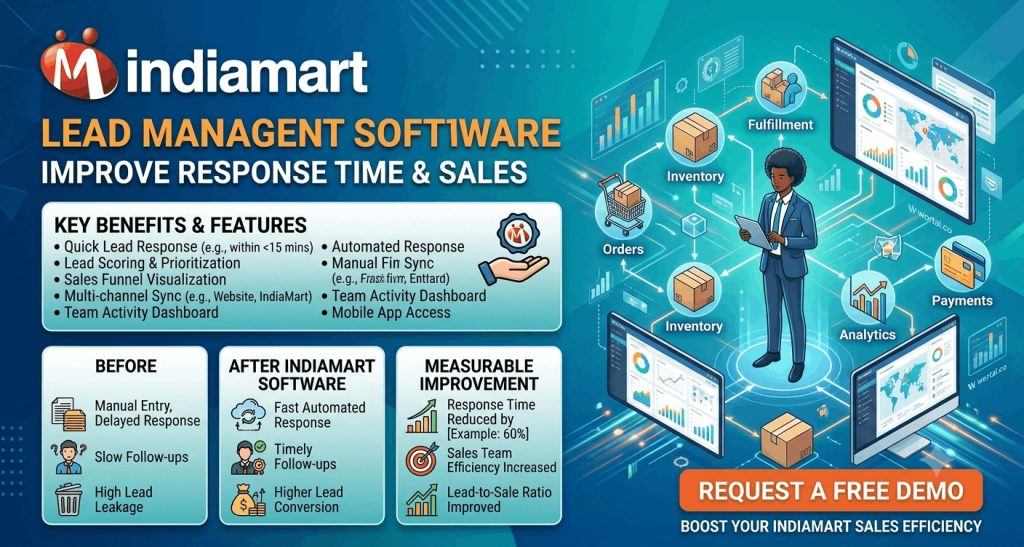
With an IndiaMART Lead Management System:
- Lead syncs automatically the moment it’s generated
- Assigned instantly to the right salesperson
- WhatsApp or call reminder triggers immediately
- Every conversation logged against the lead
- Manager sees pending follow-ups in real time
Here’s a simple way to visualize the difference in response flow:
WITHOUT A SYSTEM:
IndiaMART Inquiry → Email Inbox → Manual Check (hours later) →
Excel Entry → Verbal Handoff → Call (Day 2 or later) → Buyer Gone
WITH A SYSTEM:
IndiaMART Inquiry → Auto-Sync → Instant Assignment →
WhatsApp Alert to Sales Rep → Call within Minutes → Logged Follow-up
That gap in the first flow is where most of your marketing budget quietly disappears.
Book a Free Demo
See how Wortal can simplify your business and help you close more deals.


Why Response Time Is the Real Sales Metric (Not Just Lead Volume)
Most businesses obsess over “how many leads did we get this month.” Almost nobody tracks “how fast did we respond.” That second number matters far more.
Take two suppliers of packaging machinery, both getting roughly 200 IndiaMART inquiries a month. One responds within 10 minutes on average. The other averages 6 hours. The first one converts at nearly double the rate – not because their product is better, but because they show up first.
In practical terms, buyers on IndiaMART aren’t loyal. They’re comparing quotes from multiple sellers in the same session. Whoever picks up the phone first gets the conversation. Whoever calls last gets the leftover attention, if any.
An IndiaMART Lead Follow-up Software solves this by removing the human delay. It doesn’t wait for someone to “remember” to check leads. It pushes the lead the second it lands, flags it as unattended if nobody responds within a set window, and escalates to a manager if needed.
Where Businesses Usually Go Wrong With Lead Follow-Up
Here’s what actually matters and what most people miss.
1. They treat all leads equally. A bulk buyer asking for 500 meters of fabric needs different urgency than someone asking for a sample. A good system lets you tag and prioritize leads by order size or buyer intent, not just by arrival time.
2. They lose the follow-up trail. A salesperson leaves the company, and with them goes every WhatsApp chat and call note about ongoing leads. New hire starts from zero. This alone kills more deals than bad pricing ever does.
3. They don’t track why leads are lost. Was it price? Was it delivery time? Was it because nobody followed up after the third call? Without recording this, you repeat the same mistakes every quarter.
4. They rely on memory instead of reminders. “I’ll call him tomorrow” becomes “I forgot” way too often when there are 40 other leads waiting.
This is where an IndiaMART CRM Software does the heavy lifting – not replacing your sales team, but making sure nothing falls through gaps that memory and Excel sheets can’t cover.
What a Good IndiaMART Integration Should Actually Do
If you’re evaluating tools, don’t get distracted by flashy dashboards. Check for these basics first:
- Auto-sync with IndiaMART so leads don’t sit in an inbox
- Instant WhatsApp or call alerts to the assigned salesperson
- Follow-up reminders that repeat until the lead is closed or marked lost
- Call and chat history attached to each lead permanently
- Manager visibility into pending, ignored, and converted leads
- Reports on response time, not just lead count
Tools like Wortal were built around this exact gap for Indian SMBs – syncing IndiaMART inquiries directly into a pipeline, sending instant alerts, and giving owners a clear view of which leads are aging without a call. It’s one of a few options in this space, alongside CRMs like Zoho and Kylas, but the core idea stays the same across all of them: speed wins deals, not just software.
Real Case: A Surat Textile Trader’s Turnaround

A yarn trading business in Surat was generating around 150 IndiaMART leads monthly. Their close rate was stuck below 8%. The owner assumed it was pricing pressure from competitors in Bhiwandi.
We looked at their actual response data. Average first response time: 4 hours 20 minutes. Nearly 30% of leads never got a second follow-up at all – the first call happened, no answer, and nobody called again.
They moved to a structured IndiaMART Lead Management System with automatic WhatsApp alerts and a mandatory 3-touch follow-up rule (call, WhatsApp, call again within 48 hours).
Within two months:
- Average response time dropped to under 15 minutes
- Second-touch follow-ups went from 70% to 96%
- Close rate moved from 8% to just over 14%
Nothing changed about their product or pricing. Just speed and consistency.
Key Takeaways
- Lead volume means nothing if response time is slow
- The first 5-10 minutes after an inquiry decide most outcomes
- Manual tracking through Excel or memory always leaks leads eventually
- A proper IndiaMART CRM Software setup should alert, assign, and log automatically
- Track why leads are lost, not just how many you got
- Multiple follow-up touches convert far better than a single call