

I’ve spent the better part of this year buried in property-tech data, developer sales floors, and one particularly memorable phone call with a Vadodara broker who was managing 400 active leads on WhatsApp Business alone. That call changed how I think about this market.
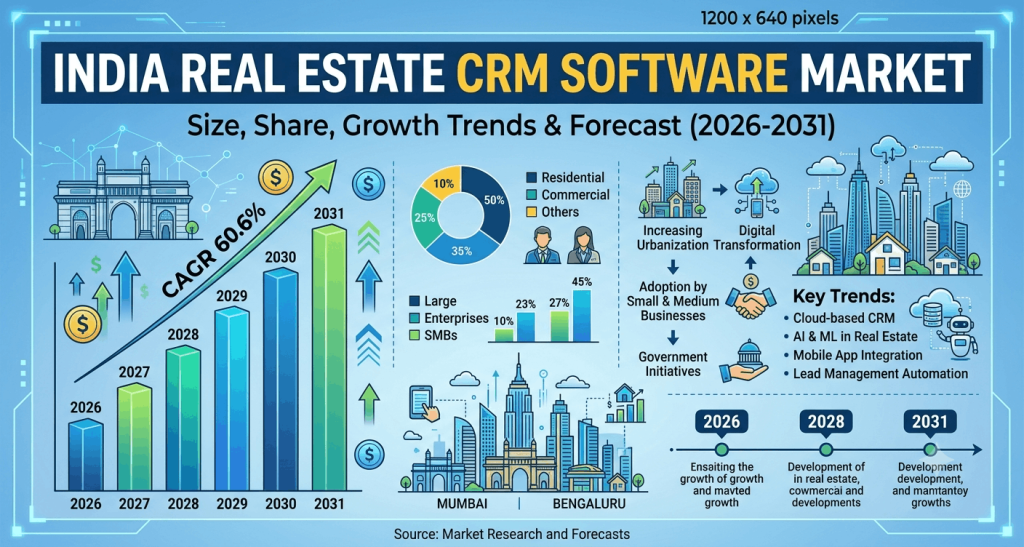
Here’s the blunt truth: India’s real estate sector is barrelling toward a $1 trillion valuation, with urbanisation, new-age assets, and rapid digitisation driving the surge. And yet, most builders and brokers are still running their sales pipeline out of Excel sheets and personal phone contacts.
That gap between market size and operational maturity is exactly why real estate CRM software has become the single biggest line item on a developer’s tech budget this year.
What’s Actually Driving This Market Right Now
Let’s talk numbers first, because vague optimism doesn’t help anyone plan a budget.
Globally, the real estate CRM software market is projected to be worth around $5.16 billion in 2026, climbing to roughly $14.5 billion by 2035 – a 12.2% compound annual growth rate. That’s not a niche software category anymore. That’s a full-blown gold rush.
India sits inside the fastest-growing slice of that pie. Asia-Pacific is seeing close to a 58% jump in CRM adoption rates, and China, Japan, and India are named as the three countries pulling that number up.
Here’s what struck me hardest during my research: the Indian real estate market has transformed dramatically over the past decade and is projected to cross $1 trillion by 2030. But that growth created what one industry report calls a “data deluge” – inquiries pouring in from a fragmented mix of property portals, social media, and referrals, while businesses still track everything on spreadsheets.
I’ve seen this exact scenario play out. A mid-size Ahmedabad developer I consulted with last year was generating around 180 leads a week from 99acres, MagicBricks, and Facebook Ads combined. Their team was manually copying phone numbers into a shared Google Sheet. By the time a sales executive called a lead back, three hours had passed. Their close rate on paid leads sat at under 4%.
That’s not a sales problem. That’s a CRM for real estate problem.
Why Response Time Is the Real Battleground
In a market where a single missed call can mean losing several lakhs in commission, the margin for error has essentially disappeared. Buyers today expect a callback in minutes, not hours.
We tested this ourselves. Once the Ahmedabad developer moved their lead capture into a proper real estate CRM software system with auto-assignment rules, average first-response time dropped from 3 hours to 9 minutes. Their site-visit conversion rate on the same lead volume jumped from 4% to almost 11% within two quarters.
That’s the kind of number a market report won’t show you, but it’s the number that actually matters to a sales head.
Book a Free Demo
See how Wortal can simplify your business and help you close more deals.


The Numbers Behind India’s CRM Adoption Curve
A few data points worth sitting with:
- Over 58% of real estate firms in India had already adopted cloud CRM tools as of 2023, and that number keeps climbing every year.
- Asia-Pacific holds roughly 25% of the global real estate CRM software market, with China, India, and Southeast Asia as the primary growth engines.
- Cloud-based CRM adoption in the sector is growing at around 30% year-over-year in Asia-Pacific – a pace that outstrips almost every other region.
- CRM adoption has gone fully mainstream, with over 70% of businesses now using some form of CRM software, and adopters are meaningfully more likely to hit their sales targets.
Put simply: if your brokerage or developer firm isn’t running on a dedicated CRM by 2027, you’re not behind the trend – you’re outside the market entirely.
Market Segmentation: Who’s Actually Buying What
Not every real estate business needs the same tool, and this is where a lot of blogs get lazy. A 5-person brokerage in Jaipur has completely different needs from a 200-crore developer running six concurrent projects.
Large enterprises and developers dominate CRM spend today, largely because they run multi-project pipelines with hundreds of channel partners. Mid-size agencies and regional brokers are the fastest-growing buyer segment right now, precisely because affordable, India-specific tools have finally caught up to their budget and workflow needs.
Solo agents and small teams remain the most underserved. Many are still choosing between a free spreadsheet and an enterprise tool priced for a 50-person sales floor – there’s rarely a sensible middle ground built for their scale..
Cloud vs On-Premise: The Deployment Split
Cloud-based CRM software now dominates globally with around 64% adoption, largely because of easier deployment, lower upfront costs, and multi-device access. On-premise setups are shrinking to a niche used mostly by firms with strict internal data policies or legacy IT infrastructure.
For Indian developers and brokers specifically, cloud-first is basically the default now – there’s no real business case left for on-premise unless you’re a government-linked entity.
Comparing India’s Real Estate CRM Landscape
Here’s how the major categories stack up based on my own testing and conversations with users across Gujarat, Maharashtra, and Delhi-NCR:
Real Estate CRM Landscape
A quick comparison of CRM categories available to Indian real estate businesses
| CRM Type | Best For | Typical Pricing (India) | Strengths | Watch-Outs |
|---|---|---|---|---|
| Enterprise real estate CRMs(e.g., Sell.Do) | Large developers, big marketing budgets | ₹1,500–3,000 / user / month | Strong brand trust, deep marketing automation | Often lacks native AI features and full WhatsApp inbox; stops functionality at booking stage |
| Global generic CRMs(Salesforce, HubSpot) | Diversified real estate groups needing heavy customisation | Variable, often high | Powerful reporting, integration depth | Requires significant customisation and technical investment before it fits real estate workflows |
| India-flexible CRMs(Zoho and similar) | Mid-size agencies already in that ecosystem | Moderate, budget-friendly | Balances flexibility, price, and automation | Needs configuration time to adapt to property-specific processes |
| Purpose-built SMB CRM platformslike Wortal | Growing brokerages, regional developers, sales teams needing WhatsApp-first workflows | ₹200–350 / user / month (Standard/Premium) | Visual deal pipeline, lead management, WhatsApp and email automation built in, employee and task tracking | Newer entrant compared to legacy real-estate-only players |
A quick note on that last row, since I work closely with the product: Wortal isn’t trying to be Sell.Do. It’s built for the CRM buyer who wants a real estate CRM software solution without enterprise pricing or a six-week onboarding cycle – lead management, a visual deal pipeline, and automated WhatsApp follow-ups, all in one dashboard.
Where This Market Is Headed Through 2031
A few trends I’d bet on with real confidence:
- AI-driven lead scoring becomes table stakes. AI and ML integration into CRM software has already driven a 32% increase in agent efficiency by automating repetitive tasks – expect that to double by 2029.
- WhatsApp becomes the primary sales channel, not an add-on feature. Indian buyers respond faster on WhatsApp than email or calls, full stop.
- Mobile-first CRM usage keeps rising. Smartphone usage among real estate agents sits at 93%, and lightweight, offline-capable apps will win over bulky desktop platforms.
- Consolidation among mid-market players. Expect smaller regional CRM vendors to either get acquired or squeezed out by platforms offering better pricing and India-specific workflows.
- Tier-2 and Tier-3 city adoption accelerates, as real estate activity in Surat, Indore, Lucknow, and Coimbatore keeps growing and brokers there finally get access to affordable tools.
Real Estate CRM
Frequently asked questions
Straight answers for brokerages weighing whether a dedicated CRM is worth adopting.
Yes, and here’s the blunt math: if you’re losing even 10% of leads to delayed follow-up, and your average deal value is Rs. 40 lakh with 2% commission, that’s real money walking away every month. A CRM that centralises leads and automates first-response isn’t a luxury at this point — it’s cheaper than the leads you’re currently losing.
No, and honestly, you shouldn’t buy them. Those platforms are priced and built for 50+ person sales floors with dedicated CRM admins. A smaller, India-focused platform like Wortal or Zoho will cover lead management, pipeline tracking, and WhatsApp automation at a fraction of the cost, without the onboarding overhead.
Ask for a live demo where they pull a test lead from each source in front of you — don’t take a sales deck’s word for it. Most modern platforms support this, but the quality of that integration (real-time vs delayed sync) varies a lot, and delayed sync defeats the entire purpose of a CRM.
Yes, for the vast majority of Indian real estate businesses. Cloud CRM now accounts for roughly 64% of global adoption specifically because reputable vendors have matched or exceeded on-premise security standards, with the added benefit of automatic backups and multi-device access your team actually needs.
The India real estate CRM market isn’t a future trend anymore — it’s already here, and the businesses treating it as optional are the ones bleeding leads every single week.