

Real estate CRM shopping is confusing right now. Every vendor claims to be “the best,” every demo looks the same, and most agents, developers, and brokers end up buying software that solves someone else’s problem, not theirs.
I’ve watched this happen more times than I can count. A broker buys a tool built for solo agents and then wonders why it can’t handle 40 salespeople across three projects. A developer buys a lightweight CRM meant for door-to-door agents and then can’t track tower-wise inventory. The tool isn’t bad. It’s just wrong for the job.
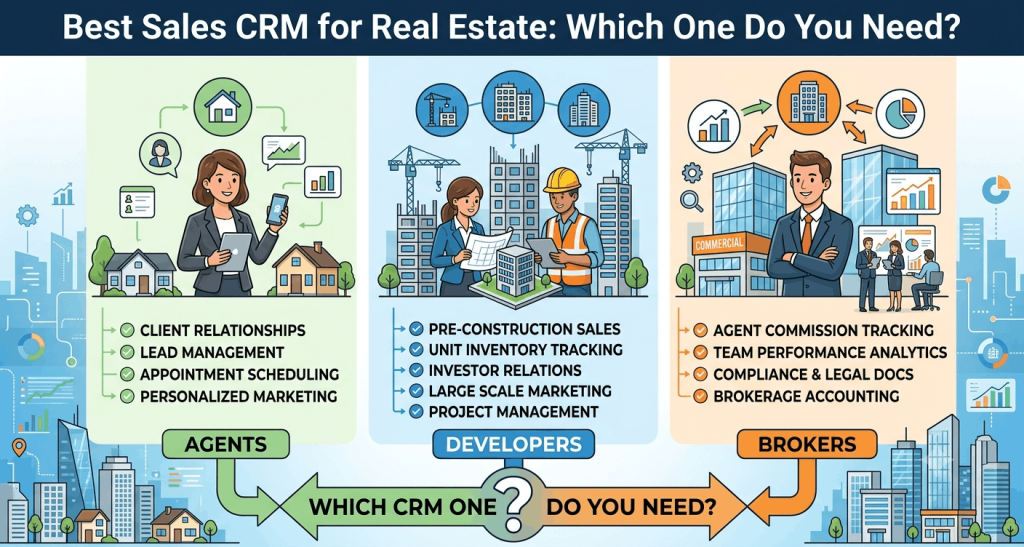
So let’s actually break this down properly – what a CRM for real estate agents needs versus a CRM for real estate developers versus a CRM for real estate brokers. These are three different jobs wearing the same “real estate” label.
Why “One CRM Fits All” Doesn’t Work
Here’s what actually matters: agents, developers, and brokers don’t sell the same way, don’t manage the same volume, and don’t need the same reports.
An agent is closing 3-5 deals a month, mostly on the phone and WhatsApp, chasing individual buyers.
A developer is managing hundreds of units across multiple towers, tracking bookings, cancellations, payment schedules, and channel partner commissions – sometimes for years on a single project.
A broker sits in between. They’re running a team of agents, juggling multiple builder tie-ups, and need visibility into who’s talking to which lead and how fast.
If you pick software built for one of these and try to force it into another use case, you’ll hit walls within three months. I’ve seen it happen with a broker who bought an agent-focused tool – no team hierarchy, no way to reassign leads when an agent quit. Painful migration later.
CRM for Real Estate Agents – What You Actually Need
If you’re an individual agent or a small team, your CRM for real estate agent needs are actually pretty simple on paper, but they need to work fast.
What matters most:
- Quick lead capture from IndiaMART, 99acres, Housing.com, Facebook ads, and walk-ins – all landing in one place
- WhatsApp integration because let’s be honest, that’s where 80% of your buyer conversations actually happen in India
- Follow-up reminders so leads don’t go cold (this is where most agents lose deals, not lack of leads)
- Simple deal pipeline – new lead, site visit, negotiation, booking, closed
- Mobile-first design, because you’re not sitting at a desk
A good CRM for real estate agent should feel like an extension of your phone, not a separate system you have to “log into” every evening to update.
I’ve talked to agents who tried spreadsheets for years. It works until you hit 50+ active leads. Then things slip. A buyer who was “hot” three weeks ago gets forgotten because there was no reminder nudging you to call back.
This is genuinely why most agents in Tier 2 and Tier 3 cities are now searching for the best CRM for real estate agents in India – not because it’s trendy, but because manual tracking simply breaks past a certain lead volume.
CRM for Real Estate Developers – A Completely Different Game
Now flip to the developer side. A CRM for real estate developers isn’t really about lead follow-up anymore – that’s a small piece. It’s about inventory and money.
Developers need:
- Unit-wise inventory tracking – which flats are booked, blocked, available, or cancelled, tower by tower, floor by floor
- Payment schedule management tied to construction milestones
- Channel partner and broker management – commission tracking across dozens of external brokers feeding leads
- Multi-project dashboards, because most mid-size developers run 2-3 projects simultaneously
- Integration with site visit scheduling across sales offices
Here’s the thing most people miss: a developer’s CRM failure doesn’t look like “lost leads.” It looks like double-booking a flat, or paying a broker commission twice because nobody had visibility into who closed what.
A CRM for real estate developers has to handle both the sales funnel and the post-sale paperwork trail – because a booking isn’t the finish line, possession is.
Book a Free Demo
See how Wortal can simplify your business and help you close more deals.


CRM for Real Estate Brokers – The Middle Layer Nobody Talks About
This is the segment that gets ignored in most CRM comparison articles, but a CRM for real estate brokers is arguably the hardest to get right.
Why? Because brokers are managing three moving parts at once – their own team of agents, multiple builder relationships, and a buyer base that spans several projects at a time.
What a broker actually needs:
- Team-level lead distribution – auto-assign leads to agents based on location, budget, or workload
- Performance tracking per agent – who’s converting, who’s sitting on stale leads
- Multi-builder inventory view without mixing up commission structures
- Call and WhatsApp logs visible to the broker, not locked in the agent’s personal phone
That last point matters more than people realize. I’ve seen brokerages lose institutional knowledge because an agent left and took every conversation history with them – literally, on their personal WhatsApp. A proper CRM for real estate brokers keeps that data with the business, not the individual.
Brokers also need reporting that a solo agent never would – weekly team performance, source-wise lead quality, and conversion ratios by project. This is management software as much as sales software.
Feature comparison: Agent vs Developer vs Broker
Agent
Individual field agent
Developer
Project developer
Broker
Team / brokerage lead
That’s the quick-glance version. Now here’s the part that actually matters – how to use this in practice.
Practical Insights: What Breaks If You Get This Wrong
I’ve seen three specific failure patterns play out repeatedly:
Agents using developer-grade CRMs. Too many fields, too much setup time. An agent doesn’t need “phase-wise construction tracking.” They need to call back Mr. Sharma before he books with the competitor down the street.
Developers using agent-grade CRMs. Works fine for the first 20 bookings. Then someone books a flat that was already sold because there was no real-time inventory lock. This is expensive, not just annoying.
Brokers using nothing at all, or spreadsheets. This is more common than people admit. A broker with 15 agents running deals through personal WhatsApp numbers has zero visibility into pipeline health until month-end, when it’s too late to fix anything.
The fix isn’t complicated – match the tool to the actual job, not the job title on your visiting card.
Real-Life Case Study: A Surat Broker’s CRM Switch

A mid-size brokerage in Surat was running a team of 12 agents across residential resale and two builder tie-ups. For two years, everything ran on Excel and personal WhatsApp.
The problem showed up slowly. Leads from IndiaMART and Facebook were landing with different agents, sometimes duplicated, sometimes ignored for days. The owner had no clean way to see which agent was actually converting versus just sitting on leads.
They moved to Wortal, set up as their CRM for real estate brokers, with automatic lead assignment by locality and a shared WhatsApp automation layer so conversations stayed logged under the business, not the agent’s personal number.
Within two months:
- Lead response time dropped from an average of 6 hours to under 40 minutes
- The owner could finally see a weekly conversion report by agent, not just by gut feeling
- Two underperforming agents were identified and coached – something that was invisible before
Nothing magical happened. It was just visibility that didn’t exist before, applied consistently.
Key Takeaways
- Don’t buy a CRM for real estate agent use case if you’re managing a team or multiple projects – you’ll outgrow it fast
- A CRM for real estate developers must handle inventory and payment schedules, not just leads
- A CRM for real estate brokers needs to protect business data from walking out the door with an agent who quits
- When searching for the best CRM for real estate agents in India, prioritize WhatsApp integration and mobile usability over flashy dashboards nobody opens
- Match the software to your actual daily workflow, not the vendor’s generic sales pitch
Honestly, it depends on scale. If you’re doing one small project alongside brokering, a flexible platform like Wortal can handle both with the right modules switched on. If you’re running large multi-tower projects, you’ll eventually want dedicated inventory management on top.
Because that’s genuinely where the conversation happens here. Buyers don’t want to fill forms – they want to send a voice note asking about the 2BHK price. If your CRM can’t capture that, you’re manually copying data, and that’s where leads get lost.
In my experience, about 2-3 weeks for basic comfort, and a month before agents stop reverting to old habits like WhatsApp-only tracking. The key is making lead assignment automatic from day one – agents adopt tools faster when it saves them effort, not adds to it.
Yes, usually. Sales agents can plug into the developer’s CRM as users, but the backend – inventory, payment milestones, possession tracking – needs to live in one system. Splitting this across tools is where double-bookings happen.