

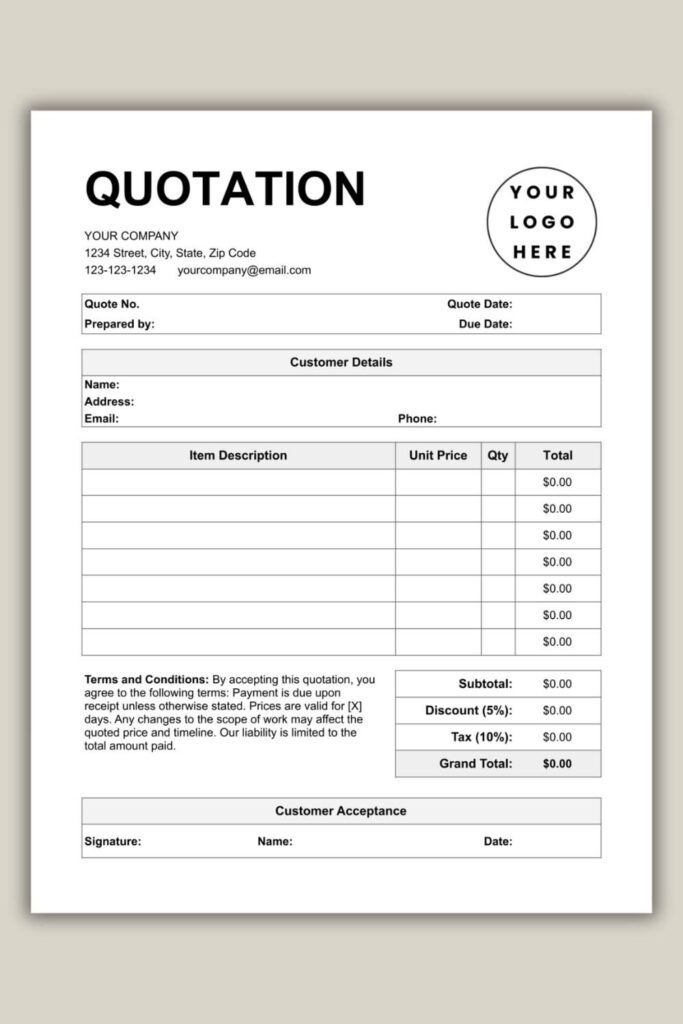

Have you ever sent a price estimate to a massive retail buyer or a garment manufacturer, only to hear absolute crickets? You know your fabric quality is top-notch. Your pricing is highly competitive in the market. So why did they ghost you?
The real issue is often right in front of you: how you present the numbers. If your quotation format textile business relies on a messy spreadsheet slapped together at two in the morning, buyers will assume your manufacturing process is just as chaotic.
Getting a solid Textile Business Quotation Format in place isn’t just about making things look pretty. It’s about building instant trust with procurement managers. Let’s break down exactly how to structure your paperwork so it actually wins you deals, saves you time, and protects your margins.
Why Your Textile Business Quotation Format Actually Matters
Most people ignore this part. They think a quick WhatsApp message with a per-meter rate and a couple of photos is enough to close a deal. But in B2B textiles, procurement managers at large brands need a formal, structured document to get approval from their finance teams.
If they have to chase you down to figure out your delivery timelines, minimum order quantities (MOQs), or tax breakdown, they will simply move on to the next supplier. A complete and professional quotation format textile business eliminates that back-and-forth.
In practical terms, a well-structured document speeds up the entire sales cycle. I recently worked with a mid-sized denim weaver in Ahmedabad. They were getting plenty of inquiries but struggling to convert them into actual paying customers. We overhauled their paperwork, implementing a clear, branded Textile Business Quotation Format. Within a month, their conversion rate jumped significantly. Buyers didn’t have to guess what was included in the price, which made saying “yes” much easier.
Navigating Local Taxes: The Gst Quotation Format For Textile Industry
If you are selling domestically within India, your paperwork needs to be absolutely bulletproof regarding tax codes. The tax laws here get complicated quickly. Woven cotton fabrics might attract a 5% rate, while certain readymade apparel pieces or synthetic blends might sit at 12% depending on the specific sale value.
That’s where things usually go wrong. A buyer receives a quote, assumes the taxes are already included in your per-meter rate, and then gets a nasty surprise on the final invoice.
Your Gst Quotation Format For Textile Industry needs to explicitly show the base price, the specific HSN code for the material, and the exact SGST, CGST, or IGST breakdown. If you are shipping goods from Surat to Mumbai, you apply IGST. Shipping from Surat to Ahmedabad? That requires CGST and SGST.
Here’s what actually matters: your buyer needs to claim their input tax credit (ITC). If your Gst Quotation Format For Textile Industry is sloppy, lacks the proper registration numbers, or misses the HSN codes, their accountant will flat-out reject it.
Using software like Wortal makes handling this incredibly easy. Instead of manually calculating tax brackets every single time, Wortal automates your Gst Quotation Format For Textile Industry, ensuring you never mess up a calculation or leave out a crucial tax identifier again. Providing a fully compliant Gst Quotation Format For Textile Industry builds immense credibility with corporate buyers from day one.
Crossing Borders: The Export Quotation Format For Garments
Selling overseas is a completely different ballgame. An international buyer out of Europe or the US doesn’t care about your local GST structures. They care about shipping terms, customs duties, and currency conversions. Your standard domestic document simply won’t cut it here. You need a dedicated Export Quotation Format For Garments.
Let’s look at a real-life scenario from a knitwear exporter based in Tirupur. They sent a basic quote to a new retail buyer in Germany. The quote just stated “$5 per t-shirt.” The German buyer pushed back immediately. Why? Because the Export Quotation Format For Garments didn’t specify the Incoterms. Was that $5 FOB (Free on Board) Mumbai? Or was it CIF (Cost, Insurance, and Freight) Hamburg? The buyer had no idea who was supposed to pay for the ocean freight and insurance.
When you craft an Export Quotation Format For Garments, you absolutely must include the port of loading, port of discharge, currency validity, and precise packing details. How many garments fit in a master carton? What’s the total CBM (Cubic Meter) volume?
A professional Export Quotation Format For Garments answers all these logistical questions before the buyer even has to ask them. Furthermore, international trade heavily relies on Letters of Credit (LC). Your documentation has to match the bank’s requirements perfectly. If you are using Wortal, you can easily switch your templates to an Export Quotation Format For Garments that instantly aligns with global trade standards, keeping you looking professional on the world stage.
The Anatomy of a Winning quotation format textile business
Whether you are doing local drops or international freight, certain elements are completely non-negotiable. Let’s break down the ideal quotation format textile business structure that you should be using.
- Clear Header & Branding: Don’t send a plain, unbranded Word document. Put your company logo at the top. Include your business registration details and full contact information prominently.
- Date and Price Validity: Yarn and raw cotton prices fluctuate almost daily. Your Textile Business Quotation Format must state exactly how long the price holds good. Writing “Prices valid for 7 days” protects you from sudden raw material price hikes.
- Detailed Line Items: Don’t just write “Cotton Fabric.” Specify the weave type, weight (GSM), color lot, and thread count. A precise quotation format textile business leaves zero room for misinterpretation.
- Quality Tolerances: In the textile trade, mention your acceptable shrinkage percentage and shade variation tolerances. This protects you from unfair rejections later.
- Payment & Sampling Terms: Are you charging for the physical sample swatch? Who pays for the courier? Is payment 30% advance and 70% against delivery? Mention it all clearly.
You can save these standard terms and conditions inside Wortal so you aren’t typing them out manually every single time you need to generate a new quotation format textile business.
Avoiding The Trap of Bad Paperwork
We have talked about what to include, but let’s look at what to avoid. I see textile entrepreneurs making the exact same mistakes repeatedly. They spend weeks negotiating a massive bulk order of polyester blends, only to lose the client at the finish line because their Textile Business Quotation Format was literally unreadable on a mobile phone.
Think about it from the buyer’s perspective. Procurement managers are busy. They are often opening your PDF on their smartphone while sitting in transit or between meetings. If your quotation format textile business requires them to pinch, zoom, and squint just to read the unit price, you are creating unnecessary friction.
This brings me back to my earlier point. The real issue is treating this paperwork as an afterthought. You might have the best weaving machinery and dye houses in the state, but the buyer only sees the document you send them.
That is exactly why we built Wortal. We saw too many fantastic manufacturers losing out to competitors who simply had cleaner paperwork. Wortal gives you a ready-to-use quotation format textile business that looks incredibly professional, calculates totals correctly, and reads perfectly on both desktop and mobile screens.
Practical Insights for Your Next Deal
Before you hit send on another price estimate, run it through a quick mental checklist. Ask yourself these questions:
- Does this document anticipate and answer all the buyer’s potential questions?
- If I am selling locally, is my Gst Quotation Format For Textile Industry fully compliant with the current tax slabs for this specific fabric?
- If I am shipping overseas, does my Export Quotation Format For Garments clearly state the freight responsibilities and Incoterms?
- Is the overall design of my Textile Business Quotation Format clean, uncluttered, and easy to digest?
If you answered no to any of those, it’s time to overhaul your sales process. Don’t let bad formatting eat into your hard-earned profit margins. Grab a solid quotation format textile business template, or better yet, automate the entire headache with Wortal, and get back to focusing on what you actually do best: producing great textiles.
- Fabric weave and blend (e.g., 100% cotton, poly-viscose)
- Fabric weight (GSM) and thread count
- Width and color lot/shade number
- Acceptable shrinkage and shade variation tolerances
- CGST + SGST: For intrastate sales (within the same state).
- IGST: For interstate sales (between different states).
- Transparent tax breakdowns ensure the buyer’s accountant can easily verify Input Tax Credit (ITC) eligibility.