
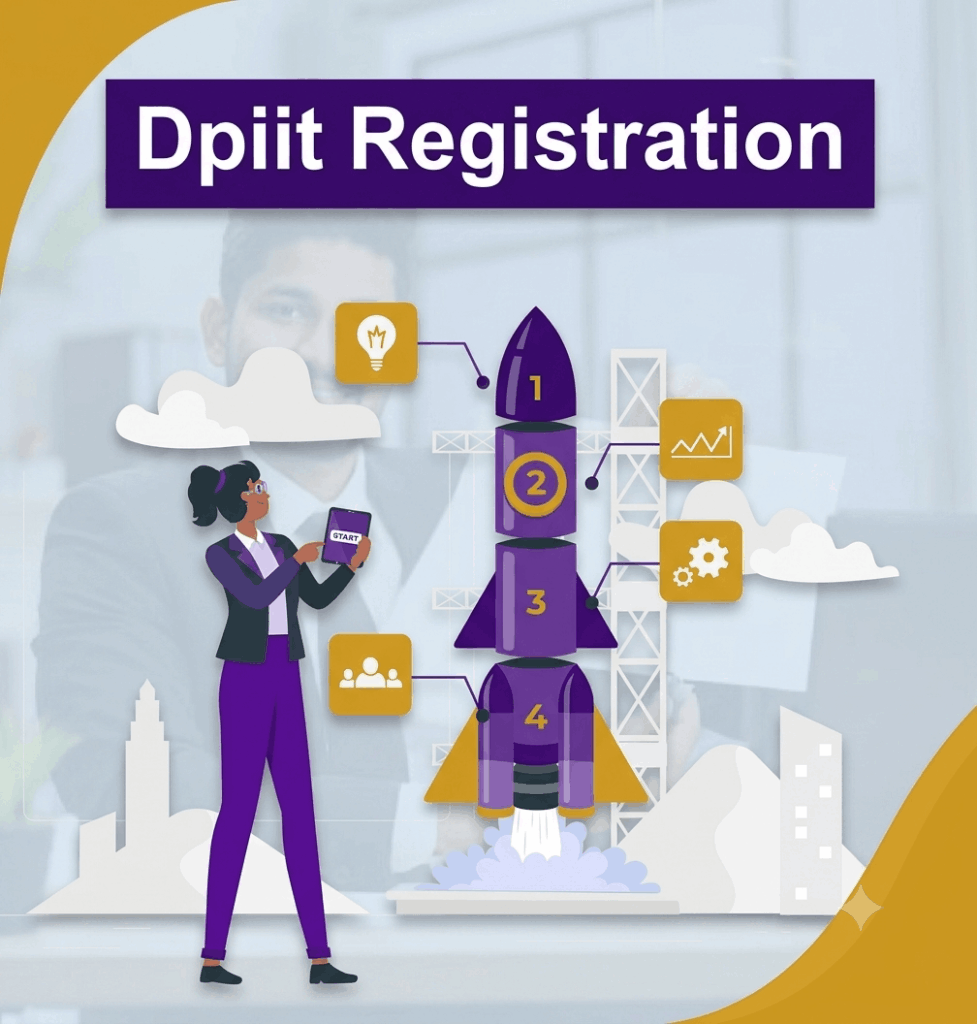

DPIIT registration, more accurately called DPIIT startup recognition, is an official recognition given by the Department for Promotion of Industry and Internal Trade (DPIIT) to eligible startups under the Startup India initiative. It tells government authorities that a business meets the prescribed conditions for being recognised as a startup in India.
For founders, this matters because DPIIT recognition can open the door to specific benefits such as intellectual property support, easier participation in government procurement, self certification under certain laws, and eligibility to apply for particular tax and funding related schemes.
But there is one common misunderstanding: getting DPIIT registration does not automatically give a startup every benefit associated with Startup India. Several benefits have their own eligibility conditions and separate application processes.
Quick Summary
This guide explains:
- What DPIIT registration for startups actually means
- Who can apply for DPIIT startup recognition
- Current age and turnover limits
- Documents required
- How to apply through the National Single Window System
- Major benefits of recognition
- Why DPIIT recognition is different from tax exemption
- Common application mistakes
- A practical startup case study
- How a CRM can help a recognised startup manage growth after registration
This guide is useful for founders, co-founders, startup finance teams, consultants and professionals helping new businesses complete their startup compliance.
What Is DPIIT Registration?
DPIIT registration for startups is the process through which an eligible business applies to be officially recognised as a startup by the Department for Promotion of Industry and Internal Trade.
The application is currently available through the National Single Window System (NSWS). A startup creates an account, adds the “Registration as a Startup” approval and submits the required information and supporting documents.
It is useful to understand the terminology here.
People commonly say “DPIIT registration”, but the official concept is DPIIT startup recognition.
The distinction matters because the government is not simply registering a new company. Your company should already be incorporated or registered in an eligible form. DPIIT then evaluates whether it meets the startup recognition criteria.
In simple words
Think of it as:
Startup India Journey
Follow the key steps from business incorporation to DPIIT recognition and access to applicable benefits.
Business Incorporation
Establish and legally register your business under an eligible entity structure.
GET STARTEDStartup Eligibility
Check whether your entity meets the applicable Startup India and DPIIT recognition criteria.
CHECK ELIGIBILITYDPIIT Recognition
Submit the recognition application with the required information and supporting documents.
GET RECOGNISEDAccess Applicable Benefits
Explore benefits available to DPIIT-recognised startups, subject to the relevant eligibility.
GROW & SCALEGetting recognition does not replace company incorporation, GST registration, PAN, professional tax registration or other licences that may apply to your business.
Who Is Eligible for DPIIT Startup Recognition?
The current Startup India criteria provide that an eligible startup can be incorporated or registered as:
- Private Limited Company
- Registered Partnership Firm
- Limited Liability Partnership (LLP)
- Cooperative Society
For a regular startup, the entity must generally be within 10 years from incorporation or registration and have turnover not exceeding Rs.200 crore in any financial year since incorporation or registration.
For DeepTech startups, the current framework provides a longer period of up to 20 years and a turnover ceiling of Rs.300 crore, subject to the applicable DeepTech criteria.
The business must also be working towards innovation, development or improvement of products, processes or services, or have a scalable business model with high potential for employment generation or wealth creation.
An entity created by splitting up or reconstructing an existing business is not treated as an eligible startup under the recognition framework.
A simple eligibility example
Suppose a software company was incorporated four years ago.
It has:
- A valid eligible entity structure
- Rs.8 crore annual turnover
- A SaaS product
- A scalable business model
- A clear explanation of how its product improves an existing process
The company may have a basis to apply for DPIIT registration for startups, subject to the complete eligibility assessment.
Now consider a traditional business that has simply been transferred into a new company without genuine innovation or a scalable business model.
Changing the company’s name or legal structure alone does not automatically make it eligible.
DPIIT Eligibility at a Glance
| Criteria | Regular Startup | DeepTech Startup |
|---|---|---|
| Maximum recognition period | 10 years | 20 years |
| Turnover ceiling | Rs.200 crore | Rs.300 crore |
| Entity types | Pvt Ltd, registered partnership, LLP, cooperative society | Same eligible forms |
| Innovation / improvement | Required | Required |
| Scalable employment/wealth potential | Relevant | Relevant |
| Split/reconstruction of existing business | Not eligible | Not eligible |
Expert Insight: Do not check eligibility only by looking at turnover. The nature of the business and its innovation, improvement or scalability also matters.
What Documents Are Required for DPIIT Registration?
The exact information and supporting material can depend on the startup and the application. The current recognition form requires incorporation/registration information and supporting evidence about the startup’s activities.
Commonly relevant documents and information include:
- Certificate of Incorporation or Registration
- PAN details
- Entity and authorised representative details
- Authorisation letter, where required
- Website or product information
- Pitch deck, video or other proof explaining the startup
- Patent, trademark or other IPR information, if applicable
- Details explaining innovation, improvement or scalability
The Startup India portal specifically asks applicants to explain how the startup is working towards innovation, development or improvement of products, processes or services, or scalability in terms of employment or wealth creation.
What should your explanation contain?
Don’t write:
“We are an innovative company providing modern technology solutions.”
That sentence says almost nothing.
Instead explain:
- What problem exists?
- Who experiences the problem?
- What does your product or service change?
- What is different about your approach?
- How can the model scale?
- What evidence supports your claims?
For example:
“Our SaaS platform automates purchase reconciliation for small distributors by connecting purchase invoices with inventory records and exception reports. The system reduces manual reconciliation work and can be deployed across multiple branches.”
That gives the reviewer something concrete to understand.
How to Apply for DPIIT Registration: Step-by-Step
The current application route is through the National Single Window System (NSWS).
Step 1: Confirm your basic eligibility
Before starting the form, check:
- Entity type
- Incorporation date
- Turnover
- Business activity
- Innovation or improvement
- Scalability
- Whether the business was created by splitting or reconstructing an existing business
This takes less time than correcting an application later.
Step 2: Create an account on NSWS
Go to the National Single Window System and create the required account.
Step 3: Add the Startup Registration approval
From the NSWS dashboard:
Add Approvals → Central Approvals → Registration as a Startup
The Startup India portal currently directs applicants to NSWS for the recognition application.
Step 4: Enter entity details
You may need details such as:
- Legal entity name
- CIN or registration number, where applicable
- Incorporation/registration date
- PAN
- Industry
- Sector
- Business activity
- Founder/authorised representative information
Step 5: Explain your startup
This is one of the sections founders should take seriously.
Explain your product, service, process or business model in plain language.
Focus on the actual business problem and the change your startup creates.
Step 6: Upload supporting documents
Upload the required incorporation/registration certificate and other relevant documents or supporting evidence.
Depending on the stage and nature of the startup, the portal can ask for supporting proof such as a website, pitch deck, video or other evidence.
Step 7: Review the application
Check every important field before submission.
Pay particular attention to:
- Company name
- Incorporation date
- PAN
- CIN/registration number
- Turnover
- Founder details
- Business description
- Uploaded documents
Step 8: Submit the application
Submit the application through the prescribed online process.
DPIIT recognition applications are based on self certification, and the government states that false information or unsupported claims can lead to revocation of recognition.
Step 9: Download and preserve the certificate
If recognised, the startup receives a system generated, verifiable recognition certificate. The certificate can also be accessed through DigiLocker.
What Are the Benefits of DPIIT Startup Recognition?
The benefits are useful, but they should not be treated as automatic discounts or tax waivers.
Here are the major areas where DPIIT startup recognition can help.
1. Intellectual Property Support
Startups working on technology, products, designs or new processes may need patent and trademark protection early.
Under Startup India IPR support, recognised startups can receive assistance through facilitators. Patent applications can receive an 80% rebate in filing fees, while the current Startup India material also provides a 50% rebate for trademark filing and design related benefits under the applicable scheme.
This can be particularly useful for:
- SaaS companies
- Hardware startups
- Manufacturing startups
- Textile technology companies
- Consumer product businesses
- DeepTech companies
Business Tip: Don’t wait until investors ask about your IP. If your competitive advantage depends on technology, brand or design, understand what should be protected before competitors copy it.
2. Easier Public Procurement
Government procurement can be difficult for a young company because tenders may ask for previous turnover, previous experience or an Earnest Money Deposit.
DPIIT recognised startups can receive specified relaxations in public procurement, including exemption from EMD and relaxation of prior experience and turnover requirements, subject to applicable tender conditions. Recognised startups can also use GeM as a route to sell products and services to government buyers.
This can matter for a startup that sells:
- Software
- Industrial equipment
- Consulting services
- Manufacturing products
- Technology solutions
- Specialised services
It does not mean a startup automatically wins a government tender. Technical specifications, capability and tender specific conditions still matter.
3. Self Certification Under Certain Laws
Eligible recognised startups can use self certification mechanisms under specified labour and environmental laws.
The purpose is to reduce unnecessary compliance burden for qualifying startups. However, the facility has conditions and does not mean that startups can ignore applicable laws.
That distinction is important.
Self certification is not the same as exemption from compliance.
4. Eligibility to Apply for Section 80-IAC Tax Exemption
This is one of the most misunderstood benefits.
DPIIT recognition can make an eligible startup able to apply for tax exemption under Section 80-IAC. But recognition itself is not a tax exemption.
The Startup India portal states that eligible recognised startups can apply for a tax deduction for three consecutive financial years out of the first ten years from incorporation, subject to the separate conditions.
The 80-IAC process currently has additional eligibility requirements, including that the entity be a Private Limited Company or LLP and that it meet the applicable turnover and incorporation conditions.
So remember:
DPIIT recognition ≠ automatic income tax holiday.
The tax benefit requires a separate eligibility/application process.
5. Access to Startup Focused Government Schemes
DPIIT recognition can also become relevant when applying for certain Startup India programmes and schemes.
But don’t assume:
“I have a DPIIT certificate, therefore I will receive funding.”
Funding programmes have their own rules, selection processes and eligibility requirements.
For example, schemes relating to seed funding, credit guarantees, incubators and government procurement each operate differently. The current Startup India scheme material lists multiple programmes and benefits for recognised startups.
DPIIT Recognition vs Tax Exemption: Don’t Mix Them Up
| Item | DPIIT Recognition | Section 80-IAC |
|---|---|---|
| Purpose | Recognises eligible startup | Provides specified income tax deduction |
| Application | Startup recognition application | Separate tax exemption process |
| Automatically granted? | No, recognition requires approval | No |
| Available to every recognised startup? | Subject to recognition criteria | No |
| Entity restriction | Multiple eligible entity forms | Pvt Ltd / LLP under current criteria |
| Benefit | Access to applicable Startup India benefits | Eligible tax deduction for specified years |
This distinction is worth remembering because many startup websites incorrectly present DPIIT recognition as if it automatically creates a three year tax holiday.
It doesn’t.
What About Angel Tax?
This is another area where older startup articles can create confusion.
You may still find articles describing a DPIIT startup’s eligibility for exemption from the old Section 56(2)(viib) “angel tax” provisions.
However, Startup India’s regulatory updates state that the Finance Act (No. 2), 2024 removed Section 56(2)(viib) from the Income Tax Act with effect from 1 April 2025.
So a current article should not present “angel tax exemption” as if it were an unchanged, current standalone benefit of DPIIT recognition.
Practical advice: For tax planning, always check the current Income Tax Act, Finance Act changes and professional advice rather than relying on an old Startup India blog.
Common Mistakes During DPIIT Registration
Mistake 1: Treating DPIIT recognition like company incorporation
DPIIT recognition does not create your company.
First comes incorporation or registration under the applicable legal framework.
Mistake 2: Writing a vague innovation statement
“AI-based innovative platform” is not enough.
Explain what the product actually does and what problem it improves.
Mistake 3: Using outdated eligibility figures
There is a lot of old DPIIT information online.
Older material commonly mentions a Rs.100 crore turnover limit. Current Startup India recognition material states Rs.200 crore for regular startups and Rs.300 crore for DeepTech startups.
Always check the current government portal before filing.
Mistake 4: Assuming recognition means every benefit is automatic
It doesn’t.
Tax exemptions, funding programmes, procurement opportunities and IPR benefits can have additional rules.
Mistake 5: Paying someone unnecessarily
The Startup India portal specifically states that DPIIT does not charge a fee for the Certificate of Recognition and has not appointed private agencies, representatives or franchises to obtain the certificate on behalf of startups.
Be careful if someone claims that a government “DPIIT registration fee” must be paid to them.
A Practical Decision Framework
Before applying, ask these five questions:
Startup Eligibility Check
Follow these simple steps to understand whether your startup meets the key eligibility requirements.
Is the business legally incorporated or registered?
Is the entity type eligible?
Is the startup within the applicable age & turnover limits?
Can we clearly explain innovation, improvement or scalability?
Do we have supporting documents/evidence?
Prepare & Submit Application
If all eligibility checks are satisfied, proceed with your application.
If you cannot clearly answer the fourth question, spend some time improving your business description before submitting.
Illustrative Case Study: A SaaS Startup Scaling Its Sales Team
Consider a fictional startup called FlowDesk Technologies.
It sells workflow software to small distributors.
The problem
The company had 12 employees and around 150 active prospects.
Sales information was scattered across:
- Excel sheets
- WhatsApp conversations
- Individual notebooks
- Email threads
The founder knew the business was growing, but couldn’t answer simple questions quickly:
- Which leads need follow-up today?
- Which salesperson owns each opportunity?
- How many deals are in negotiation?
- Which prospects have gone cold?
- What revenue is expected this month?
The solution
After handling its initial legal and startup compliance work, the company introduced a structured CRM process.
Every enquiry was recorded.
Each opportunity had:
- An owner
- A sales stage
- Next follow-up date
- Expected value
- Customer information
- Activity history
The team also created standard stages:
Lead Conversion Pipeline
Track every lead through each stage of your sales journey, from first contact to the final outcome.
New Lead
Capture and organize new prospects.
NEWContacted
Connect with the prospect and start the conversation.
CONTACTEDQualified
Identify prospects with genuine buying potential.
QUALIFIEDDemo
Show how your product or service solves their needs.
DEMOProposal
Share pricing, scope and a tailored proposal.
PROPOSALNegotiation
Discuss terms, pricing and finalize the deal.
NEGOTIATIONWon / Lost
Record the final outcome of the opportunity.
CLOSEDThe result
The company could now see where its pipeline was leaking.
For example, the founder discovered that many proposals were being sent but not followed up consistently.
The problem wasn’t a lack of leads.
It was a process problem.
This is where DPIIT recognition and business operations meet.
A certificate can help a startup access certain government benefits. But it doesn’t organise sales, customer data, follow-ups or team accountability.
Those operational systems still need to be built.
Why CRM Matters After DPIIT Registration
A startup can complete its DPIIT registration for startups and still struggle with day to day growth.
This usually happens when the founder remains the central person for everything.
At 10 customers, that may work.
At 100 customers, it becomes difficult.
At 500 customers, it can become a serious operational problem.
A CRM gives the team one place to manage:
- Leads
- Customer information
- Sales opportunities
- Follow-ups
- Tasks
- Sales pipeline
- Team ownership
- Customer communication
- Reports
For a startup selling to businesses, this becomes especially useful as the team grows.
For example, a textile SaaS startup may have leads coming from exhibitions, WhatsApp, website enquiries and referrals. Without a common system, two salespeople may contact the same buyer while another high value enquiry gets forgotten.
A distributor tech startup can face a different problem: leads may be generated quickly, but nobody knows which opportunities are genuinely active.
This is why DPIIT startup recognition should be treated as one part of the larger startup operating system.
Compliance gets the business ready.
Processes help it scale.
Where Wortal Fits
Wortal can be useful for startups that have moved beyond founder only selling and need a more organised way to manage their sales operations.
For example, a growing startup can use a CRM to bring enquiries from different channels into one pipeline, assign ownership, track follow-ups and understand where deals are getting delayed.
That becomes particularly useful when the startup has:
- Multiple salespeople
- Different lead sources
- A growing customer base
- Longer B2B sales cycles
- Regular follow-ups
- Multiple products or services
The idea is simple: DPIIT recognition helps establish eligibility for government startup benefits; a CRM helps the business manage the commercial work that follows.
Key Takeaways
- DPIIT registration is commonly used to describe the official DPIIT startup recognition process.
- Recognition is available to eligible entities meeting the prescribed criteria.
- Current Startup India material states a Rs.200 crore turnover ceiling for regular startups.
- The current DeepTech framework provides a Rs.300 crore ceiling and up to 20 years, subject to applicable criteria.
- The startup must demonstrate innovation, improvement or a scalable business model with employment or wealth-creation potential.
- The application is currently routed through the National Single Window System.
- Keep your incorporation certificate and business explanation ready before applying.
- Supporting evidence such as a website, pitch deck or product material can help explain the startup clearly.
- DPIIT recognition can provide access to specific IPR and public procurement benefits.
- DPIIT recognition does not automatically grant every tax or funding benefit.
- Section 80-IAC has separate eligibility and application requirements.
- Old information about “angel tax exemption” should be checked against current tax law because Section 56(2)(viib) was removed from 1 April 2025.
- Recognition is only one part of startup growth. Sales, finance, customer management and internal processes still need proper systems.
Conclusion
Getting DPIIT registration for startups is not about collecting another certificate and keeping it in a company folder.
The real value is understanding what that recognition makes possible and then actually using the relevant benefits.
A technology startup may need IPR support. A manufacturing startup may care about government procurement. A growing SaaS company may eventually need stronger sales and customer processes. A founder planning to claim Section 80-IAC benefits needs to understand that tax exemption is a separate step.
The smartest approach is therefore simple: first confirm eligibility, prepare a clear and truthful application, understand which benefits actually apply to your business, and then build the operational systems needed for growth.
Because once a startup moves beyond the founder doing everything personally, good processes become just as important as a good product.