

Over the years I’ve set up more CRMs than I can count, and one pattern never changes. A company spends weeks picking the perfect tool, signs up, trains everyone, and within a month half the team has quietly gone back to their notebooks and WhatsApp chats. The software wasn’t the problem. The fit was.
So this list isn’t about which tool has the most buttons. It’s about which ones Indian sales teams actually stick with. I’ve installed, tested, and abandoned most of these myself, so what follows is honest, not a brochure.
Let’s get into it.
How I Judge a CRM (Quick, But Read This)
The Best Sales CRM Software in India is rarely the most expensive one. I’ve watched a company pay lakhs for Salesforce and run it like a glorified Excel sheet. Total waste.
The real issue is adoption. If your reps don’t open it every morning, it’s dead weight. So when I rank these, I’m thinking about three things: will the team use it, does it fit how they already sell, and is the price fair for what you get.
That’s it. No magic.
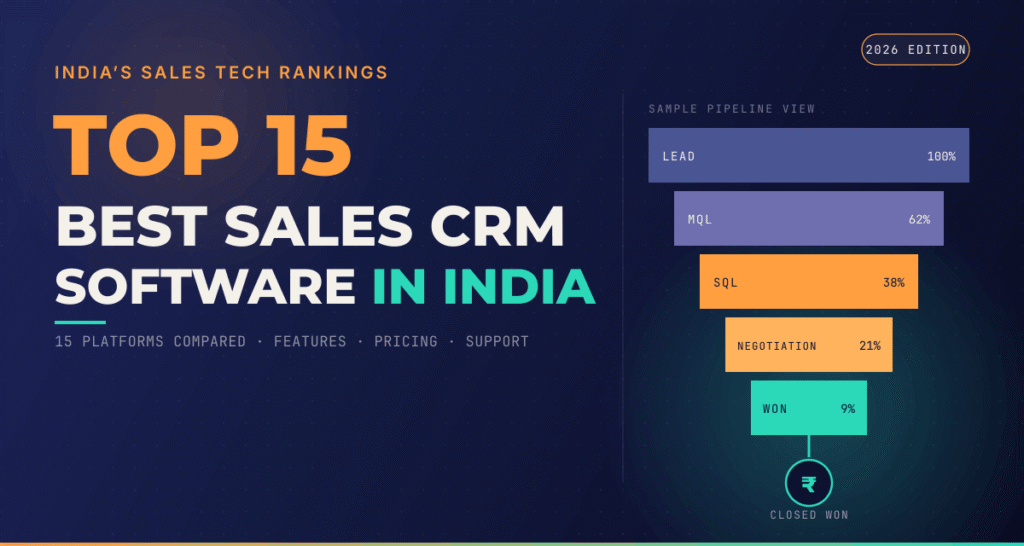
The 15 Best Sales CRM Software in India for 2026
1. Wortal CRM
I’ll be upfront, Wortal is built for Indian businesses, and it shows. It pulls leads from different channels, assigns them automatically, and keeps the pipeline tidy without burying small teams in features they’ll never touch. As far as Lead Management CRM Software in India goes, it’s one of the easier ones to roll out fast.
Features:
- Captures leads from IndiaMART, TradeIndia, web forms – everything lands in one place, nothing slips through
- Auto-assigns leads to the right rep instantly so nobody’s waiting around wondering whose job it is
- Drag-and-drop deal pipeline – you can see where every deal stands without clicking through ten screens
- WhatsApp and email automation fires on its own based on deal stage – no manual follow-up chasing needed
Pros: Affordable, quick to onboard, strong lead capture, clearly made with Indian SMBs in mind.
Cons: The integration library is still growing compared to the big global names.
2. Zoho CRM
A homegrown classic. You get a lot of depth for the money, and three users can run free.
Features:
- Build your own fields, layouts, and views – it actually matches how your team works, not some template
- Workflow automation handles follow-up reminders and alerts without anyone having to remember
- SalesSignals tells your rep the moment a prospect opens their email or revisits the pricing page
- Territory management keeps leads and visibility clean across different cities or regions
Pros: Great value, deep customisation, massive ecosystem.
Cons: It can feel busy. New folks sometimes get lost in the settings menus.
3. Salesforce
The heavyweight. If you’re heading into enterprise complexity, nothing handles it better.
Features:
- Sales Cloud handles even the messiest, most layered enterprise pipelines without breaking a sweat
- Einstein AI scores leads and suggests next steps – useful once your data volume is worth something
- Multi-layer forecasting from rep level all the way up to VP – finance teams finally stop guessing
- AppExchange fills every gap the core product leaves with thousands of ready-built integrations
Pros: Hugely powerful, endless integrations.
Cons: Pricey, and you’ll probably need a consultant. Way too much for a five-person shop.
4. HubSpot
Good when marketing and sales work hand in hand. The free CRM is a smart starting point.
Features:
- Free plan gives you unlimited contacts, deals, and activity history – no expiry, no hidden catch
- Email tracking shows exactly when a prospect opened your message and how many times
- Marketing Hub feeds reps context on which blogs, ads, or emails a lead engaged with before the call
- Meeting scheduler lets prospects book a slot themselves – kills the back-and-forth completely
Pros: Clean look, excellent for inbound, generous free tier.
Cons: The bill climbs quickly once you add the paid hubs.
5. Freshsales
From Freshworks, a Chennai company. A lot of Sales Management Software India teams like it for the built-in calling and email.
Features:
- Calling and email built right in – no third-party setup, every call gets logged automatically
- Freddy AI prioritises leads based on real signals like site visits, email opens, and reply behaviour
- Full contact timeline so reps know the entire history before they even dial
- Freshchat integration pulls website chat leads straight into the CRM without manual entry
Pros: Easy to use, decent AI lead scoring, fair price.
Cons: Reporting gets thin once your data piles up.
6. Kylas Sales CRM
This one genuinely surprised me. Unlimited users on paid plans is rare, and it’s aimed straight at Indian SMBs.
Features:
- Unlimited users on paid plans – the team grows, the bill doesn’t
- Custom fields on every lead and contact so it fits your industry, not a generic B2B mould
- WhatsApp integration for sending follow-ups and documents tied directly to the lead record
- Role-based access controls – reps see only what’s relevant to them, no messy data overlap
Pros: Flat pricing, no per-seat trap, helpful onboarding.
Cons: Fewer native integrations than the old guard.
7. LeadSquared
The choice for high-velocity teams, think edtech, lending, real estate. If your reps make a hundred calls a day, it earns its keep.
Features:
- Pulls leads from portals, ads, chat, and email into one queue – no lead falls through the cracks
- GPS check-in and route tracking built for field teams spread across multiple cities
- Step-by-step sales execution with scripts and task logic baked in – reps stop improvising
- Direct connectors for 99acres, MagicBricks, education portals, and lending platforms out of the box
Pros: Built for volume, strong field-sales tracking.
Cons: Setup takes real effort, and it’s not built for tiny teams.
8. Pipedrive
A rep favourite worldwide, and for good reason. The pipeline view is about as clean as it gets.
Features:
- Pipeline view is drag-and-drop clean – reps see their whole week laid out in one screen
- Flags any deal with no next activity scheduled so nothing quietly goes cold
- Two-way Gmail and Outlook sync – emails log against the deal automatically, zero manual work
- Lead Inbox keeps unqualified prospects out of the main pipeline so the view stays realistic
Pros: Visual, simple, fast to pick up.
Cons: Light on marketing tools, so you’ll bolt on extras.
9. Bigin by Zoho
Zoho’s pocket-sized CRM for micro-businesses crawling out of spreadsheets. Honestly a joy for first-timers.
Features:
- Multiple pipelines for different business areas – takes minutes to set up, not hours
- Built-in calling with recordings tied to the contact, no separate tool needed
- WhatsApp messaging sent directly from inside the CRM
- When you outgrow it, migration to full Zoho CRM is smooth – your data doesn’t start over
Pros: Cheap, very easy, mobile-first.
Cons: You’ll outgrow it once the team scales up.
10. Vtiger
Open-source roots, all-in-one ambitions. A solid middle ground for growing companies.
Features:
- One View brings sales history, support tickets, and marketing activity into a single customer record
- Help desk ticketing sits right next to the CRM – reps see open issues before they call
- Multi-step workflow automation with branching logic – more depth than you’d expect at this price
- Calculus AI flags deal health and suggests coaching points for underperforming reps
Pros: Feature-rich, fair pricing, good automation.
Cons: The interface looks a bit dated in spots.
11. TeleCRM
If your business lives on phone calls, this telecalling-first tool is for you. Most people ignore call-heavy workflows until they’re drowning in them.
Features:
- Automated dialer keeps reps moving – when one call ends, the next number is already on screen
- Every call recorded and tied to the lead for coaching, disputes, and quality checks
- Disposition tagging after each call updates lead status automatically – no manual updating
- Real-time dashboard shows each rep’s call count, connection rate, and outcomes as the day runs
Pros: Brilliant for telecalling teams, low cost.
Cons: Narrow by design, not a full suite.
12. NeoDove
Another telecalling and lead-management option that’s quietly winning over Indian SMBs and agencies.
Features:
- Leads from Facebook, IndiaMART, and web forms pulled in automatically – no copy-pasting
- Missed call campaign setup captures leads from a missed call number without any agent involvement
- WhatsApp messages sent from inside the lead record – templates, follow-ups, documents, all in one place
- Disposition management updates the pipeline in real time as reps tag each call outcome
Pros: Simple, WhatsApp built in, easy on the budget.
Cons: Limited once you step outside outbound calling.
13. Salesmate
Underrated, in my opinion. Good automation and a clean pipeline without a scary price tag.
Features:
- Built-in calling and SMS with a power dialler for teams doing serious outbound volume
- Sales sequences mix email, SMS, and tasks – set it up once and it runs on its own
- Email open notifications tell reps exactly when to follow up, not just when to guess
- Internal chat and shared deal notes keep team conversations inside the tool, not scattered across WhatsApp
Pros: Solid value, dependable automation, responsive support.
Cons: Smaller brand, so fewer community guides to lean on.
14. SAP CRM
For big enterprises already living inside SAP. Outside that world, skip it.
Features:
- Fully integrated with SAP ERP and S/4HANA – sales and operations finally work off the same data
- CPQ lets reps build accurate quotes for complex products in minutes, with pricing rules enforced automatically
- Territory and quota management built for large national sales forces with multiple layers of hierarchy
- Live stock availability from ERP shows up when a rep is quoting – no more promising what isn’t there
Pros: Deep enterprise integration, rock solid.
Cons: Heavy, costly, wrong fit for small and mid-size teams.
15. Monday CRM
Built on the Monday work platform, so it’s flexible and very visual. Teams that love colour-coded boards take to it quickly.
Features:
- Fully customisable boards rename stages, add any column type, build it exactly how your team thinks
- Colour-coded pipeline makes problem deals obvious at a glance without digging into individual records
- Guest access lets you bring clients or external partners into specific boards with limited visibility
- Connects with Gmail, Outlook, Slack, and Zoom without much setup friction
Pros: Highly customisable, lovely interface.
Cons: Can get expensive, and it wasn’t born as a CRM.
Best CRM Software in India Compared Side-by-Side
| CRM Software | Starting Price | Free Trial | Best For | Pricing Model | |
|---|---|---|---|---|---|
| Wortal CRM | ₹200/user/month | Free Trial | Indian SMBs & Lead Management | ✓ Yes | Per User |
| Zoho CRM | ₹800/user/month | Free (3 Users) | Customizable SMB CRM | ✓ Yes | Per User |
| Salesforce | ₹2,100+/user/month | ✕ No | Large Enterprises | AppExchange | Per User |
| HubSpot CRM | Free / ₹1,800+ | Free Plan | Inbound Sales & Marketing | Paid Plans | Per User |
| Freshsales | ₹999/user/month | Free (3 Users) | Mid-size Sales Teams | ✓ Yes | Per User |
| Kylas | ₹12,999/month | ✕ No | Growing Businesses | ✓ Yes | Flat Rate |
A Real Case Study: The Pune Firm That Was Losing Leads

A few years ago I helped a Pune interior design firm. Twelve salespeople, all juggling leads across WhatsApp, Excel, and memory. Leads vanished daily and nobody could explain why deals kept stalling.
We shifted them onto a proper Lead Management CRM Software in India setup with auto-assignment and follow-up nudges. Two months later their response time fell from nearly a full day to under twenty minutes. Conversions climbed roughly 30%.
Here’s what actually mattered. It wasn’t the flashiest tool on the market. It was the one the team would actually open. That’s where things usually go wrong-businesses buy power they never end up using.
I’ve seen the same story play out across sectors, from a Surat textile trading hub looking for a CRM for Manufacturing setup to a Bengaluru agency optimizing their pipeline. Different industries, same lesson.
Book a Free Demo
See how Wortal can simplify your business and help you close more deals.


Picking the Right One Without Regret
Choosing the right platform comes down to a handful of honest questions. Be real with yourself on these:
Match the Tool to Your Habits
A telecalling team needs something very different from a B2B enterprise crew. Don’t fight your own workflow; choose a tool that naturally aligns with how your team communicates.
Test Adoption, Not Features
Run a two-week trial with actual sales reps, not just the founder poking around the dashboard. If the reps find it tedious, it will fail.
Watch the Pricing Model
Per-user fees punish growth. Opting for affordable, scaling-friendly choices or looking closely at a transparent CRM Pricing Plan can save you serious money as you scale your team.
Don’t Over-Buy
Most small teams don’t need AI forecasting yet. They just need clean lead management, reliable follow-ups, and clear reporting. That’s genuinely all.
In practical terms, the best software for a 200-person enterprise and a 10-person startup are almost never the same product. Know where you stand today, not where you hope to be in five years. And whatever you pick, assign someone to own it. A CRM without a champion slowly rots.
Key Takeaways
If you remember nothing else, remember this: The best CRM is the one your team logs into without being chased. Start small, trial properly, and grow into a bigger tool only when you actually feel the pinch.
For Micro-Teams & Startups
Start with highly streamlined, budget-friendly options like Bigin or HubSpot’s free tier to build the habit of logging data.
For Growing Indian SMBs
Look for regional compliance, deep WhatsApp workflows, and solid support. Solutions like Wortal CRM or Zoho provide the perfect balance of local channel integration and feature depth without enterprise bloat.
For Large Enterprise Setup
When complexity demands deep multi-tier hierarchies, robust ERP syncing, or massive databases, graduate to LeadSquared, Salesforce, or SAP.