

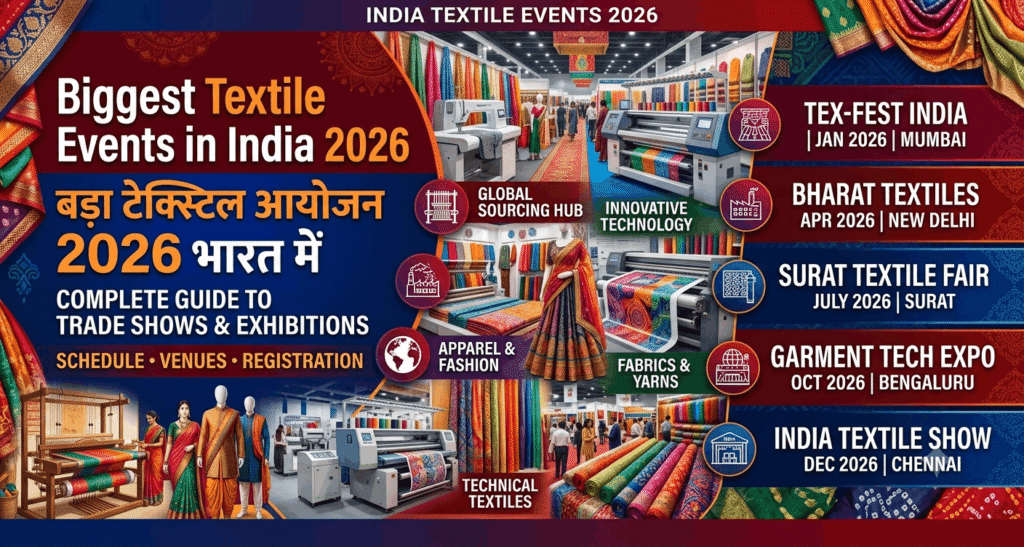

If you’re in the textile business, you already know one thing. Deals rarely happen from behind a desk. They happen on a trade show floor, over a cup of chai, while looking at a fabric sample under proper light. That’s exactly why textile events in India 2026 matter so much this year.
2026 is shaping up to be a big year for Indian textiles. Export targets are rising. Global buyers are actively looking to diversify away from a few traditional sourcing countries. And India, with its mix of scale, skill, and cost advantage, is right in the middle of that shift. Trade shows are where all of this comes together – buyers, sellers, machine makers, and fresh technology, all under one roof.
This guide walks you through the major textile exhibitions happening across India in 2026. You’ll get venues, dates, who should attend, and why each one is worth your time.
Why Textile Events Matter
Let’s be honest. Exhibitions cost money. Travel, stall booking, staff time – it adds up. So why do smart textile businesses still show up year after year?
Networking that actually converts. A phone call from an unknown supplier gets ignored. A face-to-face conversation at a stall gets remembered. Trade shows compress months of relationship-building into three or four days.
Finding buyers without middlemen. Many exporters land their first international order at a show like Bharat Tex or SITEX. Buyers travel to India specifically to meet multiple suppliers in one trip.
Finding suppliers you didn’t know existed. Fabric mills discover new yarn sources. Garment units discover new machinery vendors. You can’t Google your way to some of these connections.
Learning what’s actually new. Machinery brochures look the same online. Seeing a digital printing machine run live, or touching a new sustainable fabric, tells you far more.
Export opportunities. Government-backed shows like Bharat Tex bring in reverse buyer-seller meets, where international buyers are pre-scheduled to meet Indian exporters.
Sustainability conversations. Recycled fibres, organic cotton, water-saving dyeing – this is now a business requirement, not just a talking point. Exhibitions are where these solutions get demonstrated.
Government initiatives. Ministry of Textiles support, PLI scheme updates, and export incentive announcements are often shared first at these platforms.
Plain business growth. New orders, new partnerships, new markets. That’s the real return on investment.
Biggest Textile Events in India 2026
Bharat Tex 2026
Overview: Bharat Tex has quickly become India’s flagship textile exhibition. It’s organised by the Bharat Tex Trade Federation (BTTF), an umbrella body of textile export promotion councils, with backing from the Ministry of Textiles. The event is expected to see over 3,500 business exhibitors, more than 7,000 international buyers from over 140 countries, and over 1,30,000 trade visitors, making it one of the largest integrated textile shows anywhere.
Venue: Bharat Mandapam (Pragati Maidan), New Delhi
Expected dates: 14-17 July 2026
Organiser: The Consortium of textile-related councils, with support from the Ministry of Textiles, incorporating the 75th India International Garment Fair
Highlights: The show covers the entire textile ecosystem – fibres and yarns, fabrics, apparel and fashion, home textiles, technical textiles, handicrafts, handlooms, and smart manufacturing technologies. There’s also a Global Textile Dialogue with policy sessions on trade, ESG standards, and Industry 5.0.
Industries covered: Apparel, home furnishings, fibres, yarns, technical textiles, handloom, and handicrafts.
Who should attend: Exporters chasing new markets, buyers doing bulk sourcing, manufacturers scouting new machinery, and startups wanting visibility.
Why it’s important: This is the closest thing India has to a single national textile platform. If you can only attend one show a year, this is often the one people pick.
Business opportunities: Reverse buyer-seller meets, government policy briefings, and direct access to a genuinely international buyer base.
Garment Technology Expo (GTE)
Overview: GTE is India’s long-running exhibition for garment manufacturing machinery and technology. It’s been running since 2001 and has built a loyal base of repeat exhibitors.
Venue and dates: GTE runs two editions a year. The Greater Noida edition takes place at India Expo Centre and Mart from 20-23 March 2026, and the Bengaluru edition is held at Gayatri Vihar, Palace Grounds, starting 18 September and running through 20 September 2026.
Organiser: Garment Technology Expo Pvt. Ltd.
Highlights: Live demonstrations of sewing, knitting, embroidery, laundry, and cutting machinery. Past editions have drawn over 275 participants representing companies from 16 or more countries, with technology showcased from over 20 countries.
Industries covered: Garment manufacturing, machine spares, CAD/CAM systems, dyeing and finishing equipment, and packaging solutions.
Who should attend: Garment factory owners, production heads, technical supervisors, and machinery importers.
Why it’s important: If your business runs on machines, not just fabric, this is where you compare options side by side instead of relying on a salesman’s word.
Business opportunities: Direct negotiation with machinery makers and early access to new product launches.
Yarnex
Overview: Yarnex is India’s dedicated exhibition for fibres and yarns, bringing together suppliers from every major textile hub in the country.
Venue and dates: Yarnex TexIndia 2026 was held in Kolkata from 16 to 18 January 2026 at Biswa Bangla Mela Prangan. A second edition, Yarnex Tiruppur, runs from 24 to 26 September 2026 at the India Knit Fair Complex.
Organiser: S S Textile Media Pvt. Ltd.
Highlights: Exhibitors span fibres, yarns, fabrics, garments, trims, accessories, printing solutions, interlinings, and textile services, with strong representation from Ludhiana, Surat, Kolkata, Delhi, Mumbai, Tirupur, Ahmedabad, and Bengaluru.
Industries covered: Spinning, knitting, weaving, and yarn trading.
Who should attend: Powerloom weavers, knitters, composite mills, and clothing exporters looking for raw material sources.
Why it’s important: Raw material sourcing decisions directly affect your margins. Meeting yarn suppliers in person lets you check quality and negotiate rates you’d never get over WhatsApp.
Business opportunities: Building direct supplier relationships and bypassing traders.
TexIndia
Overview: TexIndia, running alongside Yarnex as the 23rd Textile Sourcing Fair, focuses on sourcing across the textile value chain, reinforcing regional hubs as sourcing centres for eastern India and neighbouring markets.
Venue and dates: Held jointly with Yarnex in Kolkata; check current organiser listings for confirmed dates of future editions, as this show’s schedule is subject to official confirmation each year.
Organiser: S S Textile Media Pvt. Ltd.
Highlights: A trade-only exhibition connecting manufacturers directly with garment buyers and sourcing teams.
Industries covered: Fabric sourcing, garment accessories, and textile trims.
Who should attend: Buying houses, sourcing agents, and export-focused manufacturers.
Why it’s important: It strengthens sourcing corridors that many smaller exporters rely on but rarely get written about.
Business opportunities: Building repeat-order relationships with regional buyers.
Knit Show
Overview: Knit Show is Tirupur’s flagship exhibition, and Tirupur itself needs no introduction if you’re in knitwear. The city produces around 90% of India’s cotton knitwear exports, so this show sits right at the centre of that ecosystem.
Venue: Toplight Centre, Manimahal Stop, Kangeyam Road, Tirupur
Expected dates: 21-23 August 2026
Organiser: City Leaves Media Events Pvt. Ltd.
Highlights: Over 500 exhibitors are expected, showcasing machinery, fashion accessories, fabrics, dyes, and chemicals.
Industries covered: Knitwear manufacturing, garment machinery, dyeing, and printing.
Who should attend: Knitwear manufacturers, export houses, buying agents, and fashion accessory suppliers.
Why it’s important: Tirupur’s knitwear cluster runs on tight timelines. A local show like this means faster follow-ups and shorter travel for regional businesses.
Business opportunities: Direct connections with Tirupur’s dense manufacturing base, plus visibility among Coimbatore, Karur, Erode, and Salem buyers who travel in for the show.
Book a Free Demo
See how Wortal can simplify your business and help you close more deals.


SITEX Surat
Overview: SITEX, organised by the Southern Gujarat Chamber of Commerce and Industry (SGCCI), is Surat’s own textile machinery showcase. Surat calls itself the textile capital of India for good reason – it’s a major hub for synthetic fabrics, sarees, and embroidered textiles.
Venue: Surat International Exhibition and Convention Centre (SIECC), Sarsana, Surat
Expected dates: SITEX has two editions in 2026 – the 13th edition ran from 21 to 23 February 2026, and a 14th edition follows on 4-6 July 2026, both at SIECC.
Organiser: Southern Gujarat Chamber of Commerce and Industry (SGCCI)
Highlights: World-class textile machinery and advanced technologies are showcased, including several machines launched in India for the first time.
Industries covered: Spinning, weaving, knitting, dyeing, printing, and technical textile machinery.
Who should attend: Manufacturers, dealers, wholesalers, and retailers across the textile value chain, especially those based in or sourcing from Gujarat.
Why it’s important: Around 15,000 B2B visitors attended the previous edition, and for anyone in Surat’s textile trade, this is practically a home-ground show.
Business opportunities: First-look access to machinery being launched in India, plus strong local buyer footfall.
Denim Show
Overview: Denim Show is India’s dedicated platform for the denim industry, held alongside Gartex Texprocess India.
Venue and dates: Organised twice a year – once in Delhi and once in Mumbai. The Delhi edition runs 6-8 August 2026 at Bharat Mandapam, Pragati Maidan, while the Mumbai edition was held 9-11 April 2026 at Bombay Exhibition Centre.
Organiser: MEX Exhibitions Pvt. Ltd. and Messe Frankfurt India, in collaboration with the Denim Manufacturers’ Association (DMA)
Highlights: India has grown into the world’s second-largest producer of denim fabric, with manufacturing capacity touching around 1,600 million meters annually, and this show reflects that scale.
Industries covered: Denim mills, accessories and trims, denim finishing and washing technology, and garment machinery.
Who should attend: Denim manufacturers, garment fabricators, fabric sourcing teams, and denim designers.
Why it’s important: Denim has its own supply chain quirks – washing, finishing, sustainability compliance – and this show speaks that specific language.
Business opportunities: Over 250 exhibitors typically showcase the latest denim products, technologies, and trends, giving buyers a concentrated view of what’s new in one category.
Global Fabric Expo
Overview: Another SGCCI initiative, this one focused purely on fabric, positioned as a B2B sourcing platform for the fabric segment.
Venue: Surat International Exhibition and Convention Centre (SIECC), Surat
Expected dates: 26-28 June 2026
Organiser: Southern Gujarat Chamber of Commerce & Industry (SGCCI)
Highlights: The show connects weavers, knitters, technical textile makers, and narrow fabric manufacturers with brand apparel manufacturers, wholesale traders, retailers, and fashion houses. Organisers expected participation from over 250 manufacturers and 20,000-plus buyers.
Industries covered: Weaving, knitting, technical textiles, and fabric trading.
Who should attend: Fabric buyers, apparel brands, and fashion designers looking for direct mill connections.
Why it’s important: For anyone buying fabric in bulk, this cuts out layers of trading and gets you straight to the manufacturer.
Business opportunities: Bulk sourcing deals and long-term partnerships with Surat-based mills.
Comparison Table
Textile Industry Trends in 2026
Sustainable textiles are no longer a niche request. Buyers, especially international ones, are asking for traceable, low-impact production as a baseline requirement, not a bonus.
Smart textiles are gaining ground – fabrics embedded with sensors or performance features for sportswear and technical use.
Technical textiles cover everything from medical fabrics to geotextiles used in construction. This segment is growing faster than traditional apparel textiles in many reports.
AI in textile manufacturing is showing up in quality inspection, demand forecasting, and even design generation. It’s still early, but the adoption curve is climbing.
Automation continues to reduce dependence on manual labour for repetitive tasks like cutting and stitching, especially in larger export units.
Digital printing keeps replacing older screen-printing methods because it’s faster for smaller batch sizes and reduces water use.
Circular fashion – recycling old garments into new fibre – is moving from pilot projects into actual commercial lines.
Organic fibres like organic cotton and hemp are seeing steady demand growth, particularly from European buyers.
Export growth remains a policy priority, with schemes aimed at helping Indian textile exporters compete with countries like Bangladesh and Vietnam on cost and speed.
Textile machinery innovation is a quiet but important trend – Indian machinery makers are increasingly competing with imported equipment on both price and quality.
Tips Before Visiting Textile Exhibitions
- Register early. Many shows offer free or discounted visitor passes for early registration.
- Schedule your meetings in advance instead of hoping to bump into the right person.
- Carry enough business cards. You’ll hand out more than you think.
- Prepare a compact product catalogue, digital and printed both.
- Wear comfortable shoes. You’ll be walking for hours.
- Download the event app if one is available – most now offer exhibitor maps and session schedules.
- Follow up within a week of the show. Leads go cold fast.
- Set a clear goal before you go – new buyers, new suppliers, or just market research. Walking in without a goal wastes the trip.
Who Should Attend
Manufacturers get to see machinery and materials firsthand before committing a budget.
Exporters get direct access to international buyers, often through pre-arranged meetings.
Buyers can compare multiple suppliers in a single visit instead of coordinating separate factory tours.
Designers pick up on new fabric textures, colours, and finishing techniques early.
Retailers scout upcoming trends before they hit the shelves.
Machinery suppliers get face time with decision-makers who actually approve purchases.
Students get a real-world view of the industry they’re entering, often with placement or internship leads.
Investors get a fast read on which segments – technical textiles, sustainable fabrics, denim – are actually growing.
A Real-World Example: How One Surat Exporter Grew Through Trade Shows

This is an illustrative example based on common outcomes seen in the Surat textile trade, not a specific verified case.
A mid-sized fabric export unit in Surat had been selling mostly to domestic wholesalers for years. Their production quality was solid, but their buyer base wasn’t growing.
They took a stall at a Surat-based textile expo, mainly to test the waters. Within the three-day show, they had conversations with buyers from two other states and one overseas sourcing agent, something that would have taken months of cold outreach otherwise.
Over the following year, that single connection turned into a recurring export order. The unit also picked up ideas on digital printing after watching a live demo at the same show, which they later added as a service line.
This pattern repeats often in Surat’s textile ecosystem. A single exhibition conversation, followed up properly, can shift a business from local supplier to regional or export player.
Planning Your 2026 Exhibition Calendar
Textile exhibitions aren’t just industry events. They’re where partnerships start, where you spot the next machine you’ll invest in, and where you understand what buyers actually want before your competitor does.
With shows spread across Delhi, Surat, Kolkata, Tirupur, and Bengaluru through 2026, there’s likely one that fits your calendar and your business goals. The businesses that treat these shows as a yearly habit, not a one-off, tend to be the ones that keep finding new buyers and staying ahead on technology.
Start planning your visits early. Book your travel, set your meeting goals, and treat each show as a genuine business trip, not a sightseeing one.
} ] }