

Most business owners hit the same wall at some point – the team is growing, processes are getting messier, and someone suggests “we need software.” Then comes the question: CRM or ERP?
The terms get thrown around a lot, often interchangeably. But they solve very different problems. Picking the wrong one – or worse, investing in both without clarity -can waste months of implementation time and serious money.
Here’s what actually matters when you’re trying to figure this out.
What Is CRM Software, and What Does It Actually Do?
CRM stands for Customer Relationship Management. At its core, it’s a tool built around one idea: manage every interaction with your leads and customers in one place.
Think of it this way. A sales representative follows up with 40 prospects a week. Without a CRM, they’re relying on memory, scattered notes, and WhatsApp reminders. With the right CRM software, every call, email, deal stage, and follow-up is tracked automatically.
For Indian SMBs especially, CRM software India adoption has picked up significantly in recent years – and for good reason. The sales cycle for most businesses here involves a lot of manual follow-up, relationship-building, and multi-channel communication. A good CRM ties all of that together.
Key functions of CRM software:
- Lead capture and tracking
- Sales pipeline management
- Customer communication history
- Task and follow-up reminders
- Reports on team performance and deal conversion
If your biggest challenge is “we’re losing leads” or “our sales team has no visibility” – a CRM is what you’re looking for.
What Is ERP Software, and How Is It Different?
ERP stands for Enterprise Resource Planning. Where CRM focuses on the front end – sales, marketing, customer communication – ERP handles the back end: finance, inventory, production, procurement, HR.
A manufacturing company in Surat, for example, might use ERP to manage raw material inventory, track production orders, process payroll, and handle GST filing – all from one system.
The real issue is that ERP is a much heavier system. It’s designed to integrate every operational department, which makes it powerful but also complex to implement. Most ERP implementations take months and require dedicated IT support.
CRM vs ERP: The Core Differences at a Glance
| Feature | CRM | ERP |
|---|---|---|
| Primary Focus | Sales & Customer Relationship Management | Operations, Finance & Resource Planning |
| Best For | Sales Teams, Service Businesses & SMEs | Manufacturing, Logistics & Large Enterprises |
| Implementation Time | Days to Weeks | Several Weeks to Months |
| Cost | Lower Investment, Usually Per-User Pricing | Higher Initial Investment & Setup Costs |
| Typical Users | Sales Representatives, Managers & Support Teams | Finance, HR, Operations & Management Teams |
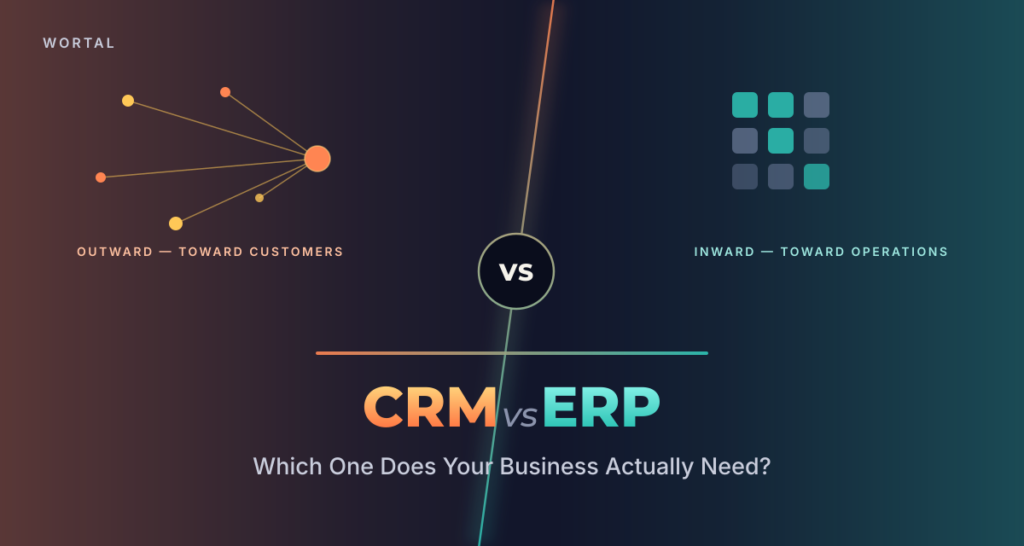
The simplest way to think about it: CRM is outward-facing (customers), ERP is inward-facing (operations).
Book a Free Demo
See how Wortal can simplify your business and help you close more deals.


When Does Your Business Need CRM Software?
Not every business needs an ERP – especially if you’re a growing SMB. But most businesses benefit from a business management software that handles customer-facing processes from day one.
Here’s when CRM is clearly the right call:
You’re a Service-Based or B2B Business
Consultants, real estate agents, insurance companies, IT firms – any business where relationships and follow-ups drive revenue needs a CRM before anything else.
Your Sales Team Is Growing
The moment you have more than 3-4 sales reps, manual tracking stops working. Deals fall through the cracks, leads get forgotten, and accountability goes out the window.
You Need Visibility into Your Pipeline
If your manager is asking “where are we with that client?” and no one has a clear answer, that’s a CRM problem.
You Want WhatsApp and Email Automation
Modern sales automation tools – including WhatsApp automation built for Indian businesses – let you automate follow-ups, trigger messages on deal stage changes, and track communication without manual effort.
When Does an ERP Make Sense?
ERP makes sense when operations complexity outgrows spreadsheets and standalone tools.
A company managing a factory floor, multiple warehouses, a large workforce, and multi-state GST compliance is a natural ERP candidate. That’s where disconnected systems create real financial and operational risk.
But here’s what most people ignore: a lot of Indian businesses try to jump to ERP too early. They end up with expensive software they use at 20% capacity because the core problem wasn’t operations – it was sales process and lead management software gaps.
Can CRM and ERP Work Together?
Yes – and for mid-sized companies, this eventually makes sense. A business might use a CRM for sales and customer management while connecting it to an ERP for billing, inventory, and accounts.
The key is sequencing. Most growing businesses in India benefit from solving their customer relationship management and sales pipeline challenges first. Once that’s running smoothly, adding ERP capabilities – or integrating an ERP tool – becomes a much cleaner exercise.
Key Takeaways Before You Decide
- If you’re primarily struggling with leads, follow-ups, and sales visibility – start with CRM.
- If your operations are complex and you need to manage inventory, finance, and HR in one system – ERP deserves serious consideration.
- For Indian SMBs just scaling up, CRM software India built for local business needs (WhatsApp automation, Indian lead sources, regional pricing) is usually the faster and more affordable starting point.
- Don’t overcomplicate it. A simple, well-adopted CRM beats a powerful ERP that no one uses.
In practical terms, the right software is the one your team will actually use consistently. Fancy features mean nothing if adoption is poor.
Frequently Asked Questions
CRM focuses on managing customer relationships, sales pipelines, and communication. ERP covers internal operations like finance, inventory, HR, and production. They serve different functions and often different departments.
For most small businesses in India, CRM software is the better starting point. It’s quicker to implement, more affordable, and directly impacts revenue by improving sales follow-up and lead conversion.
Not entirely, but it can handle a large portion of what a growing SMB actually needs on a day-to-day basis. Many businesses run effectively on a CRM plus a separate accounting tool without needing full ERP functionality.
Look for lead management, WhatsApp integration, visual sales pipeline, task tracking, and report dashboards. Pricing in INR and local customer support are also important factors when evaluating CRM software India options.
Yes. Many businesses use both CRM for the sales side and ERP for operations, then integrate them so data flows between the two systems. This works well once your business has outgrown using each tool in isolation.