

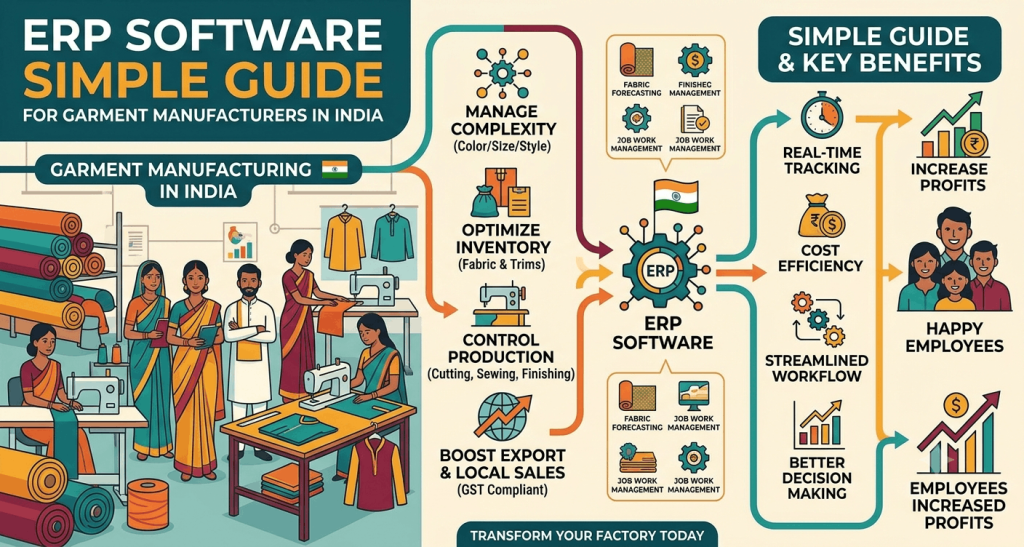

If you run a garment business in India, you already know the daily chaos. Fabric orders here. Production updates there. Payments tracked in a notebook. Buyer calls asking about delivery dates you can’t answer right away.
This is where ERP software for garment manufacturers comes in. It’s not complicated. It simply puts all your business information in one place, so you don’t have to remember everything or chase five people for one answer.
Let’s understand this properly, in plain language.
What is ERP for a garment business?
ERP stands for Enterprise Resource Planning. In simple words, it’s software that connects every part of your business.
Your fabric stock. Your cutting process. Your stitching line. Your quality checks. Your billing. Your dispatch. All of it sits in one system instead of scattered across registers, Excel sheets, and WhatsApp chats.
For garment units, this matters more than most industries. Why? Because one order passes through many hands. Fabric team, cutting master, tailors, quality checker, packing staff, accountant. If even one person forgets to update something, the whole order tracking goes wrong.
A good ERP for garment industry India fixes this by making sure everyone updates the same system. No confusion. No guesswork.
Why garment manufacturers in India need this now
Let’s talk about real problems, not just theory.
Problem 1: Fabric wastage nobody notices – Cutting masters estimate fabric usage. Nobody checks it against actual usage later. Small gaps add up. Over a few months, this quietly eats your profit.
Problem 2: No one knows order status instantly – The owner finds out an order is late only when the buyer calls. By then, it’s already a problem.
Problem 3: Payments and orders live in one person’s head Usually it’s the accountant or the owner’s trusted staff member. If that person is on leave, work stops.
Problem 4: No idea which orders actually made profit You know your yearly profit. But you don’t know if a specific order, after rework and delays, actually lost money.
These problems are common. They happen in almost every unit that runs without a proper system. That’s exactly why more owners are now looking for the best ERP software for garment business India has to offer.
What features actually matter for garment units
Not every ERP is built the same way. Garment manufacturing has its own needs. Here’s what your system should handle:
Order tracking by size and colour: A shirt order of 500 pieces is not one number. It’s different sizes, different colours, maybe different delivery dates. Your system should track all of this clearly.
Fabric consumption tracking: When cutting starts, the actual fabric used should get recorded right there. Not guessed. Not checked later.
Job work tracking : Many units send work outside for stitching, printing, or embroidery. Your ERP should track what fabric went out and what finished goods came back. This is one of the biggest leakage points in garment businesses.
GST billing built in – E-invoice, e-way bill, GST return matching – this should be part of your daily work, not a separate task done once a month.
WhatsApp-based updates : Factory staff won’t sit and use a computer all day. If updates can go through WhatsApp, your team will actually use the system daily.
Simple dashboard for the owner: You should be able to check order status, payments, and production without calling anyone.
Book a Free Demo
See how Wortal can simplify your business and help you close more deals.


How the process works, step by step
Here’s how a proper ERP setup manages one order from start to finish:
- Order gets booked with size, colour, and quantity details
- Fabric gets issued for cutting, and actual usage gets recorded
- Stitching happens, and daily output gets updated
- Quality check happens, and any rework gets logged
- Approved pieces move to packing and dispatch
- Invoice and e-way bill get generated automatically
- Owner sees the full picture on one dashboard
Notice step 4. Rework happens often in garment units. A proper system should send pieces back for correction and still keep track of everything. This is where most spreadsheet systems fail. They simply lose the data once something goes back for rework.
Comparing your options
A quick look at how each option handles the essentials for a garment business
| What you use | Fabric tracking | Order profit tracking | Job work tracking | Setup time |
|---|---|---|---|---|
| Excel and WhatsApp | Manual, often wrong | Very difficult | Not tracked | Quick, but unreliable |
| Basic accounting software | Not built for this | Partial | Not tracked | A few days |
| Large global ERP systems | Yes, but too complex for small units | Yes | Needs heavy setup | Months |
| ERP built for Indian garment SMBs | Yes, built-in | Yes | Yes, built-in | 1 to 3 weeks |
This is exactly where Wortal fits in. It is built for Indian small and medium businesses, including textile and garment units. It handles lead tracking, inventory, and order pipeline in one simple system, without the heavy setup that large ERP systems demand.
A real example from the textile trade

Take a garment unit in Surat that supplies to domestic retail stores. Before using any proper system, order tracking happened through a diary and a shared Excel file, updated by two different supervisors.
One season, a buyer placed a repeat order. They expected the same fabric colour as the previous batch. But the fabric lot had changed slightly, and nobody noticed this in time. The order got dispatched. The buyer rejected almost a third of the pieces due to colour mismatch.
This is a costly mistake. Rework costs money. Delayed dispatch costs trust. And a repeat buyer almost walked away because of one missed detail.
Once the unit started tracking fabric lot numbers along with each order, this kind of mistake became easy to catch before dispatch. It’s a small change. But it protects both money and relationships.
This is the real value of using proper ERP software for garment manufacturers. It’s not about fancy features. It’s about catching small mistakes before they become big losses.
Key takeaways for garment business owners
- Fabric wastage and job work leakage are silent profit killers. Track both properly.
- Track orders by size and colour, not just total pieces.
- Keep GST billing inside your daily workflow, not as a separate task.
- Choose a system your staff will actually use. WhatsApp-based updates work better than complex dashboards.
- Look for the best ERP software for garment business India offers specifically for SMBs, not large global systems built for bigger industries.
- Track profit order by order, not just at year end.