

Walk into any textile unit in Surat, Bhiwandi, or Erode at 10 am and you’ll see the same scene. Someone shouting fabric measurements over the phone. A register with half the entries crossed out. An owner trying to remember which buyer still owes money for the last three months. This isn’t a small-town problem. It happens in units doing 2 crore a year and units doing 50 crore a year.
The textile business runs on speed and memory. But memory fails, and speed without control just means faster losses. That’s the real reason textile ERP software India has become such a hot topic among manufacturers this year – not because of some tech trend, but because the old way of running things has hit its limit.
This guide isn’t going to give you a textbook definition of ERP. You’ve probably heard that already. Instead, let’s talk about what actually happens when a textile manufacturer adopts the right system, what goes wrong when they pick the wrong one, and how to think about this decision like a business owner, not an IT person.
Why Textile Manufacturing Needs a Different Kind of ERP
Most generic ERP systems are built for manufacturing in general – bolts, machinery parts, packaged goods. Textile is different in ways that trip up standard software.
Fabric doesn’t move in simple units. A single order might involve shade variation, lot numbers, GSM, width, and quality grade – all for the same fabric type. A generic system treats “cotton fabric” as one item. A textile business needs to treat it as dozens of sub-variants that all look the same to an outsider but mean completely different things to a buyer.
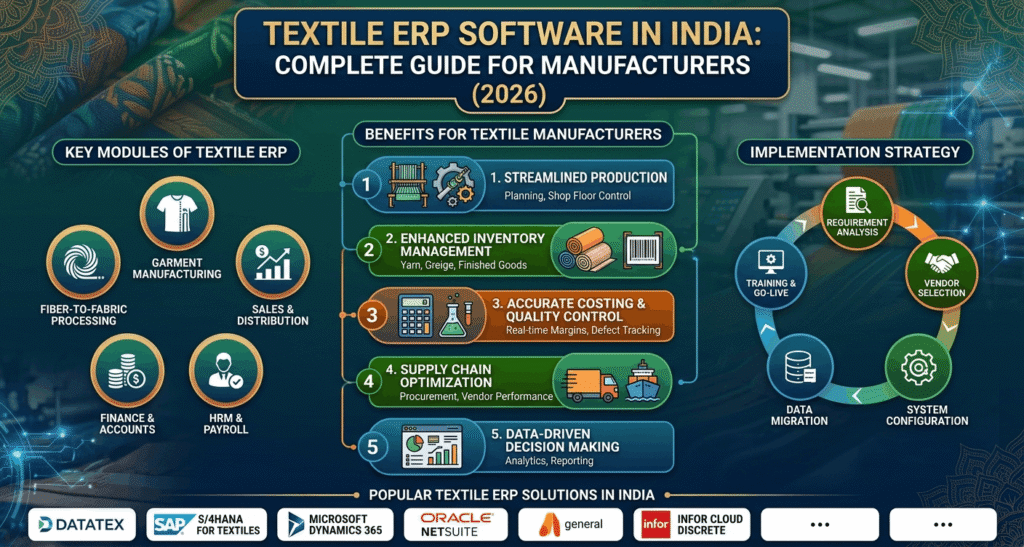
This is where ERP software for textile manufacturers needs to be purpose-built. It has to track:
- Fabric by shade, lot, and roll number
- Godown-wise and rack-wise stock
- Job work sent to weavers, dyers, and printers
- Wastage percentage across processing stages
- Buyer-specific rate cards and credit cycles
A regular accounting tool or a bolted-together spreadsheet system just can’t hold this complexity without breaking down somewhere.
The Real Cost of Not Having One
Here’s what actually matters when you’re running a textile unit without proper systems in place.
Most owners think the loss shows up in obvious places – a wrong invoice, a missed payment reminder. It rarely does. The loss hides in small leaks that add up over months.
A trader in Surat once told me his firm was losing close to 4% of stock value every year to what he called “normal wastage.” When his team finally sat down and mapped every roll against actual sales, they found nearly half of that wasn’t wastage at all – it was stock sitting in a corner of the godown that nobody had billed, because the paper register never got updated after a partial dispatch.
That’s the pattern. Not theft, not fraud – just untracked movement. And untracked movement is exactly what a proper system is designed to close.
Book a Free Demo
See how Wortal can simplify your business and help you close more deals.


What Good Textile ERP Software Actually Looks Like
Let’s get specific, because vague promises like “manage your business better” don’t help anyone.
1. Inventory That Understands Fabric
Stock tracking in textile has to go beyond quantity. It needs shade-wise and lot-wise visibility so that when a buyer calls asking “do you have 200 meters of navy blue in lot 14,” someone can answer in ten seconds, not ten minutes.
2. Job Work and Process Tracking
Textile production often moves across multiple units – greige to dyeing unit to printing unit to your own warehouse. A good system tracks the fabric at every stage, including what’s pending, what’s overdue, and what’s been short-received.
3. GST and Billing Built for Textile Trade
E-invoicing, e-way bills, and GST reconciliation aren’t optional anymore. A system that auto-generates these on order creation saves hours every single week, especially during peak season when order volume triples.
4. Buyer and Order Management
Textile buyers negotiate hard, often on credit, often in bulk. Having a visual pipeline of every deal – from inquiry to confirmed order to dispatch – keeps sales teams from losing track of who’s actually going to pay versus who’s just browsing rates.
5. WhatsApp-First Communication
Let’s be honest – in textile trade, WhatsApp is the real communication channel, not email. A system that can send payment reminders, dispatch confirmations, and rate updates directly through WhatsApp fits how this industry actually works, instead of forcing owners to change their habits.
Here’s a simple way to visualize where the real gaps usually sit in a textile business before ERP adoption:
Order Received → Fabric Sourced → Job Work (Dyeing/Printing) → Quality Check → Dispatch → Billing → Payment Collection
| | | | | | |
Manual entry No lot tracking No pending alerts Skipped often Delayed GST errors No follow-up
Every arrow above is a point where a paper-based or spreadsheet-based system quietly leaks time, stock, or money. An ERP system closes these gaps one by one.
Small Business vs Large Manufacturer: Different Needs, Same Foundation
There’s a common myth that ERP is only for big manufacturers with 100+ employees. That’s outdated thinking.
Textile ERP software for small business owners actually benefits more in relative terms, because small units run on thinner margins and can’t absorb the same losses a large mill can. A trading unit with 8 employees loses proportionally more from one missed payment follow-up than a factory with 200 workers.
The difference isn’t whether small businesses need ERP – it’s what features they need first.
| Business Size | Priority Features | Typical Monthly Investment |
|---|---|---|
| Small trader/manufacturer (5-15 staff) | Inventory, billing, WhatsApp automation | Rs.200-350 per user |
| Mid size unit (15-50 staff) | Job work tracking, multi-branch, deal pipeline | Rs.350-500 per user |
| Large manufacturer (50+ staff) | Full production tracking, multi-business, advanced analytics | Custom pricing |
Notice the pricing doesn’t jump dramatically between small and mid-size. That’s intentional in most modern SaaS-based systems – the cost curve is designed to stay affordable as a business scales, not punish growth.
Where Wortal Fits Into This Picture
Wortal is a CRM and business management platform built specifically with Indian SMBs in mind, and textile has been one of its strongest use cases – especially among Surat-based trading and manufacturing units.
What makes it relevant here isn’t a long feature list. It’s that the core modules – lead management, inventory, sales pipeline, employee tracking, and WhatsApp/email automation – map directly onto the daily friction points textile businesses actually deal with. A textile trader doesn’t need forty modules. They need five or six that work reliably, every single day, without a three-week training program.
If you’re comparing options, it’s worth putting Wortal next to platforms like Zoho, Kylas, or Salesmate and asking one honest question – does this system understand fabric-level complexity, or is it a generic CRM with a textile label stuck on top?
Practical Tips Before You Choose a System
A few things I’d tell any manufacturer sitting on this decision right now:
- Don’t buy on features alone. Ask for a live demo using your actual product categories – shade, lot, GSM – not a generic demo dataset.
- Check WhatsApp integration depth. Not every system that claims WhatsApp automation actually sends real-time triggers on task or invoice creation.
- Ask about offline usage. Many godowns and factory floors still have patchy internet. A system that fails without constant connectivity will frustrate your floor staff fast.
- Involve your accountant early. GST reconciliation errors are one of the most common reasons textile ERP rollouts get abandoned within the first three months.
- Start with one branch or one product line. Full rollout across a multi-branch operation on day one almost always causes resistance from staff who aren’t used to digital entry.
A Real Example: How One Surat Unit Turned It Around

A fabric trading business in Surat, dealing mainly in synthetic sarees, was running everything on Excel and a physical stock register till early 2025. The owner’s biggest complaint wasn’t sales – sales were fine. It was that he never knew, on any given day, exactly how much stock was actually available versus already committed to a buyer.
This led to a recurring problem: sales staff would confirm orders on fabric that had technically already been promised to someone else. Buyers got upset. Deliveries got delayed. Trust took a hit with two long-term clients.
After moving to a proper textile ERP software India solution, the business set up shade and lot-wise inventory tracking along with a live deal pipeline. Within four months, double-booking complaints dropped to nearly zero. More importantly, the owner started using the dashboard every morning – five minutes, before opening the shop – to check pending payments and low-stock alerts.
He told me the biggest shift wasn’t the software itself. It was that his sales team stopped guessing. Every number they quoted to a buyer was based on real data, not memory.
Key Takeaways
- Textile businesses need systems built around fabric-specific complexity – shade, lot, GSM – not generic inventory logic.
- The real cost of not having an ERP isn’t obvious losses; it’s the small, repeated leaks in untracked stock and missed follow-ups.
- ERP software for textile manufacturers should support job work tracking across dyeing, printing, and processing units, not just finished goods.
- Small businesses benefit as much as, or more than, large manufacturers – pricing models today reflect that.
- WhatsApp-based automation matters more in this industry than most software vendors admit.
- Start small – one branch, one product category – before rolling out company-wide.