

If you run a textile shop or a wholesale unit anywhere in India, you already know the headache. Bills scattered across notebooks. GST returns filed at 11 pm the night before the deadline. A customer asking for a proper invoice and you fumbling with Excel sheets that don’t match your stock register.
I’ve spent years talking to textile traders – from Surat’s Ring Road market to smaller units in Bhiwandi and Erode – and the story is almost always the same. The business is doing fine. The billing is a mess.
That’s where GST billing software India solutions come in. Not as some fancy tech upgrade, but as a basic survival tool for anyone selling fabric, sarees, or garments at scale.
Why Textile Businesses Struggle More With GST Than Other Industries
Textile isn’t like selling one product with one HSN code. A single trader might deal with:
- Grey fabric (one GST slab)
- Finished garments (different slab)
- Job work transactions with karigars
- Interstate sales to Delhi or Kolkata buyers
- Cash-heavy retail counters alongside B2B wholesale
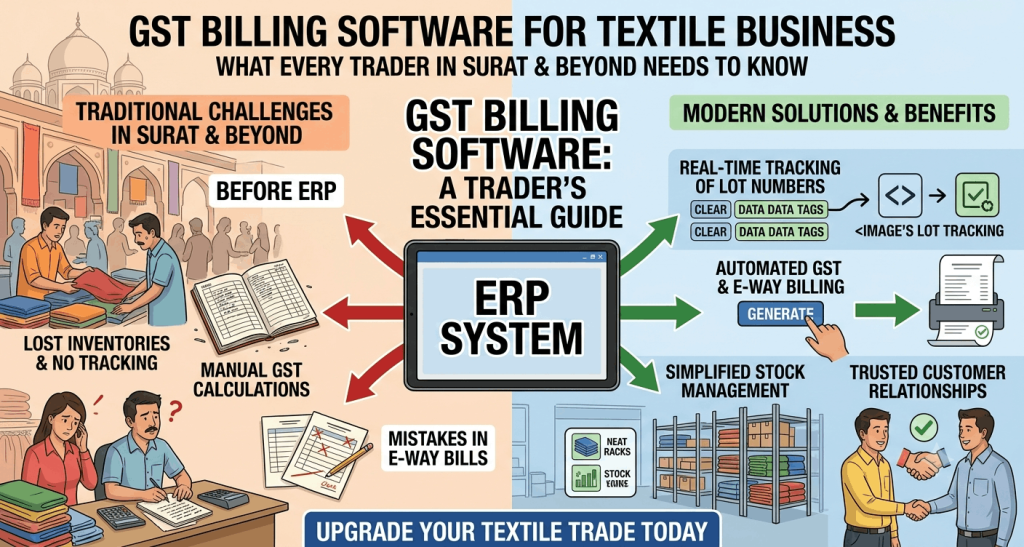
Most people ignore this part – but the real complexity in textile GST comes from mixed transaction types happening in the same shop, on the same day. A generic accounting tool wasn’t built for that. A proper textile billing software with GST built-in was.
I remember a trader in Sachin GIDC telling me his CA charged him extra every month just to reconcile GSTR-1 with his manual bills. That’s not a one-off story. That’s the norm when billing and tax filing live in two different worlds.
Book a Free Demo
See how Wortal can simplify your business and help you close more deals.


What Actually Matters When Choosing GST Software
Here’s what actually matters – not the shiny dashboard, not the number of features listed on a sales page.
1. HSN Code Handling for Textile Items
Textile has some of the most confusing HSN classifications in Indian GST. Your software should auto-suggest HSN codes based on product category, not leave you googling every time.
2. GST Rate Auto-Application
Cotton, synthetic, blended fabric – rates differ. If your billing tool doesn’t auto-apply the correct rate per SKU, you’re one invoice away from a mismatch notice.
3. E-Way Bill Generation
If you’re moving fabric rolls worth over Rs.50,000 between states, you need e-way bills generated directly from the same invoice – not a separate portal login every single time.
4. WhatsApp and Email Invoice Sharing
In practical terms, most textile buyers today expect the bill on WhatsApp within minutes of the deal closing. If your system can’t do that, you’re already behind your competitor down the lane.
5. Reconciliation With GSTR-2B
This is the part that saves real money. Matching your purchase invoices against GSTR-2B tells you exactly how much input tax credit you’re actually eligible for – and how much you’re losing due to vendor non-compliance.
The Real Cost of Manual Billing (With Numbers)
Let’s talk numbers, because vague warnings don’t convince traders.
A mid-sized textile wholesaler doing around Rs.40 lakh monthly turnover typically issues 150-200 invoices a month. Manually:
Time saved with GST software
A side-by-side look at manual GST work versus automated GST software
| Task | Manual process time | With GST software |
|---|---|---|
| Invoice creation per bill | 8-10 minutes | 1-2 minutes |
| Monthly GSTR-1 prep | 6-8 hours | 30-45 minutes |
| ITC reconciliation | 4-5 hours (often skipped) | Automated matching |
| E-way bill per transaction | 5-7 minutes | Instant, linked to invoice |
That’s roughly 25-30 hours saved every month. For a shop owner also managing staff, inventory, and buyers, that’s almost a full working week reclaimed.
Choosing the Best GST Software for Textile Shop – A Practical Checklist
When traders ask me how to shortlist the best GST software for textile shop use, I tell them to ignore the marketing brochures and test these things directly:
- Can it handle both retail counter sales and wholesale B2B billing in one system?
- Does it support multi-branch operations if you have a godown and a separate showroom?
- Can your accountant get login access without seeing your full banking details?
- Does it auto-generate GSTR-1 ready data instead of just raw invoice exports?
- Is customer support available in Hindi or Gujarati, not just English chatbots?
That last point sounds small. It isn’t. I’ve seen traders abandon software mid-year purely because support was unreachable during filing week.
Where Wortal Fits Into This Picture
This is where I’ll be direct instead of vague. Wortal was built keeping India’s SMB textile ecosystem in mind – not adapted from some global template.
For a textile business, Wortal’s lead and inventory management works alongside GST-ready billing so your stock movement and your tax filing are talking to each other, not sitting in separate spreadsheets. The visiting card scanning feature alone has changed how traders at trade fairs and exhibitions capture new buyer leads – scan a card, and the contact plus deal stage is logged instantly instead of sitting in a drawer of cards you’ll never follow up on.
Combined with WhatsApp automation for order confirmations and inventory tracking down to the godown level, it solves the exact fragmentation problem textile traders face daily.
A Real Case: Rahul’s Story From Surat

Dheeraj runs a saree wholesale unit near Ring Road, Surat. Turnover around Rs.60 lakh a month, dealing mainly with buyers from Kolkata and Hyderabad.
Before switching to proper GST billing software India tools, his monthly routine looked like this: bills written by hand at the counter, data entered into Tally at night by his brother-in-law, and GST returns handled by a CA who charged extra for reconciliation because half the invoices had missing HSN codes or wrong tax slabs.
Two things changed after he moved to a proper billing system. First, his invoice generation time dropped from almost 10 minutes per bill to under 2. Second – and this mattered more – his ITC claims went up by nearly 12% in the first quarter simply because the system caught mismatches his manual process had been missing for years.
His words to me, almost word for word: “Main pehle sochta tha ye software sirf bade companies ke liye hai. Ab lagta hai chhote trader ko iski zyada zaroorat hai.”
That’s the honest truth most software vendors won’t tell you – smaller traders need this more than large corporations who already have full accounting departments.
Key Takeaways for Textile Traders
- Don’t pick software just because it’s cheap – check if it actually understands textile-specific HSN and tax slabs
- Prioritize e-way bill and WhatsApp invoicing over flashy dashboards you’ll never use
- Test the ITC reconciliation feature before buying – this is where real money is saved
- Make sure your CA or accountant can access data without you sharing full login credentials
- A textile billing software with GST that also handles leads and inventory saves you from juggling three different tools
A Quick Word on GST Compliance Trends
GST enforcement around e-invoicing thresholds has tightened steadily. Traders crossing certain turnover limits are already required to generate e-invoices, and this threshold has been lowering year on year. If you’re not automated yet, you’re not just losing time – you’re closer to non-compliance than you think.