

If you run a sales team in India, you already know the real problem isn’t finding leads. It’s losing them after you find them.
Ask any sales manager in Surat, Ahmedabad, or Bhiwandi and you’ll hear the same story. A lead comes in from IndiaMART or a WhatsApp inquiry, someone jots it on a notepad or a WhatsApp chat, and then it sits there. Three follow-ups later, the prospect has already bought from someone who replied faster.
That gap between “lead captured” and “lead converted” is exactly what’s fueling India’s lead management software boom right now. And the numbers behind this shift are worth understanding if you’re a business owner, a sales head, or someone evaluating software for your team.
What’s actually driving this market
Lead management is technically a slice of the broader CRM software space, and that space in India has been growing at a steady clip. Industry estimates put India’s CRM software market somewhere in the USD 2.3 to 2.5 billion range as of 2024-25, with most analysts projecting a compound annual growth rate between 9% and 12% through the early 2030s. Lead management tools, being the entry point most SMBs actually use first, are growing faster than the CRM category average.
Here’s what’s really pushing this:
WhatsApp became the default sales channel. Not email, not phone calls first. In sectors like textiles, real estate, and manufacturing, a huge chunk of buyer conversations start on WhatsApp. Software that doesn’t track WhatsApp threads is basically invisible to how Indian SMBs actually sell.
IndiaMART and TradeIndia lead volumes exploded. A single manufacturing SME can get 40-80 leads a day from these platforms during peak season. Nobody manages that in a spreadsheet without leads falling through.
GST formalization pushed more businesses into digital record-keeping. Once you’re maintaining digital books for compliance, moving your sales pipeline online stops feeling optional.
Trade shows and exhibitions are back at full scale. Events like Bharat Tex are generating thousands of business card exchanges in two or three days. Manually entering those into a system afterward is where most of that data quietly dies.
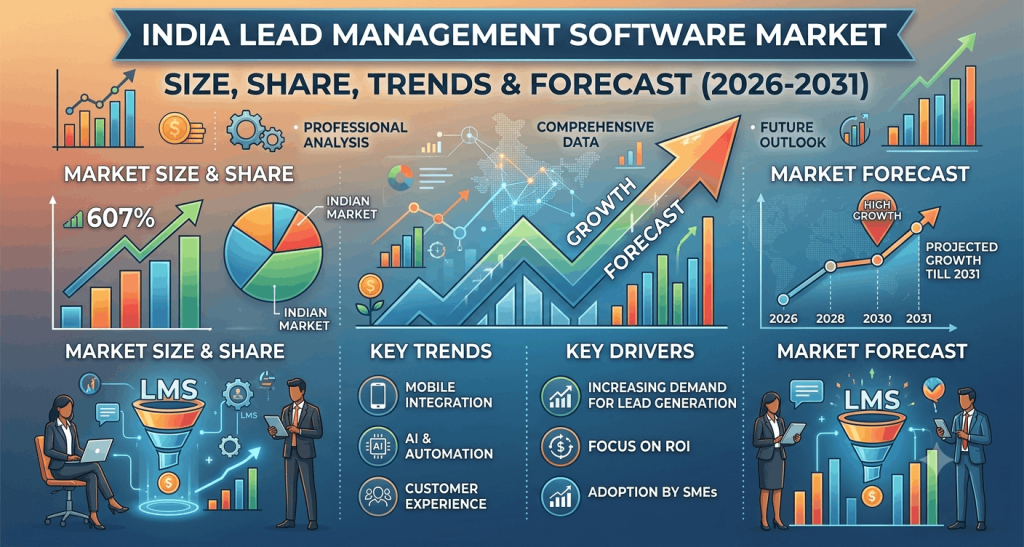
Let me show you how the market breaks down over the next few years:

That steady upward curve isn’t hype. It reflects a genuine shift: businesses that used to treat “software” as a large-enterprise expense are now buying tools priced for their actual size.
Book a Free Demo
See how Wortal can simplify your business and help you close more deals.


Who’s segmenting this market, and how
The India lead management space splits along a few clear lines. Understanding these helps you see where the real competition and real opportunity sit.
By business size
- Micro and small businesses (under 20 employees): This is the fastest-growing segment, driven almost entirely by pricing. Tools priced under Rs.500 per user per month are winning here.
- Mid-size SMBs (20-200 employees): This segment wants automation more than basic tracking – auto-assignment, WhatsApp triggers, pipeline visibility.
- Large enterprises: Still dominated by Salesforce, Zoho One, and custom builds, but even here, department-level teams are adopting lighter tools for specific use cases.
By industry vertical
Textile and apparel, real estate, manufacturing, and insurance are the four verticals generating the most lead management software demand in India right now. Each has a distinct reason:
- Textile businesses in hubs like Surat and Tiruppur deal with high lead volume from trade shows and B2B marketplaces, and buyers expect near-instant WhatsApp replies.
- Real estate teams need lead scoring because site visit conversions depend on speed and follow-up discipline.
- Manufacturing firms need lead-to-order tracking that ties into inventory, since a lead isn’t “closed” until stock is confirmed.
- Insurance agents need renewal reminders baked into the same system that captured the original lead.
By deployment type
Cloud-based, mobile-first tools are winning decisively over on-premise setups. This isn’t surprising given how much Indian sales activity happens from a phone in the field, not a desktop in an office.
The part most reports skip: why lead loss actually happens
Most market reports stop at “adoption is rising.” Here’s what actually happens on the ground, because I’ve seen this pattern repeat across dozens of SMBs.
A business gets a lead from an exhibition. Someone scans a visiting card or types the details into a phone note. That note sits until the person is back at their desk, sometimes three or four days later. By then, two things have happened: the prospect has forgotten the conversation, and a competitor who followed up sooner has already sent a quote.
This is not a motivation problem. It’s a systems problem. The lead management tools growing fastest right now are the ones solving this exact gap – OCR-based card scanning that turns a photo into a CRM entry on the spot, and WhatsApp automation that sends a follow-up message within minutes of capture, not days.
Key takeaways for anyone buying or building in this space
- Speed to first response matters more than feature count. A tool with fewer features but faster capture-to-follow-up time will outperform a feature-heavy tool that requires manual entry.
- WhatsApp integration isn’t a nice-to-have anymore. If a lead management tool doesn’t track WhatsApp conversations, it’s missing where most Indian B2B conversations actually happen.
- Regional and sector-specific tools are gaining ground against generic global CRMs. A textile business doesn’t want to configure Salesforce for six months; it wants something that understands godown-to-dispatch workflows out of the box.
- Pricing transparency wins trust. SMB buyers in India are wary of “contact sales” pricing pages. Clear per-user monthly pricing converts better.
A real case: what changed for a Surat textile trader
A mid-sized fabric trading unit in Surat’s Ring Road market used to run its entire sales pipeline through a shared notebook and a WhatsApp broadcast list. During Bharat Tex season, their two-person sales team collected close to 300 visiting cards over three days. By the time they were back in Surat and had a free afternoon, they’d manually entered maybe 60 of those cards. The rest sat in a drawer.
After moving to a CRM with visiting card scanning and automated WhatsApp follow-ups – Wortal is one option built for exactly this kind of use case, alongside tools like Kylas and Zoho – the same team started capturing leads the moment they scanned a card at the booth. Follow-up messages went out automatically within the hour instead of within the week.
Their conversion rate from exhibition leads didn’t double overnight. But their response time dropped from an average of 4 days to under 6 hours, and that alone recovered a meaningful chunk of leads that would have otherwise gone cold. The lesson here isn’t about any one tool – it’s about how much revenue sits in the gap between capture and contact.
Yes, if you’re getting more than 10-15 leads a week from multiple sources like WhatsApp, IndiaMART, and walk-ins. Below that volume, a well-organized spreadsheet might still work fine. The moment leads start coming from more than two channels, tracking manually gets messy fast.
Lead management is narrower. It focuses on capturing, scoring, and following up on leads before they become customers. A full CRM also handles post-sale relationship management, support tickets, and sometimes billing. Many Indian SMBs start with lead management and grow into a full CRM later.
It depends on how specific your workflow is. If your sales process is fairly standard (inquiry, quote, follow-up, close), a generic CRM works fine. If your business has industry quirks – like textile lead-to-dispatch tracking or real estate site-visit scheduling – a sector-aware tool saves you months of custom configuration.
Still growing. Large enterprises adopted CRM years ago, but Indian SMBs are the newer wave of buyers, and there are millions of small businesses yet to move off manual tracking. That’s most of where the growth over the next five years is coming from.