

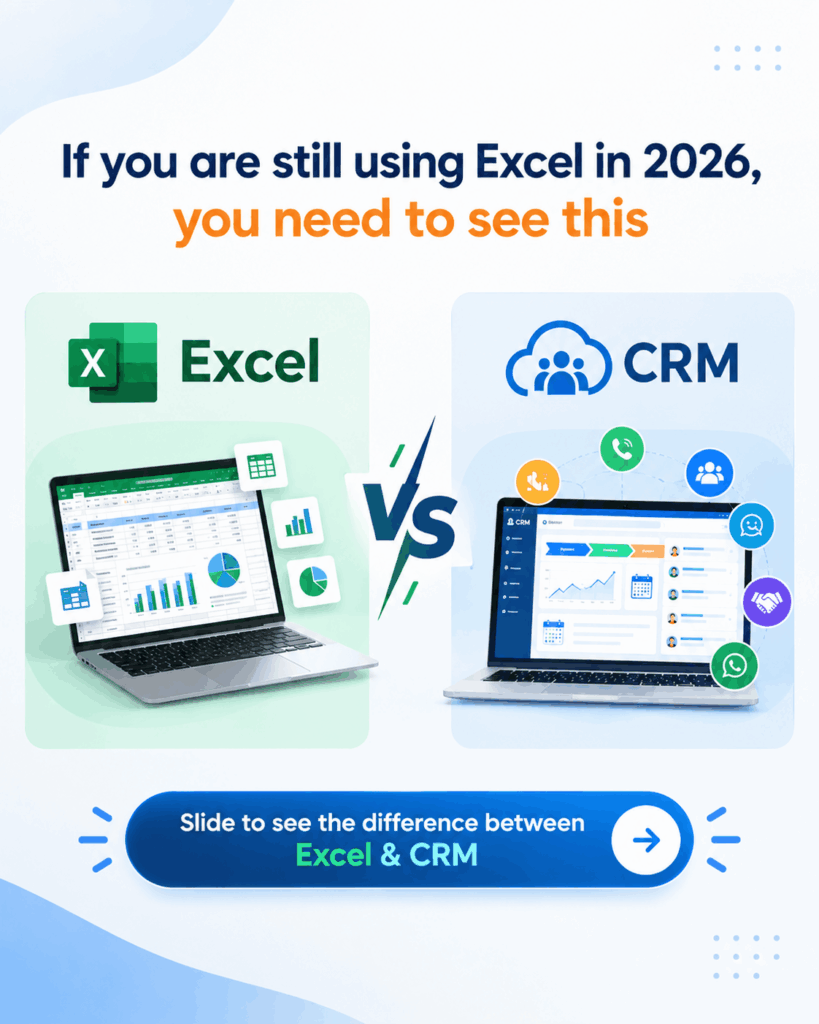

Every second business owner I’ve spoken with in the last few years has the same story. They started with an Excel sheet. It worked fine for the first twenty leads. Then it stopped working, and nobody noticed until a big client walked away.
That’s usually the moment someone starts Googling Lead Management Software.
I’ve watched this shift happen across textile units, real estate firms, and small manufacturing setups. The pattern is almost identical everywhere. Excel feels free and familiar in the beginning. Then the business grows, the leads pile up, and the sheet turns into a mess nobody wants to open.
Let’s talk about why this switch is happening, and why it’s not just a trend, it’s a survival move for growing businesses.
The Excel Sheet Problem Nobody Talks About Openly
Excel isn’t a bad tool. It’s just the wrong tool for tracking people.
Here’s what actually happens in most small businesses. A sales guy adds a new lead. He forgets to update the status. Two weeks later, someone else calls the same lead, not knowing it was already followed up. The client gets irritated. He assumes the company is disorganized. He picks a competitor instead.
This isn’t a one-off mistake. It’s a structural flaw in how spreadsheets work.
A few things spreadsheets simply can’t do well:
- They don’t send reminders when a follow-up is due
- They don’t show you which leads are going cold
- They don’t track who called, when, and what was said
- Multiple people editing the same file causes version chaos
- There’s no automatic record of missed opportunities
Most people ignore this part until it costs them a real deal. And by then, the damage is already done.
What Lead Management Software Actually Solves
A Lead Management Software isn’t just a fancier version of Excel. It’s built around one job, making sure no lead falls through the cracks.
Think of it like this. An Excel sheet is a diary. A Lead Tracking Software is a personal assistant who reads that diary every morning and tells you exactly who to call, why, and what was said last time.
Here’s a simple way to picture the difference:
Excel Sheet vs. Lead Management Software Workflow
That’s the real gap. It’s not about looking modern. It’s about not losing money that’s already sitting in your pipeline.
Why Indian Businesses Are Switching Faster Than You’d Expect
The demand for Lead Management Software in India has grown quietly but steadily, especially among SMBs that used to run entirely on WhatsApp groups and Excel files.
A few reasons this is happening specifically in India right now:
1. WhatsApp is the actual sales floor
Most Indian businesses, especially in textile, real estate, and trading, do their real selling on WhatsApp. But WhatsApp chats aren’t searchable across a team, and they vanish into scroll history within days. A good Lead Management Software pulls WhatsApp conversations into one dashboard so nothing gets buried.
2. Teams are growing but processes aren’t
A business that had two salespeople two years ago now has eight. Excel worked fine for two people sitting in the same room. It falls apart completely once you have eight people working from different cities.
3. Owners want visibility without micromanaging
I’ve heard this from more business owners than I can count – “I don’t want to call my sales team every evening asking what happened today.” A Lead Tracking Software gives that visibility automatically, through dashboards instead of daily interrogation calls.
4. Competition has gotten sharper
If a customer messages three vendors and gets a callback from only one within the hour, that one usually wins. Speed matters more than price in a lot of B2B deals now, and speed needs a system, not memory.
The Real Cost of Sticking With Excel
Let’s put some rough numbers to this, because “we might lose a lead” sounds abstract until you calculate it.
Say a business gets 200 leads a month. If even 15% of those are mishandled – forgotten, duplicated, or followed up too late, that’s 30 leads gone every month. If the average deal value is even Rs.15,000, that’s over Rs.4.5 lakh in monthly leakage.
Most owners don’t see this number because Excel doesn’t show them what they lost. It only shows what they remembered to type.
That’s where things usually go wrong. The damage is invisible until someone actually audits the pipeline, which almost nobody does on a spreadsheet.
What to Actually Look for in a Lead Management Software
Not every tool in the market is worth paying for. Here’s what genuinely matters, based on what businesses complain about most after switching:
- Automatic lead capture from website forms, calls, and WhatsApp, manual entry defeats the purpose
- Follow up reminders that actually notify the salesperson, not just sit in a dashboard
- Call tracking so you know who called, how long, and what was discussed
- Visual pipeline view to see where each deal is stuck
- Team wise reporting without needing to ask anyone directly
- Mobile access, because most Indian sales teams are out in the field, not at a desk
This is roughly the checklist we followed while building Wortal, because these were the exact gaps our early users kept describing before they signed up.
Nine days of silence cost Rs. 2.8 lakh
A furniture manufacturer in Ahmedabad ran their entire sales pipeline off one shared Excel sheet — until a Rajkot distributor’s inquiry sat unclaimed for over a week.
One inquiry. Nobody claimed it.
By the time someone finally called back, the distributor had already placed the order elsewhere — a single missed lead worth roughly Rs. 2.8 lakh in potential business.
The system started doing the remembering
Before
- One shared Excel file, updated whenever someone remembered to
- Leads reviewed occasionally, not tracked
- No ownership — inquiries could sit unclaimed indefinitely
- Owner had no visibility without asking around
After
- Every inquiry auto-assigned the moment it arrives
- Follow-up reminders trigger automatically
- Owner sees untouched leads past 24 hours, instantly
- Nothing depends on someone remembering to check
The numbers, plainly
From missed call to auto-assigned lead
Rajkot distributor’s inquiry sits in a shared sheet. No one is responsible for it, so no one acts on it.
A callback finally goes out — too late. The order has already gone to a competitor.
Lead Tracking Software goes live. Every new inquiry is auto-assigned the moment it lands.
Average response time falls from 2 days to under 4 hours. The owner can see stalled leads without asking anyone.
“It’s not a dramatic transformation. It’s just what happens when the system does the remembering instead of a person.”
Key Takeaways
In practical terms, here's what businesses need to weigh before deciding:
- Excel works fine for very small teams with very few leads, nothing more
- The moment leads start slipping through, it's already costing real money
- A Lead Management Software isn't a luxury tool anymore, it's closer to basic infrastructure
- Look for automation, call tracking, and mobile access, not just a fancier looking sheet
- The switch usually pays for itself within the first few recovered deals
Before you switch from Excel
Straight answers to the questions Indian sales teams ask most before adopting a Lead Tracking Software.