

Walk into any sales office in Surat, Ahmedabad, or Delhi and you’ll see the same thing. A sales manager scrolling through three WhatsApp groups, two Excel sheets, and a notebook, trying to remember who followed up with which lead last week. Somebody always forgets. A hot lead goes cold because nobody called back on time. Sound familiar?
This is exactly why sales crm software india has become such a hot topic over the last two years. Business owners are tired of losing deals not because their product is bad, but because their follow-up process is broken.
This guide is written for exactly that person – the founder, sales head, or ops manager trying to figure out how to choose sales crm india without getting fooled by fancy dashboards and sales pitches. Let’s get into it.
Why Indian Businesses Are Finally Taking CRM Seriously
For years, CRM was treated as a “foreign company” tool. Something Salesforce sold to IT companies with 500 employees. Small and mid-sized Indian businesses managed fine with Excel and phone calls.
That’s changed, and here’s why.
Sales teams today are more distributed. A textile trader in Surat might have field agents visiting buyers in three states. A real estate firm in Pune could have telecallers, site visit teams, and channel partners all touching the same lead. Without a system, nobody knows who spoke to whom last.
Then there’s WhatsApp. It’s practically become India’s default business communication channel. Buyers expect a WhatsApp reply faster than an email. Any crm for indian businesses worth considering today needs to work the way Indian buyers actually communicate – not the way a US-built CRM assumes they do.
That’s the real shift. It’s not that Indian companies suddenly love software. It’s that manual tracking stopped scaling once teams and lead volume grew.
What Makes a Sales CRM “India-Ready”
Not every CRM built for the West works well here. A few things separate a genuinely useful sales crm software india solution from one that just looks good in a demo.
1. WhatsApp and calling built in, not bolted on Lead comes from Facebook ad, IndiaMART, or a walk-in – the CRM should let your team message or call directly from the lead card. Switching between five apps kills follow-up speed.
2. GST and invoicing awareness, Many Indian SMBs need billing tied to sales. A CRM that talks to your invoicing or lets you generate quotations directly saves a genuine amount of back-and-forth.
3. Regional flexibility Multi-branch, multi-location businesses (a manufacturer with a Surat unit and a Mumbai sales office, for example) need role-based access and branch-wise reporting, not one flat database.
4. Mobile-first design Field sales in India runs on mobile, often on average Android phones with patchy 4G. A CRM that only works well on desktop is a CRM your field team will quietly stop using within a month.
5. Simple enough for non-tech teams Here’s what actually matters: your 45-year-old sales manager who’s been in the trade for 20 years needs to use this daily. If the interface needs a training manual, adoption dies in week two.
Book a Free Demo
See how Wortal can simplify your business and help you close more deals.


How to Choose Sales CRM India: A Practical Framework
Most people jump straight to comparing pricing pages. That’s the wrong starting point. Here’s a more sensible order.
Step 1: Map your actual sales process first
Before touching any tool, write down your stages. Lead → Contacted → Qualified → Proposal Sent → Negotiation → Won/Lost. If you can’t describe your own pipeline in five stages, no CRM will fix that confusion for you.
Step 2: Check automation, not just storage
A glorified spreadsheet with a login screen isn’t a CRM. Ask: does it auto-assign leads? Does it send WhatsApp or email follow-ups on its own? Automation is what actually saves time – storage alone doesn’t.
Step 3: Test with your real data, not sample data
Every vendor demo looks smooth with dummy data. Ask for a trial and load 50 of your actual leads. You’ll immediately notice friction points a scripted demo hides.
Step 4: Look at total cost, not sticker price
A Rs.200/user/month plan can quietly become expensive once you add WhatsApp API costs, integrations, and per-feature add-ons. Ask vendors directly what’s excluded from the base plan.
Step 5: Check how fast their support actually responds
This one gets ignored constantly. Send a support query during the trial period itself. If they take three days to reply before you’ve even paid, that’s your answer about post-sale support.
Step 6: Confirm data ownership and export rights
Indian businesses often get stuck with a vendor because switching means losing years of lead history. Confirm upfront that you can export your data anytime, in a usable format.
Quick Comparison: How Popular CRMs Stack Up for Indian SMBs
A side-by-side look at Wortal against other CRM options available to small and mid-sized businesses in India
| Factor | Wortal | Zoho CRM | Kylas | LeadSquared | Salesmate |
|---|---|---|---|---|---|
| Built primarily for India | Yes | Partly | Yes | Yes | No |
| WhatsApp automation | Built-in | Add-on | Built-in | Built-in | Limited |
| Inventory + Sales together | Yes | No | No | No | No |
| Starting price (per user/month) | Rs. 200 | Rs. 800+ | Rs. 999+ | Custom | $23+ |
| Best suited for | Manufacturing, real estate, textile, IT SMBs | Larger teams needing deep customization | Growing sales-first startups | Mid-size B2B with marketing focus | Global small teams |
This isn’t about one tool being universally “best.” A real estate firm juggling site visits has different needs than a textile manufacturer tracking fabric stock alongside buyer follow-ups. That’s actually the deciding factor most comparison articles skip.
A Simple Way to Visualize Your Pipeline Before You Buy
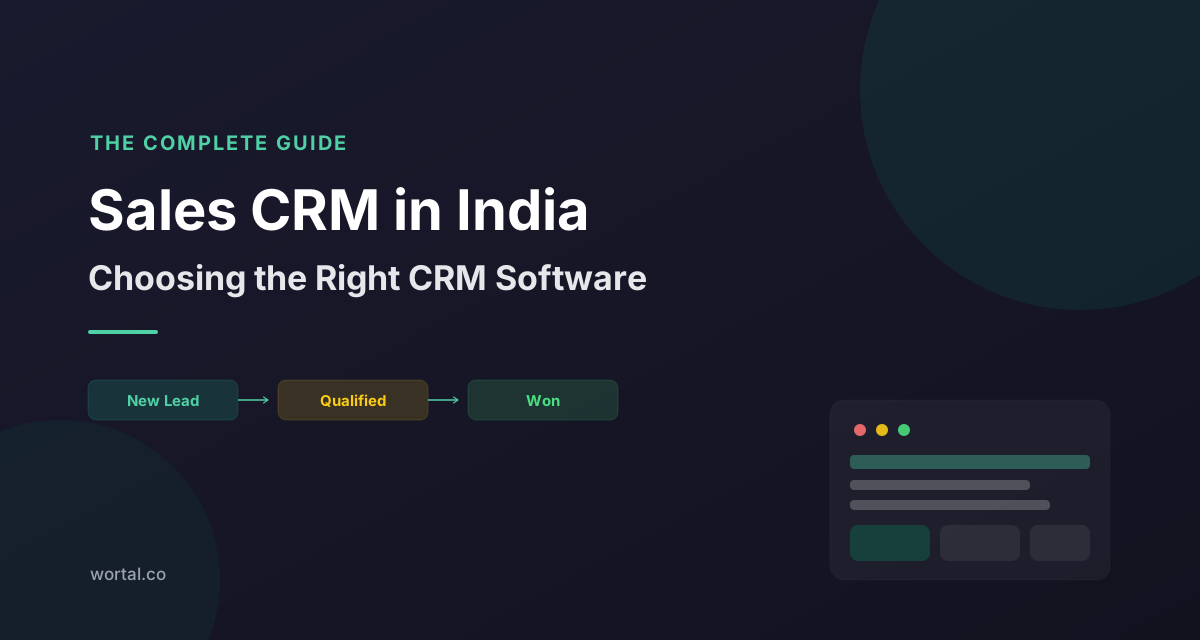
Before shortlisting any CRM, sketch your pipeline like this. It forces clarity on what stages actually need automation.
If you can map automation triggers to each stage like this, you’ll know exactly what to ask a CRM vendor during the demo – instead of nodding along to generic features.
Real-Life Case Study: A Surat Textile Trading Firm

A mid-sized fabric trading business in Surat was handling roughly 300 buyer inquiries a month through IndiaMART, WhatsApp, and referrals. Their process before adopting a CRM: leads noted in a register, follow-ups tracked on individual phones.
The problem wasn’t lead generation – leads were coming in fine. The problem was conversion. Sales staff couldn’t recall who they’d promised a sample to, or which buyer needed a rate revision follow-up.
After moving to a structured crm for indian businesses setup with WhatsApp automation and a visual pipeline, two things changed within 60 days:
- Follow-up delays dropped because reminders were automatic instead of memory-dependent
- Sales staff could see, at a glance, which buyers were stuck in “quotation sent” for over a week – something nobody was tracking before
Their conversion rate on inbound IndiaMART leads improved noticeably, not because they got more leads, but because fewer leads slipped through cracks in the process. That’s usually the real ROI of a CRM – not more leads, just fewer wasted ones.
Key Takeaways
- Don’t buy a CRM because of features you’ll never use. Buy for the 4-5 things your team will use daily.
- WhatsApp and mobile-first design matter more in India than in most CRM buying guides written for Western markets.
- Test with your own messy, real data before signing any annual contract.
- Multi-branch and role-based access matters the moment you cross a single sales office.
- The real issue is usually process, not tool – fix your pipeline stages mentally before shopping.