

Every founder I talk to says the same thing in the first five minutes: “We have leads coming in, but half of them just disappear.”
That’s not a lead generation problem. That’s a follow-up problem. And a follow-up problem is, nine times out of ten, a CRM problem – or the lack of one.
I’ve spent enough years around Indian sales teams to notice a pattern. The businesses that scale aren’t the ones with the biggest marketing budget. They’re the ones who never let a lead go cold. And the tool that decides whether a lead goes cold or converts is your CRM, or the absence of it.
But here’s what most guides miss: a CRM built for a real estate broker in Ahmedabad has almost nothing in common with one built for a SaaS founder in Bangalore. Different sales cycles, different follow-up rhythms, different data. Using a generic system across industries is like using the same shoe size for everyone in the family.
Let’s break this down properly, industry by industry.
Why “One CRM Fits All” Doesn’t Work in India
Indian sales is messy in a good way. WhatsApp is the primary channel, not email. Site visits and factory walkthroughs happen before any digital form is filled. Trust builds over phone calls, not drip campaigns.
A sales crm for real estate india needs to track site visit schedules and follow-ups spread over months. A sales crm for manufacturing india needs to handle bulk quotations and long B2B negotiation cycles. A sales crm for saas companies india needs to track trial usage and demo-to-paid conversion.
Same category of software. Completely different job to do.
Real Estate: Where the Sale Happens After Ten Follow-Ups, Not One
Real estate in India is a slow-trust business. A buyer might visit three projects, talk to five agents, and still take four months to decide.
I’ve seen brokerage firms in Surat and Pune lose serious money simply because their agents were tracking leads on WhatsApp chat threads and personal notebooks. When an agent left the company, the leads left with him. Literally walked out the door in his phone.
This is exactly where a sales crm for real estate india earns its cost back in the first month. Not because of fancy dashboards, but because of three boring things done right:
- Site visit tracking – knowing who visited, what they liked, what they didn’t
- Automated WhatsApp follow-ups – nudging a lukewarm lead without a human having to remember
- Lead ownership that stays with the company, not the individual agent
A mid-size real estate firm in Ahmedabad I know of restructured their process using a CRM with a visual deal pipeline. They stopped losing leads during agent transitions and their conversion rate on repeat-visit leads went up by almost a third. Not because the CRM sold anything. It just stopped the leaks.
Most people ignore this part: real estate sales isn’t about getting more leads. It’s about not losing the leads you already paid for.
Book a Free Demo
See how Wortal can simplify your business and help you close more deals.


Manufacturing: The Industry Everyone Forgets When Talking About CRM
Ask ten software vendors about CRM use cases and nine will talk about real estate or SaaS. Manufacturing barely gets a mention. That’s strange, because Indian manufacturing runs almost entirely on relationships, quotations, and long negotiation cycles – exactly the kind of thing a CRM is built to organize.
A textile unit in Bhiwandi or a components manufacturer in Gujarat doesn’t close a deal in one call. There’s a quote, a revision, a sample, a factory visit, another revision, and then – maybe – a purchase order three months later.
A proper sales crm for manufacturing india needs to handle:
- Multiple quotation versions tied to a single lead
- Inventory visibility, so the sales team isn’t promising stock that doesn’t exist
- Follow-up reminders spaced across weeks, not days
- IndiaMART and Trade India lead capture, since a huge chunk of B2B manufacturing leads still come through these platforms
One thing I’ve noticed working with manufacturing clients: the sales cycle isn’t the real bottleneck. The real bottleneck is the disconnect between the sales team quoting a price and the inventory team knowing what’s actually available. A CRM like Wortal, which ties inventory management into the same system as lead and sales tracking, solves this specific gap – the sales guy sees live stock before he quotes, instead of promising something the warehouse ran out of last week.
That single fix – sales and inventory talking to each other – has saved manufacturing businesses from the embarrassment of over-promising to a client they’d spent three months courting.
Retail: Fast-Moving Leads, Faster-Moving Attention Spans
Retail is a different beast entirely. Leads don’t wait three months. They wait three minutes, sometimes three seconds, before moving to the next seller in their browser tab.
Here’s what actually matters in retail sales: speed of response. A customer messages on WhatsApp asking about a product, and if nobody replies within the hour, they’ve already messaged a competitor.
Retail businesses using CRM tools in India typically need:
- Instant WhatsApp auto-replies with human handoff for serious buyers
- Simple task dashboards so nobody forgets a follow-up on a “maybe” customer
- Basic customer history – what they bought before, what they browsed
Retail doesn’t need the complexity that real estate or manufacturing CRMs carry. It needs speed and simplicity. A shop owner in a local market doesn’t have time to learn a complicated system between customers walking in.
SaaS: Where the CRM Has to Understand a Trial, Not Just a Lead
This one’s close to home for a lot of founders I speak with. SaaS sales in India looks nothing like SaaS sales in the US. Deal sizes are smaller, decision-makers are harder to pin down, and free trials often get used by people who were never going to buy.
A sales crm for saas companies india has to do something most traditional CRMs weren’t built for: track product usage alongside sales activity. It’s not enough to know someone signed up. You need to know if they logged in twice and never came back, or if they invited their whole team on day two.
Key things a SaaS-focused CRM setup should track:
- Trial start and expiry dates, with automated reminder sequences
- Feature adoption – which parts of the product the user actually touched
- Demo-to-paid conversion stages, tracked as a visible pipeline
- Renewal and churn risk flags, so account managers aren’t caught off guard
I’ve watched SaaS founders obsess over signup numbers while ignoring the fact that 80% of trial users never opened the product past day one. A CRM that surfaces this early – instead of burying it in a spreadsheet nobody checks – is the difference between a founder reacting to churn and a founder preventing it.
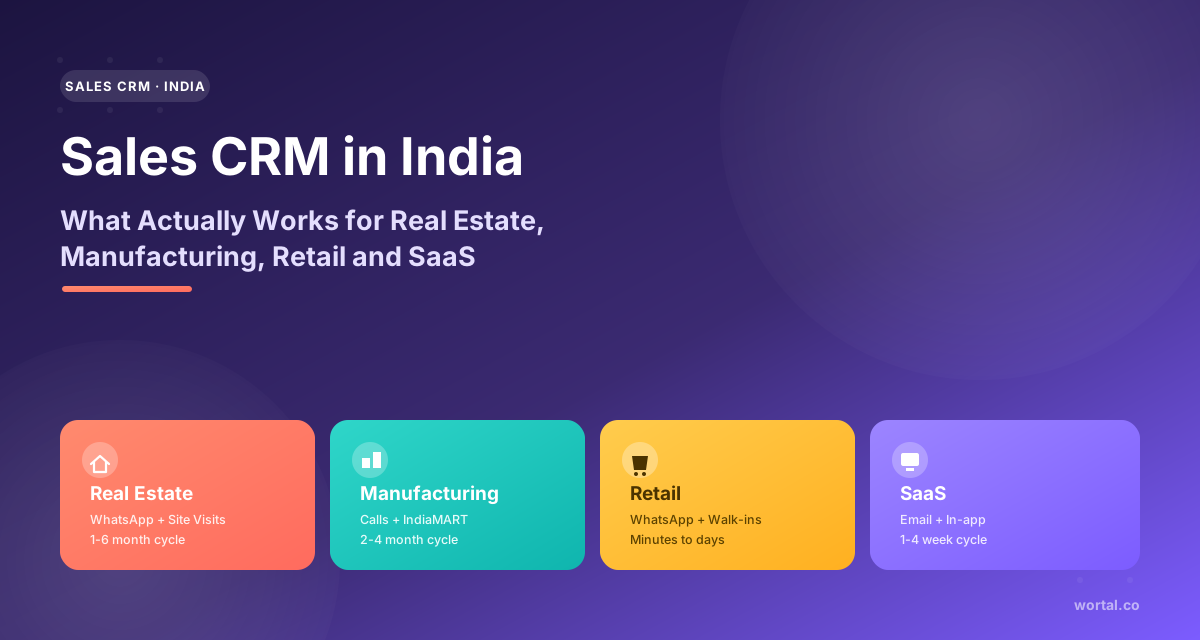
| Industry | Sales Cycle Length | Primary Channel | What the CRM Must Track |
|---|---|---|---|
| Real Estate | 1-6 months | WhatsApp + Site Visits | Visit history, agent ownership, follow-up cadence |
| Manufacturing | 2-4 months | Calls + IndiaMART | Quotations, stock levels, negotiation stage |
| Retail | Minutes to days | WhatsApp + Walk-ins | Response speed, purchase history, repeat buyers |
| SaaS | 1-4 weeks | Email + In-app | Trial usage, feature adoption, renewal risk |
If you’re evaluating any CRM, hold it up against this table first. If it can’t handle the specific rhythm of your industry, it doesn’t matter how polished the dashboard looks.
Key Takeaways Before You Pick a CRM
- Don’t buy a CRM because it has the most features. Buy one that matches your sales cycle length.
- Sales crm for real estate india should live and die by site-visit tracking and follow-up automation.
- Sales crm for manufacturing india needs quotation history and inventory visibility connected in one place, not two separate tools.
- Sales crm for saas companies india must track product usage, not just contact details.
- Retail needs speed above everything – a slow CRM is worse than no CRM at all.
- WhatsApp integration isn’t optional in India. It’s the primary channel across every industry above.
A Real Example: How a Surat Textile Trader Fixed a Three-Month-Old Problem

A fabric trading business in Surat came to us with a familiar complaint. Their sales team was juggling forty to fifty active leads at any point, tracked across three different Excel sheets and one WhatsApp group. Orders were getting quoted twice at different prices because two salespeople didn’t know the other had already spoken to the same buyer.
They moved to a CRM setup with a shared pipeline, tagged by lot and fabric type, with WhatsApp automation triggering follow-ups after every quotation. Within six weeks, duplicate quotations stopped completely. More importantly, their average time from first inquiry to confirmed order dropped from eighteen days to eleven.
Nothing exotic happened here. The business didn’t get new customers overnight. It just stopped wasting the ones it already had.
Honestly, smaller agencies need it more. Big builders have marketing teams and processes already in place. A three-person agency loses leads the fastest because everything lives in one person’s phone.
It can, until the team grows past three or four people. After that, quotations start conflicting, follow-ups get missed, and nobody has a clear picture of what’s pending. That’s usually when the “we’ll manage manually” approach breaks down.
Treating it like a US-style tool. Indian SaaS buyers respond far better to phone calls and WhatsApp than cold email sequences. If your CRM setup is built around email-only workflows, you’re fighting the market instead of working with it.
It’s built with Indian SMB workflows in mind, so it covers the WhatsApp-first, follow-up-heavy nature common to real estate, manufacturing, retail, and SaaS teams. That said, the right fit always depends on your specific sales process, so it’s worth testing with your actual leads rather than going by feature lists alone.
In my experience, about two to three weeks if the CRM is simple enough. If your team is still confused after a month, the tool is probably too complicated for what you actually need.