
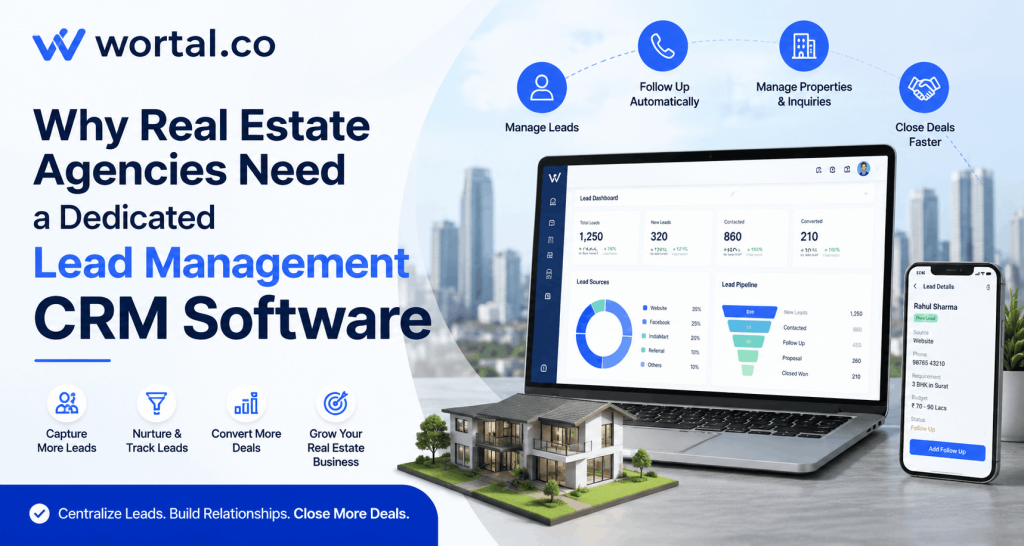

Ask any real estate agent how many leads they lost last month simply because nobody followed up on time, and most will go quiet for a second. Not because they don’t know. Because they do, and it stings.
Real estate runs on leads. A property listed on 99acres or MagicBricks can pull in 40-50 enquiries a week for a busy agency. But leads without a system behind them are just names sitting in a WhatsApp chat or an Excel file, slowly going cold while your team argues about who was supposed to call whom. This is precisely why more agencies are searching for a proper real estate lead management software instead of patching things together with spreadsheets.
That’s exactly why a lead management CRM for real estate isn’t a luxury anymore. It’s the difference between an agency that closes deals consistently and one that’s always chasing leads that have already been bought from someone else.
This post breaks down why this shift matters, what actually happens without a proper system, and how a real estate CRM software changes the day-to-day reality for agents on the ground. By the end, you’ll see exactly why a solid lead management CRM for real estate ends up saving far more than it costs.
The Real Problem Isn’t a Lack of Leads. It’s Losing Track of Them.
Most agency owners think their problem is lead generation. It usually isn’t.
The real issue is what happens after the lead comes in. A buyer fills a form for a 2BHK in Vesu, Surat. That lead lands in an inbox, gets forwarded on WhatsApp, someone jots the number on a notepad, and by the time an agent actually calls, it’s been six hours. The buyer has already spoken to two other agencies by then.
This is where CRM for real estate agents earns its place. It’s not about having fancier software for the sake of it. It’s about closing the gap between “lead arrives” and “lead gets contacted,” because in real estate, that gap is where deals are won or lost.
Here’s data that makes this painfully clear:

Look at that curve. Once a lead sits untouched for over two hours, you’ve already lost more than 60% of the race to a competitor who called first. This isn’t about your agents being lazy. It’s about human memory being an unreliable system for something that needs to happen in minutes, not hours.
What a Dedicated Real Estate CRM Actually Solves
A generic CRM built for SaaS companies or retail businesses doesn’t understand things like site visits, token amounts, builder inventory, or the fact that one client might be interested in three different properties across two cities. A real estate lead management software, on the other hand, is built around how property deals actually move. This is also where a proper real estate CRM software pays for itself many times over – it’s built for your workflow, not the other way around.
1. No Lead Ever Sits Untouched
Every enquiry – whether it comes from a Facebook ad, IndiaMART, a walk-in, or a referral – lands in one pipeline. Nobody has to dig through five WhatsApp groups to find out who called Mr. Patel last week.
2. Automatic Lead Assignment
Instead of leads getting dumped into a group chat where three agents assume someone else will handle it, the system assigns each lead to a specific agent the moment it comes in. No confusion, no double calls, no missed follow-ups.
3. Follow-Up Reminders That Don’t Depend on Memory
Real estate deals rarely close on the first call. They need three, five, sometimes ten touchpoints spread over weeks. A lead management CRM for real estate tracks every one of those touchpoints and nudges the agent when it’s time for the next call, instead of relying on someone remembering to check their notebook.
4. Visual Pipeline for Every Deal Stage
Seeing which leads are at “site visit scheduled,” which are stuck at “negotiation,” and which have gone cold gives a manager real visibility. Without this, most agencies are running on gut feeling about their own pipeline, which is a risky way to run a business that depends on cash flow.
5. Client History in One Place
If a client called six months ago about a shop in Ring Road and comes back now asking about a flat, the agent handling them today should know that history instantly. A proper CRM for real estate agents keeps every interaction, preference, and budget note tied to that one client profile.
Book a Free Demo
See how Wortal can simplify your business and help you close more deals.


The Numbers Don’t Lie: Structured Lead Management Changes Outcomes
Here’s a comparison that agency owners find eye-opening once they actually track it:

Agencies relying on registers or Excel sheets typically convert somewhere around 8% of leads into actual site visits. Agencies using a generic CRM not built for property sales do a bit better, closer to 14%. But agencies running on a real estate CRM software built specifically for property workflows regularly hit conversion rates in the mid-20s.
That’s not a small gap. For an agency handling 500 leads a month, that difference is the gap between 40 site visits and over 130.
Practical Scenarios Where This Plays Out
Scenario 1: The multi-agent chaos A mid-sized agency in Ahmedabad had four agents working leads from the same WhatsApp Business number. Two agents would sometimes call the same lead within an hour of each other, confusing the buyer and making the agency look disorganized. Once they moved leads into a proper pipeline with assigned ownership, that overlap disappeared completely within the first week.
Scenario 2: The forgotten follow-up An agent in Pune had a warm lead interested in a commercial space, but got busy with a closing deal for ten days. By the time he circled back, the client had already signed with another broker. This kind of loss is invisible until you’re tracking it – and it happens more often than agency owners realize.
Scenario 3: The referral that got missed A happy client referred their cousin, but the referral got mentioned casually on a call and was never logged anywhere. Three weeks later, nobody remembered to follow up, and the referral went cold. A real estate lead management software captures referrals the same way it captures every other lead source, so nothing depends on someone’s memory. This one habit alone – logging referrals like any other lead – is something most CRM for real estate agents setups get right by default, simply because there’s no “casual mention” category left to fall through.
Key Takeaways for Agency Owners
- Speed of response matters more than the quality of your initial pitch. Call within five minutes wherever possible.
- Don’t rely on WhatsApp groups for lead distribution. It works fine until your team grows past three people, then it breaks down fast.
- Track every lead source separately – Facebook, Google, IndiaMART, referrals, walk-ins – so you know where your best leads actually come from. This is one thing a good lead management CRM for real estate handles automatically once sources are tagged at entry.
- Use follow-up sequences instead of one-off calls. Property decisions take time, and buyers need multiple nudges, not one aggressive pitch.
- Review your pipeline weekly, not monthly. Real estate leads go cold fast, and a monthly review is often too late to save a stalling deal.
A Real-World Example: How One Surat Agency Fixed Its Lead Leakage

A textile-hub real estate agency in Surat, handling both residential and commercial listings, was generating close to 600 leads a month through property portals and social media ads. Their close rate, though, was under 3%.
When they actually audited what was happening to those leads, the picture was rough. Nearly 40% of leads had no recorded follow-up at all. Agents were relying on personal phone contacts saved under random names, and when an agent left the company, all his leads simply vanished with him.
They switched to using Wortal, a real estate lead management software built for Indian SMBs including property businesses, to centralize their lead intake and assign follow-ups automatically. Within two months, their follow-up completion rate jumped from around 60% to over 95%, largely because agents were getting reminders instead of relying on memory. Their site-visit conversion rate nearly doubled in the same period.
The bigger shift wasn’t just the software. It was that leads stopped being tied to individual agents’ phones and started belonging to the agency itself. When someone left, the leads stayed, the history stayed, and nothing got lost in the transition.
Wrapping This Up
Real estate is a relationship business, but relationships built on scattered notes and forgotten follow-ups don’t scale. Every agency eventually hits a point where the founder can no longer personally track every lead in their head, and that’s exactly when things start slipping through the cracks.
Every agency that’s grown past a handful of agents eventually has this conversation with itself, and the ones who act on it early tend to pull ahead of competitors who are still running things out of a notebook. That’s the practical case for investing in a real estate CRM software sooner rather than later.
A lead management CRM for real estate isn’t about replacing the human touch that makes this business work. It’s about making sure that human touch actually happens, consistently, for every single lead, whether it’s your top agent handling it or someone new who just joined last week.
Real Estate CRM
Frequently asked questions
Not really. Even solo agents handling 20–30 leads a month benefit, mainly because it stops leads from getting buried in personal WhatsApp chats. The benefit scales up as your team grows, but it’s useful from day one.
Generic CRMs are built for sales cycles that don’t involve site visits, token amounts, builder inventory, or long negotiation periods stretching across months. A CRM for real estate agents is designed around these exact stages, so you’re not forcing your workflow into a tool that wasn’t built for it.
WhatsApp Business is fine for communication, but it’s a terrible system for tracking, assigning, and following up on leads at scale. Once you cross even 100 active leads at a time, things start slipping through, and that’s usually when agencies start looking for something more structured.
Most agencies notice a difference in follow-up consistency within the first two to three weeks. Conversion rate improvements usually show up over the first one to two months, once the team gets used to logging every lead properly instead of half the time.
Treating it as optional for some leads and not others. The moment agents start manually deciding which leads to log and which to skip, the whole system loses its value. Every lead, every time, no exceptions — that’s when it actually works.