


Ask any textile business owner in Surat, Bhiwandi, or Erode about IndiaMART and you’ll get the same answer – “leads aate hain, par kuch hota nahi.” Leads come. Nothing happens.
They’re not wrong. IndiaMART leads waste in textile businesses is a very real problem. And it’s not because the platform doesn’t work – it genuinely does. Fabric buyers, garment manufacturers, wholesalers – they’re all on there, searching, requesting quotes every single day.
The waste happens after the lead arrives. That’s where most textile businesses have a gap so big you could drive a truck through it.
Book a Free Demo
See how Wortal can simplify your business and help you close more deals.


The Missed Call That Cost Rs.3 Lakh
A textile trader in Surat – running a mid-size operation dealing in dress materials and suiting fabric – was getting about 35-40 IndiaMART leads per month. On paper, that’s a decent volume for the subscription cost.
When he actually sat down and tracked where those leads went, the picture was ugly. Around 40% of leads had no follow-up call logged at all. Another 30% had one call – no second attempt. Only the remaining leads saw any real conversation.
One particular inquiry, a buyer from Jaipur looking for 500 metres of polyester georgette, sat unresponded for nearly two days. By the time his salesperson called, the buyer had already ordered from a competitor in Bhiwandi. Estimated order value: close to Rs.3 lakh.
This isn’t a rare story. IndiaMART leads waste in textile businesses happens quietly, every month, across thousands of businesses. Most owners don’t even know the extent of it because no one’s tracking it properly.
Why Textile Leads Die – The Real Reasons
The common excuse is that the IndiaMART leads problem textile businesses face is about lead quality. Buyers are just price checking. They’re not serious. Maybe some are. But that’s not why most leads go nowhere.
No One Owns the Lead
In a lot of textile businesses, leads land in a WhatsApp group or a shared email. Three people see it. Each one thinks the other is handling it. Nobody calls. That’s your IndiaMART leads waste textile situation right there – not bad buyers, just bad ownership.
Follow-Up Is an Afterthought
First call goes unanswered. The salesperson moves on. That buyer might have been away, driving, on a factory floor. They’d have picked up the next day. But that second call never came. In textiles, where orders take time and buyers compare multiple suppliers, one follow-up attempt is basically no follow-up at all.
No Record, No Memory
A buyer from Kolkata once inquired about cotton shirting fabric. Got quoted. Didn’t order at the time. Came back four months later. The salesperson who handled it had left. No notes, no history. The buyer had to start from scratch and felt so frustrated he placed the order elsewhere. Good textile sales lead tracking would have saved that deal.
Everyone Assumes Someone Else Is Handling It
This is the one nobody admits. When the IndiaMART notification hits, five of your salespeople might see it. No assignment system means no accountability. One person assumes their senior will handle it. The senior thinks the junior did. Classic.
What Actually Fixes IndiaMART Leads Waste in Textile Businesses
The fix isn’t buying more leads. It’s making sure the ones you already have are being worked properly.
Speed of First Response
Buyers on IndiaMART often send the same inquiry to six or seven suppliers. The first two to respond get the real conversation. Everyone else gets “haan bhai, dekhte hain.” If your first call is going out four hours after the inquiry, you’re already at a serious disadvantage. Target under 30 minutes – even a quick acknowledgment on WhatsApp buys you time.
Structured Follow-Up, Not Random Calls
One of the simplest things that comes from using textile lead management software is having a follow-up sequence that actually runs. Day 1 call, Day 3 WhatsApp, Day 6 callback – something structured. Not because buyers are ignoring you, but because the buying cycle in textiles is rarely instant. Fabric decisions take a few days. You have to stay visible.
Actual Textile Sales Lead Tracking
This means knowing – at any given moment – how many IndiaMART leads came in this month, which ones were followed up, which are in negotiation, and which ones died and why. Without textile sales lead tracking, you’re guessing. And guessing is expensive when your IndiaMART subscription is a significant monthly spend.
How Wortal Helps Textile Businesses Handle This Better
Wortal is a CRM built for Indian SMBs. It’s not complex. It doesn’t require a consultant to set up. But for textile businesses dealing with IndiaMART leads waste, it does a few things that genuinely matter.
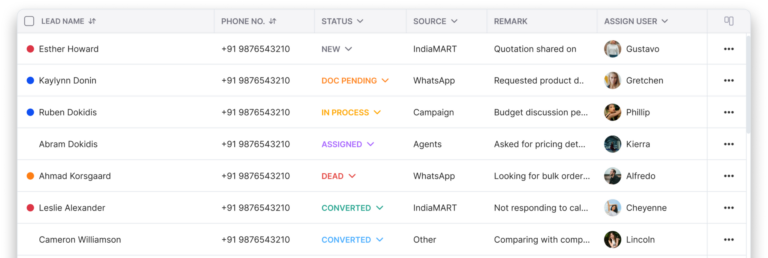
Every lead gets assigned to a specific salesperson – no more shared-WhatsApp-group confusion. Each salesperson has a task list showing what they need to follow up on and when. Managers can see the full pipeline at a glance: how many leads came in, how many are active, how many were lost and why.
The WhatsApp automation feature means follow-up messages go out even when your team is in the middle of sampling or factory visits. The WCaller app logs calls automatically, so you have a record of every conversation – not just the ones someone remembered to write down.
For textile businesses dealing with the classic IndiaMART leads problem – scattered follow-ups, no visibility, leads falling through cracks – this kind of textile lead management software setup changes how the whole sales process runs. Not overnight. But within a few weeks of consistent use, the difference in conversion clarity alone is worth it.
Wortal’s Standard plan is Rs.200/user/month. Most textile businesses lose more than that on a single wasted IndiaMART lead in a month.
Before You Close This Tab – A Few Things Worth Remembering
- IndiaMART leads waste in textile businesses is mostly a process failure, not a platform failure
- Speed of first response decides more outcomes than price does, at least in the first conversation
- Textile sales lead tracking doesn’t have to be complicated – it just has to actually exist
- Unassigned leads are dead leads. Someone has to own each one, always
- Textile lead management software pays for itself when even one lead converts that would have otherwise gone cold
- Old leads are not useless – a buyer who didn’t order in March might be ready in July. Track them