
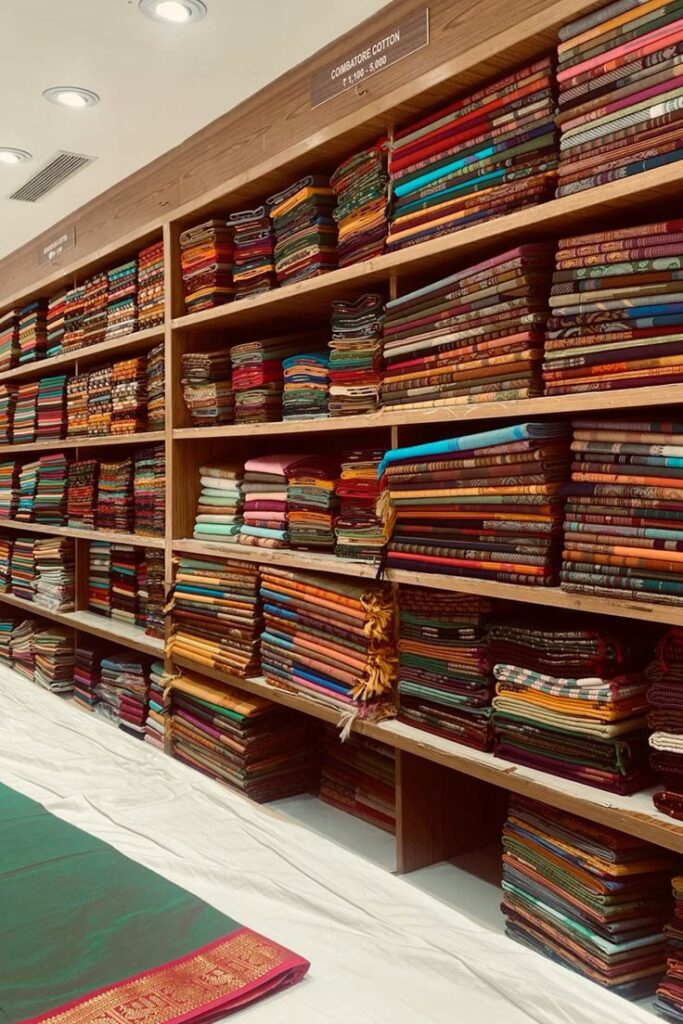

Silk and georgette sarees are two of the most in demand saree categories in the Indian textile trade, and Surat has quietly become the country’s biggest production and sourcing hub for both. If you’ve never sourced from Surat before, here’s the simplest way to understand it: Surat is where fabric gets made, dyed, printed, embroidered, and stitched into finished sarees at a scale that most other cities can’t match and it does this at prices that make sense for retailers, wholesalers, and exporters alike.
That’s why “sourcing from Surat” isn’t just a phrase traders use casually. It’s become a category of its own in the saree business. Buyers from Kolkata, Delhi, Hyderabad, and even overseas markets fly into Surat specifically to walk its textile markets and place bulk orders directly with manufacturers.
This guide is for retailers, boutique owners, wholesalers, and growing saree businesses who want to understand how sourcing actually works in Surat, not just where the markets are, but how deals get made, what mistakes buyers commonly make, and how to build a sourcing process that doesn’t fall apart after the first order.
Quick Summary
- What you’ll learn: where silk and georgette sarees are manufactured and traded in Surat, how to identify reliable suppliers, common sourcing mistakes, and a simple framework for deciding who to buy from.
- Who this is for: saree retailers, boutique owners, wholesalers, and distributors who are either new to Surat sourcing or want to make their existing sourcing more organized.
- Why it matters: the difference between a profitable saree business and a struggling one often comes down to sourcing decisions made in the first few months, not marketing, not store location.
Why Surat Became the Sourcing Capital for Sarees
Most people know Surat for diamonds. In the textile world, it’s known for something else entirely – man made fabric production. Surat produces a huge share of India’s synthetic and semi synthetic fabric, and georgette sarees in particular are almost synonymous with the city.
Here’s what actually matters for a buyer: Surat isn’t just a market, it’s a full production chain in one place. Weaving units, dyeing houses, printing units, embroidery workshops, and finishing units are all clustered close together. That means a saree can go from raw fabric to a finished, packed piece without leaving the city. For a buyer, this translates into shorter lead times and lower per piece costs compared to sourcing the same design from multiple cities.
Silk sarees from Surat work a little differently. A lot of what’s sold as “silk” in Surat is actually art silk or blended silk, produced locally, while pure silk weaving is more associated with Varanasi, Kanchipuram, and parts of Karnataka. Surat’s real strength with silk sarees is in embellishment, printing, and finishing taking base fabric (sometimes sourced in, sometimes woven locally) and turning it into a saleable, styled product at volume.
Did You Know? A single textile market complex in Surat can house several hundred shops, each representing a different manufacturer or wholesaler, often specializing in a narrow category like only georgette, only chiffon, or only embroidered silk.
Book a Free Demo
See how Wortal can simplify your business and help you close more deals.


Where to Actually Source From in Surat
New buyers usually make one mistake early on – they treat “Surat” as one big market and expect to walk in and find everything in one place. That’s not how it works. Sourcing here is split across a few distinct zones, each with its own specialty.
Wholesale Textile Markets
Surat’s textile markets (commonly located around areas like Ring Road, Sahara Darwaza, and Katargam) are where most bulk buying happens.These markets are organized into multi storey complexes where each floor or wing might be dominated by a particular product category – sarees, dress materials, dupattas, and so on.
Pro Tip: Visit during weekday mornings. Markets are far less crowded, and shop owners have more time to actually discuss customization, minimum order quantities, and payment terms, something that’s nearly impossible during peak evening rush.
Manufacturer Direct Units
For buyers doing serious volume – say, 500 pieces and above per order going directly to a manufacturing unit instead of a market shop usually works out cheaper. The trade off is that manufacturers often have higher minimum order quantities and less flexibility on last minute design changes.
Trade Fairs and Exhibitions
Surat regularly hosts textile trade fairs where manufacturers showcase new collections before they hit the general market. This is where a lot of experienced buyers actually go first, not to buy immediately, but to spot upcoming trends and lock in early orders before a design becomes common across every market shop.
Silk vs Georgette Sourcing: Key Differences Buyers Should Know
| Factor | Silk Sarees (Surat-sourced) | Georgette Sarees |
|---|---|---|
| Typical use case | Wedding, festive, premium retail | Daily wear, party wear, mid-range retail |
| Price range flexibility | Wider — depends heavily on embellishment | Narrower — driven mostly by fabric quality and print |
| Minimum order quantity | Often higher due to embroidery work | Generally more flexible |
| Lead time | Longer if heavy embroidery is involved | Shorter, especially for printed designs |
| Best sourced from | Manufacturers specializing in finishing/embellishment | Wholesale markets and printing units |
This table isn’t exhaustive, but it reflects what most buyers experience once they’ve placed a few orders and start noticing patterns.
Common Mistakes Buyers Make When Sourcing from Surat
One mistake many companies make is judging a supplier purely on sample quality. A sample piece is often the best piece a manufacturer has, bulk orders don’t always match that exact finish, especially in hand embroidered or hand embellished silk sarees.
Here are a few other recurring mistakes:
- Not confirming fabric composition in writing. “Silk” can mean pure silk, art silk, or a blend. Get this specified clearly before payment.
- Ignoring dye lot consistency. Bulk orders sourced across multiple production batches can have slight color variation. Ask upfront how dye lot matching is handled.
- Underestimating packing and logistics costs. Sarees are bulky to ship in volume, and this cost gets overlooked in early cost calculations.
- Relying on a single supplier. When one manufacturer has a delay or quality dip, buyers with no backup source lose entire selling seasons.
- Skipping a written order confirmation. Verbal orders over WhatsApp are common in Surat’s trade culture, but disputes over quantity, design, or price become very hard to resolve without some written trail.
Common Mistake: Many first time buyers negotiate hard on price but skip negotiating on delivery timelines. In this trade, a missed delivery window during the festive season can cost more than any price discount saved.
A Simple Decision Framework Before You Place an Order
Before finalizing a supplier, most experienced buyers run through a mental checklist. Here’s a version worth using:
- Is the fabric composition confirmed in writing?
- Has a physical sample been checked, not just a photo on WhatsApp?
- Is the minimum order quantity realistic for your current sales volume?
- Does the supplier have a track record with buyers in your city or segment?
- Are payment terms (advance percentage, balance on delivery) clearly agreed?
- Is there a backup supplier for the same design category?
If more than two of these are unclear before payment, it’s usually a sign to slow down, not speed up.
Case Study: How a Small Retailer Fixed a Recurring Sourcing Problem
A boutique saree retailer based in Hyderabad had been sourcing georgette sarees from Surat for about a year, mostly through referrals and WhatsApp contacts. The business was growing, but every festive season brought the same problem, orders placed with three different Surat suppliers, tracked across separate WhatsApp chats, with no central record of who owed what, which design was pending, and which payment was cleared.
The problem: By the time festive stock needed to reach the store, at least one supplier’s order was always delayed or mismatched, and there was no easy way to trace where the miscommunication happened.
The solution: The retailer moved to tracking every supplier conversation, order status, and payment stage in one system instead of scattered chats – logging each supplier as a contact with notes on design codes, agreed rates, and delivery dates.
Implementation: It took about two weeks to migrate existing supplier relationships into the new tracking process, mainly because historical order details had to be pulled out of old WhatsApp threads.
Result: The next festive season, the retailer caught a delayed order nearly ten days earlier than they would have previously, simply because the system flagged that a confirmed delivery date had passed with no update logged.
Lesson learned: Sourcing problems in the saree trade are rarely about finding good suppliers, Surat has plenty. The real issue is usually tracking and follow up once multiple suppliers are involved at once.
This is exactly the kind of gap tools like Wortal are built to close for growing textile businesses, not by replacing the relationships built on the ground in Surat, but by giving buyers a single place to track supplier leads, order stages, and follow ups instead of losing them across WhatsApp chats. For a business juggling multiple Surat suppliers during festive season, that alone can prevent avoidable stock delays.
Key Takeaways
- Surat is a full production chain for georgette sarees and a strong finishing hub for silk sarees, not just a trading market.
- Wholesale markets, manufacturer direct units, and trade fairs each serve different buying needs, know which one fits your order size.
- Always confirm fabric composition and dye lot handling in writing before bulk payment.
- Sample quality doesn’t always guarantee bulk order consistency.
- Having a backup supplier per design category protects against seasonal delays.
- Verbal WhatsApp orders are common but risky without some written confirmation.
- Delivery timeline negotiation matters as much as price negotiation.
- Tracking multiple suppliers in one organized system, rather than scattered chats, prevents the most common festive-season sourcing failures.
Final Thoughts
The retailers who consistently succeed with Surat sourcing aren’t necessarily the ones who negotiate the lowest price. They’re the ones who treat sourcing as an ongoing process – one that needs tracking, follow up, and a backup plan, rather than a one time transaction that ends once the order is placed.
Frequently Asked Questions
Common questions about sourcing sarees from Surat