

Three fabric business owners. Same industry. Completely different problems.
Sat down with all three over the span of two weeks last month. A manufacturer running power looms in Bhiwandi. A wholesale trader out of Surat’s Ring Road. A distributor supplying 180 retail shops across Gujarat. Each one asked me the same question: “Which ERP should I buy?”
Wrong question, honestly. The right question is which ERP fits what you actually do all day.
Here’s the thing nobody selling software wants to admit. Most ERP vendors show you one demo and call it universal. It isn’t. What a spinning mill needs and what a fabric trader needs barely overlap. I’ve watched businesses waste a full year’s subscription on features that were never built for them.
So let’s actually get into it.
The Core Problem: Production People vs Trading People
A manufacturer’s day starts with yarn coming in. It ends – hopefully – with finished cloth going out. Somewhere in between, dyeing happens, weaving happens, quality checks happen. And wastage happens.
A trader never touches production. Buys finished lots, stores them, sells before the season turns them into unsellable dead stock.
Different jobs. Different pain. Different software, full stop.
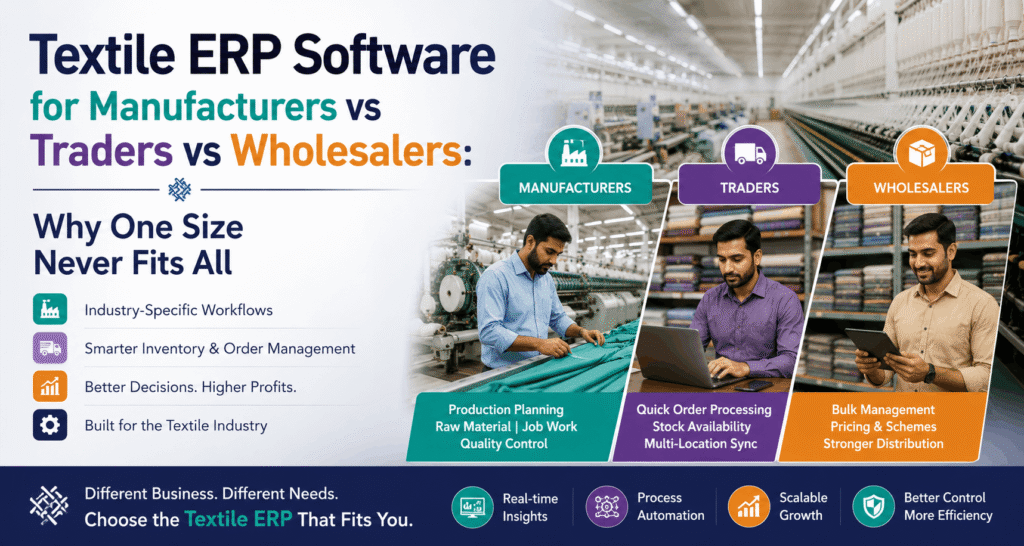
Textile ERP software for manufacturers exists to solve the production side – job costing, loom output, batch-wise wastage. A trader looking at those modules just shrugs. Doesn’t apply to him.
Textile ERP software for traders flips that entirely. Speed of turnover, shade-matching, godown-level stock visibility – that’s the whole game.
Wholesalers borrow a bit from both worlds, but honestly lean more toward the trading side, with one massive difference: credit exposure across dozens, sometimes hundreds, of retail accounts.
What Actually Keeps a Manufacturer Up at Night
Talked to this Bhiwandi guy – 42 looms, family business, third generation. His problem wasn’t sales. Orders were fine. His problem was he genuinely had no idea what any single batch cost him to produce until the month closed out.
Yarn consumption? Written on paper. Loom downtime? A notebook, sometimes forgotten for days. Wastage? Found out only after the cloth came off the loom short, and by then it’s too late to fix anything.
This is exactly the gap ERP software for textile manufacturing is supposed to close. Not billing. Not invoicing. Actual, real-time production numbers while the batch is still running, not after.
What matters here, in no particular order:
- Job work costing, whether processing is done in-house or outsourced
- Loom-wise, even machine-wise, output logs
- Conversion ratio – raw yarn in, finished fabric out
- Wastage tracked per batch instead of guessed at month-end
- Quality checkpoints logged at each production stage, not just at dispatch
Turned out, once he had this visibility, one specific loom was underperforming by roughly 12% compared to the rest. Nobody had noticed. A maintenance issue, sitting there for months, quietly eating margin. Fixed it. Software paid for itself in under ten weeks.
That’s the real argument for textile ERP software for manufacturers – it’s not a fancy dashboard flex. It’s catching the thing you’d otherwise never catch.
Book a Free Demo
See how Wortal can simplify your business and help you close more deals.


What Actually Keeps a Trader Up at Night
Now the Surat guy. Doesn’t manufacture anything. Buys finished lots from mills, stores them in three godowns, sells to garment units and a couple of export houses.
His nightmare is shade variation. Same design number, same fabric – but two different dye lots, ever so slightly off in shade. Ship the wrong one to a garment buyer and the whole consignment bounces back. Expensive mistake, and it happens more than people admit.
What textile ERP software for traders genuinely needs to nail:
- Lot-wise and shade-wise segregation so nobody ships the wrong batch
- Billing speed during festival-season rush, when 200 orders can hit in a single week
- Aging reports – flagging stock sitting past 60 or 90 days before it becomes a write-off
He had roughly Rs.40 lakh tied up in godown stock that nobody was tracking by age. Once that visibility existed, he started clearing 90-day-plus lots through targeted discounting instead of just… letting them rot on the shelf. Not glamorous. But it directly protects working capital, which is the whole point of textile ERP software for traders in the first place.
One more thing traders deal with that manufacturers mostly don’t – WhatsApp. Buyers don’t email. A voice note lands asking “shade 24, how much stock, what rate.” Systems that spit out instant shareable stock reports save real hours, every single day, not hypothetically.
Where Wholesalers Actually Sit
Wholesalers are the middle layer, buying bulk from manufacturers and pushing it out to smaller retailers, often on credit.
Shade-matching isn’t their biggest headache. Credit is. Supplying 180 retail shops on 45-day terms means somebody, somewhere, always owes you money – and if you don’t know exactly who and how much, you’re flying blind on cash flow.
Some wholesalers who also do light finishing work end up needing a hybrid – bits of ERP software for textile manufacturing bolted onto a trader-style stock and credit system. Rare, but it happens.
| Feature Needed | Manufacturer | Trader | Wholesaler |
|---|---|---|---|
| Loom/production tracking | Critical | Irrelevant | Rarely relevant |
| Job work costing | Critical | Irrelevant | Occasionally |
| Shade/lot-wise stock | Helpful | Critical | Critical |
| Credit/outstanding tracking | Moderate | Moderate | Critical |
| WhatsApp-based quotes | Helpful | Critical | Critical |
| Batch wastage reports | Critical | Irrelevant | Irrelevant |
| GST billing & e-way bills | Critical | Critical | Critical |
| Aging stock alerts | Helpful | Critical | Critical |
| Multi-godown/branch support | Occasionally | Critical | Critical |
Look at how little actually overlaps. That’s really the whole argument against buying one generic system and hoping it stretches.
Where Wortal Fits Into This
We’ve seen this exact split play out across our own customer base, and honestly it shaped how we built things. A Tiruppur knitwear manufacturer on our platform barely touches the trading-side features – he lives inside production tracking and job-work costing. A Surat sari trader, same core CRM underneath, cares only about lot-wise inventory and firing off quick WhatsApp quotes to buyers.
We never tried forcing either into one rigid template. Lead management, inventory by lot, automated WhatsApp follow-ups – whichever pieces a business actually needs, that’s what gets used. That’s the only sane way to approach textile ERP software for manufacturers and traders together, instead of shipping a bloated dashboard that half your customers never open past week two.
A Quick Checklist Before You Sign Anything
Ask these before committing to any vendor:
- Does it separate production modules from pure trading/stock modules, or jam both together whether you need them or not?
- Can you actually track shade and lot numbers without a parallel Excel sheet running on the side?
- Is WhatsApp-based quoting and follow-up built in, given how much of this trade runs through WhatsApp anyway?
- Is GST billing and e-way bill generation native, or some clunky bolt-on integration?
- Will it still work if you go from one godown to five, or are you migrating systems all over again in two years?
Most people skip this and just pick whatever’s cheapest. That’s exactly how you end up with ERP software for textile manufacturing features gathering dust if you’re purely a trader – or missing lot-tracking entirely if you’re a manufacturer who also resells finished stock on the side.
What It Actually Costs to Get This Wrong
Back to the Bhiwandi manufacturer. Before switching, he’d tried a generic ERP – retail software repackaged with a textile label slapped on. Gorgeous dashboard. Zero loom-wise tracking, zero wastage logs.
Six months of subscription fees, essentially wasted. Then he moved to something actually built around textile ERP software for manufacturers, and within one quarter, wastage tracking alone recovered the entire annual cost.
Not really a software story. It’s a fit story. Doesn’t matter how many features a system has if none of them match what you’re doing all day.